April 17, 1928
The book “The Jewish Autonomous Region: the history of the territorial structure in maps, documents and photographs” (6+) contains information that on April 17, 1928, less than three weeks after the adoption of the resolution of the Central Executive Committee, without preliminary preparation, the need for which was indicated by B. Brook’s expedition, the first 10 settlers from Smolensk passed through Moscow to the Tikhonkaya station. And on April 21, a group of immigrants from Belarus in the amount of 149 people set off to build Birobidzhan, joined by 12 Muscovites in the capital.

April 17, 1935
By Resolution of the Presidium of the Regional Executive Committee of the Jewish Autonomous Region of the Far Eastern Territory dated April 17, 1935 No. 138 “On mandatory periodic verification of weighing instruments,” a branch of the Chamber of Weights and Measures was opened, whose task was to ensure mandatory state verification of scales, weights, instruments, accounting and consumption of materials, etc.
At first, the work was carried out by a team of craftsmen from the Khabarovsk branch of Gosmerves. With the development of the regional economy, this service also developed and its functions expanded. Since 1969, the department received Interdistrict status, and then on its basis the Jewish Laboratory of State Supervision (ELGN) for standards and measuring equipment was created. Over all the years of the Center’s existence, the main goal has not changed – protecting the state and the population from unreliable measurements and low-quality products. The center has an automated information system “Dissemination of GOST”, which contains a complete updated collection of national standards.
In November 2018, a reorganization took place and the center was merged with the Federal Budgetary Institution “State Regional Center for Standardization, Metrology and Testing in the Khabarovsk Territory and the Jewish Autonomous Region.” Now the center is its branch.
April 17, 1939

Clippings from the newspaper “Birobidzhan Star”. Photo: Photo: Regional Library
The newspaper “Birobidzhan Star” (12+) wrote on April 17, 1939 that the All-Union Committee for Arts approved the construction of a new theater building in Birobidzhan with 800 seats.
The newspaper reported that a Jewish drama club had been organized in the Birakan artel “Proletary”. The first play was based on the work of Sholom Aleichem “Menchi” (12+).
The newspaper informed its readers that a joint brass band had been organized under the regional industrial union from employees of various artels. A club is being built at a garment factory. The club has a capacity of 350 people. There will be a buffet in the club's foyer, and in addition there will be two rooms for group work. There will be a film installation at the club.
Over the past year and a half, power plants have been built and put into operation in a number of resettlement collective farms in the region. Power plants were built on collective farms named after. Kirov and “Valdgeim” of the Birobidzhansky district, “Stalinford” and “Naer Lebn” of the Birsky district (now Obluchensky district), in the villages of Amurzet and Leninskoye.
On the pages of the newspaper there is information that the Moscow artist Isaac Benevich Rabichev, who is at that time in Birobidzhan, has completed work on the design of the play “The Feast” (12+) and has begun work on the layouts of the play “Wandering Stars” (12+). During his stay in Birobidzhan, Isaac Rabichev made a number of paintings in which he reflected the type of new people, landscapes and sketches of future paintings. Isaac Benyevich Rabichev was the main artist of the Birobidzhan State Jewish Theater during 1936-1938.
April 17, 2008

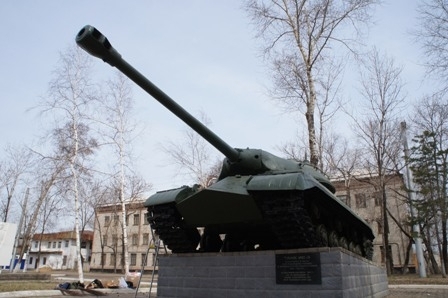
Tank IS-3. Photo: Photo: Regional Library
The Birobidzhan Star newspaper wrote on April 17, 2008 that a monument to the IS-3 Tank was erected in the area of the Dalselmash plant.
The monument “Tank IS-3” is a combat vehicle mounted on a stone pedestal. The choice of this particular technique for the monument was not accidental. At the very beginning of the Great Patriotic War, the army was in dire need of both manpower and weapons. Every resident of the country, including the Far Easterners, understood this well. To help the front, the 60th Tank Brigade was formed in Birobidzhan, which contributed to the Great Victory.
This IS-3 arrived at the territory of Dalselmash from one of the military units of the Birobidzhan garrison. The inside of the tank is completely dismantled. Four stars are painted in white paint on the barrel of a tank gun. During the war, such stars indicated the number of enemy armored vehicles destroyed. But here they were applied only for beauty.