April 16, 1935
The newspaper “Birobidzhan Star” (12+) dated April 16, 1935 published an article by associate professor of the Leningrad Mining Institute S. Muzylev “Lesser Khingan”, which talks about minerals hidden in the depths of the Lesser Khingan. An associate professor at the institute speaks in his article about the deposits of Khingan iron ore and the possibility of building a metallurgical plant on this site.
Clippings from the newspaper “Birobidzhan Star”. Photo: Photo: Regional Library
S. Muzylev in his article says that currently there are 18 independent deposits in the northern Khingan, although in 1934 there were only four. The ore reserves are huge. The Kimkan deposit alone probably holds at least 50 million tons. The total ore reserves in the Khingan exceed 6 billion tons.

Khingan Mining Department of the Vostsibolovo Combine. Photo: Photo: State Archive of the Jewish Autonomous Region
In 1934, a magnesite deposit and a graphite deposit near the village were discovered on the territory of the Jewish Autonomous Region. Soyuznogo can be recognized as one of the best deposits in the Union, both in terms of quality and mineral reserves. Graphite deposits are scattered throughout the Khingan.
“Khingan can become the base for the regional graphite industry. Hard coal was known in Khingan more than 40 years ago. It was discovered in a number of places on the Bir River, near the village of Kamenushka and on the slopes of the Sutarsky ridge. In those places where we know it (for example, on Bir), it has high qualities. Unfortunately, there is still no clarity on the issue of the general industrial assessment of these deposits.”
The same newspaper reports that A regional meeting of mobile installation mechanics was held at the Birobidzhan City Theaterwhich was organized by the “cultural industry of the regional party committee.” Guests from various parts of the Soviet Union came to this meeting: Donbass, Western Siberia, the Caucasus, Central Asia and other places.
“In his conversation with projectionists, the head of the cultural industry of the regional committee, Comrade Schwartzbard, pointed out shortcomings in their work, emphasizing the enormous cultural and political significance of their work. Comrade Schwartzbard reported on measures to improve the cultural and everyday situation of projectionists, improve their qualifications and cultural and political level.”
The newspaper informs readers that in conditions of rapid population growth in Birobidzhan, it is proposed to organize housing, rental and construction cooperation. By mobilizing share contributions, rent from residents and internal resources, it will be possible not only to preserve and restore the housing stock, but also to improve the living conditions of shareholders by organizing playgrounds, landscaping courtyards, organizing collective vegetable gardens, etc.
“Housing and rental cooperation can be organized from residents already living in the houses of the municipal economy and enterprises of the city of Birobidzhan. There is an even wider field of activity for housing and construction cooperation. Through the cooperation of workers in need of living space, it is possible to mobilize very significant funds for new housing construction. The rich long-term experience of housing cooperation in all the autonomous republics of our great Union has proven its vitality and necessity.”
April 16, 1936

Clippings from the newspaper “Birobidzhan Star”. Photo: Photo: Regional Library
The newspaper “Birobidzhan Star” on April 16, 1936, in the article “Drilling machines are testing the soils of Birobidzhan” wrote that since the beginning of December 1936, a hydrogeological drilling party has been working in Birobidzhan, which should examine the site for the construction of a thermal power plant. In addition to drilling, for the needs of designing a thermal power plant, the party also carried out scientific work; water samples were taken for chemical analysis, and soil samples were taken for mechanical analysis. A collection of pebbles was compiled to investigate the origin and causes of mineral formation. Drilling was carried out in the city for the first time. Based on the results of the work, it was established that the foundations of the new buildings of Birobidzhan will be laid in pebble, which the builders consider a good foundation. Thick gravel layers indicate that this place was never the bed of a large river.

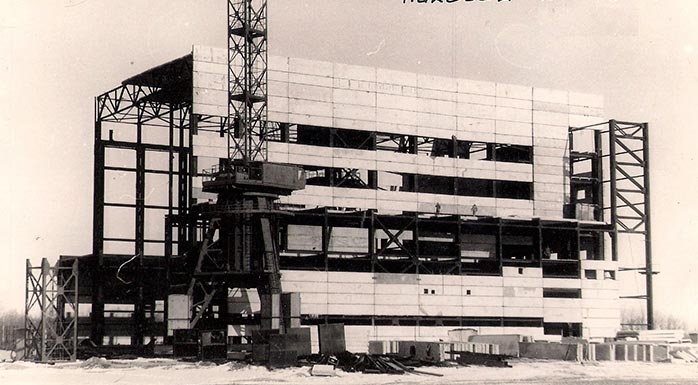
Birobidzhan CHPP became part of Khabarovskenergo in 1961. Photo: Photo: http://museum.rao-esv.ru/
“Having completed work at the thermal power plant site, the party, while waiting to be transferred to another location, drilled four wells at the Mestpromstroy sites. The face was brought to a depth of 25 meters. At the end of the drilling, a filter and casing pipe remain in the well. All that remains is to install the pumps, and the sites will be abundantly supplied with good, ground water. Experimental pumping of one of the wells with a simple hand pump showed a high influx of water.”
April 16, 1942

Clippings from the newspaper “Birobidzhan Star”. Photo: Photo: Regional Library
The newspaper “Birobidzhan Star” on April 16, 1942, in the permanent column “Around the City and Region” wrote that At the technical inspection point of the Birobidzhan station, five girls are trained to qualify as wagon inspectors. The courses regularly provide political information, read materials from newspapers, and reports from the Soviet Information Bureau. The cadets themselves, as part of practical training, inspect the cars and hand them over for loading.
In the newspaper, the director of school No. 4 in Obluchye, Barabash, says that students collected 1.5 thousand rubles for the defense fund and sent 12 parcels to the Active Army. Since the beginning of the Great Patriotic War, the guys have collected 149 tons of scrap metal. The schoolchildren also prepared over a ton of potato tops and collected 950 kilograms of cleaning material.

Subscription to the State War Loan. 1940s. Photo: Photo: State Archive of the Jewish Autonomous Region
An entire newspaper spread is dedicated to subscription to the State Military Loan. Correspondents report that in the districts and enterprises of the region, subscriptions for the War Loan are taking place with great patriotic excitement.
“…Subscriptions for the State Military Loan in our region amounted to a total of 11,573 thousand rubles.”