
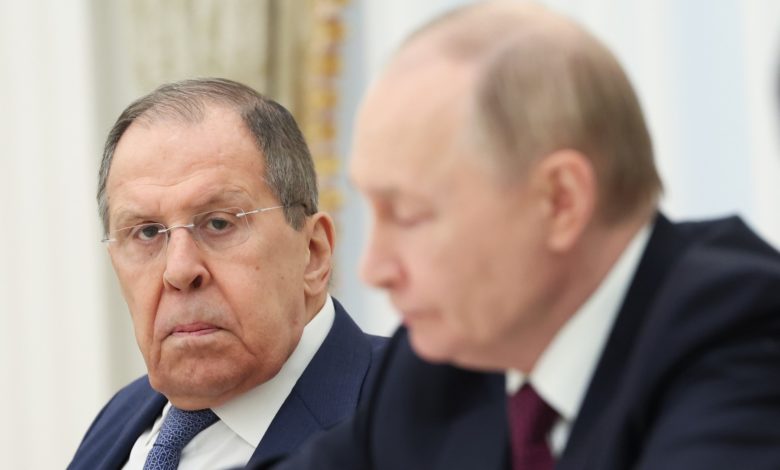
Russian Foreign Minister Sergei Lavrov says that “the right to enrich uranium for civilian purposes is an inalienable right of the Islamic Republic of Iran,” the Times of Israel reported on Wednesday.
Whether Iran, in its negotiations with the United States, decides to “pause” or “insists on preserving this right,” Russia will accept “any approach based on this principle, the principle of the universality of the right to enrichment,” Sergei Lavrov told reporters in Beijing, where he was on a two-day visit this week.
Lavrov emphasizes that Russia and China “firmly support” the talks on ending the war in the Middle East, “so that the parties can advance realistic and fair goals, fully respecting the legitimate rights of each side in accordance with international law.”
Iran is a signatory to the 1970 Nuclear Non-Proliferation Treaty, which gives countries the right to nuclear energy programs for peaceful purposes, with safeguards, but does not explicitly mention enrichment.
Iran and the US continue to exchange messages through Pakistani mediators
Iran continues to exchange messages with the US through Pakistan after the failed negotiations at the end of last week, Iranian Foreign Ministry spokesman Esmail Baghaei confirmed on Wednesday.
There is some uncertainty about what will happen when the two-week truce expires, and the Iranian Foreign Ministry spokesman did not confirm whether the ceasefire would be extended.
“For now, as I mentioned, the talks are continuing through a Pakistani mediator, and it remains to be seen how serious the other side really is about its claims regarding diplomacy,” Esmail Baghaei said, according to IRNA, Iran's official news agency.
“It is the United States that must prove its seriousness because it has not only repeatedly failed to honor its commitments, but has essentially undermined the very negotiating table,” he added.
According to Baghaei, there is no new proposal from the Iranian side and no change to the original 10-point proposal presented by Tehran in the negotiations.
The main points of disagreement are not clear, but Baghaei described some of Washington's demands as “unreasonable and unrealistic”. He again insisted on Iran's right to enrich uranium for peaceful purposes.
Two major sticking points in negotiations
Iran's “10-point proposal” is a peace plan offered to the US to end hostilities. The US has proposed its own 15-point plan, which has not been fully disclosed but is believed to include Iran pledging to give up its nuclear weapons, surrender its highly enriched uranium, limit Tehran's defense capabilities and reopen the Strait of Hormuz.
On Tuesday, two people familiar with the ongoing talks between the US and Iran told NBC News that another round of face-to-face negotiations between delegations from Washington and Tehran could take place as early as this week.
The opening of the Strait of Hormuz is a major sticking point in negotiations between the US and Iran, one of the people said. Iran's nuclear capability is another sticking point, the second source said.
The US asked Iran during marathon talks in Islamabad last weekend for a 20-year moratorium on uranium enrichment, the source added. Tehran agreed to three to five years, which Trump said was not acceptable.


