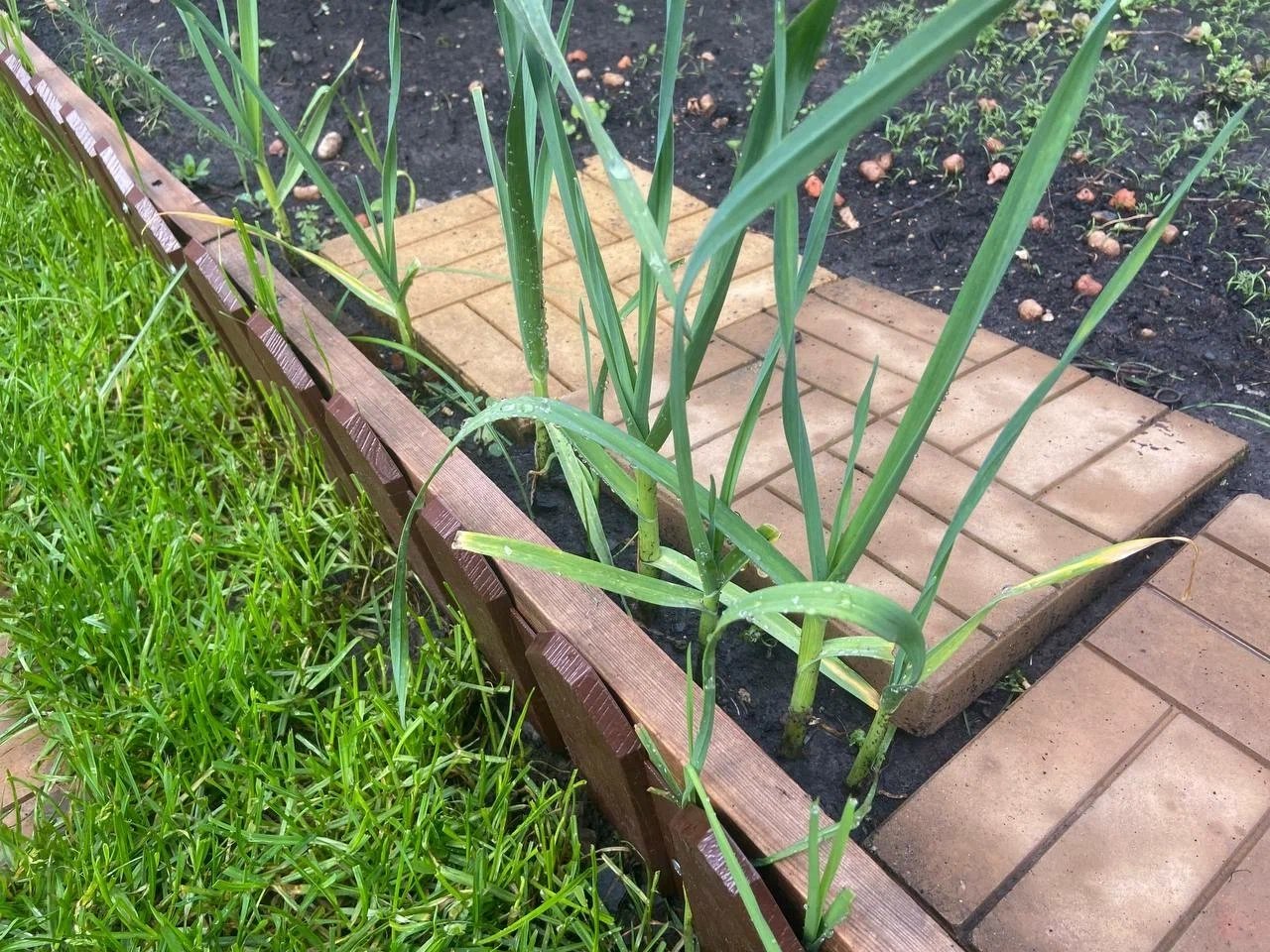
Until the garlic has grown three leaves, the root system is not yet functioning at full strength. The fertilizer that was applied earlier is simply not absorbed – the roots are not yet able to accept it.
“Phase 3 of the sheet is the only universal guideline that works in any region, regardless of calendar dates,” shares the author of the blog “About Hacienda. Country Life” (12+).
Mineral option: how to feed garlic in spring
The proportions are simple: 20 g of ammonium nitrate and 20 g of magnesium sulfate per 10 liters of water. Both fertilizers dissolve in a matter of seconds, leaving no sediment behind. Consumption – 10 liters per 1–1.5 square meters of bed.
Magnesium appeared here for a reason. It helps absorb phosphorus, which was added in the fall during planting. And sulfur, which is part of magnesium sulfate, additionally helps nitrogen to be absorbed better.
Make shallow grooves between the rows – 3-4 centimeters deep. They are spilled with the solution and immediately covered with earth. It is this local application at the roots that gives the result that can never be obtained by watering from above.
7–10 days after this feeding, the garlic leaf evens out in color and noticeably increases in growth.
Organic Option for Winter Garlic
First, mullein infusion. Dilute 1 liter of fermented mullein in 10 liters of water and water the bed when the garlic has released 3-4 leaves and they have reached a length of 10-12 centimeters. This is a nitrogen base. Without it, the organic scheme will not work: ash and herbal infusion contain practically no nitrogen.
After 15–17 days, the second stage begins. Mix 0.5 liters of wood ash and 1 liter of herbal infusion per 9 liters of water. The ash provides potassium and microelements, and the herbal infusion enriches the soil with organic matter and triggers beneficial microflora. It is this pair that creates the conditions for the growth of a large head.