
Viktor Orbán or Péter Magyar? Who would be better for Romania to win: “Let's not expect a radical change”

Our neighbors to the west, the Hungarians, choose their future leaders between Viktor Orbán and Péter Magyar, respectively FIDESZ and TISZA. Political scientist Sorina Soare, from the University of Florence, explains, for “Adevărul”, who starts with the first chance and what relevance these elections have for Romania.
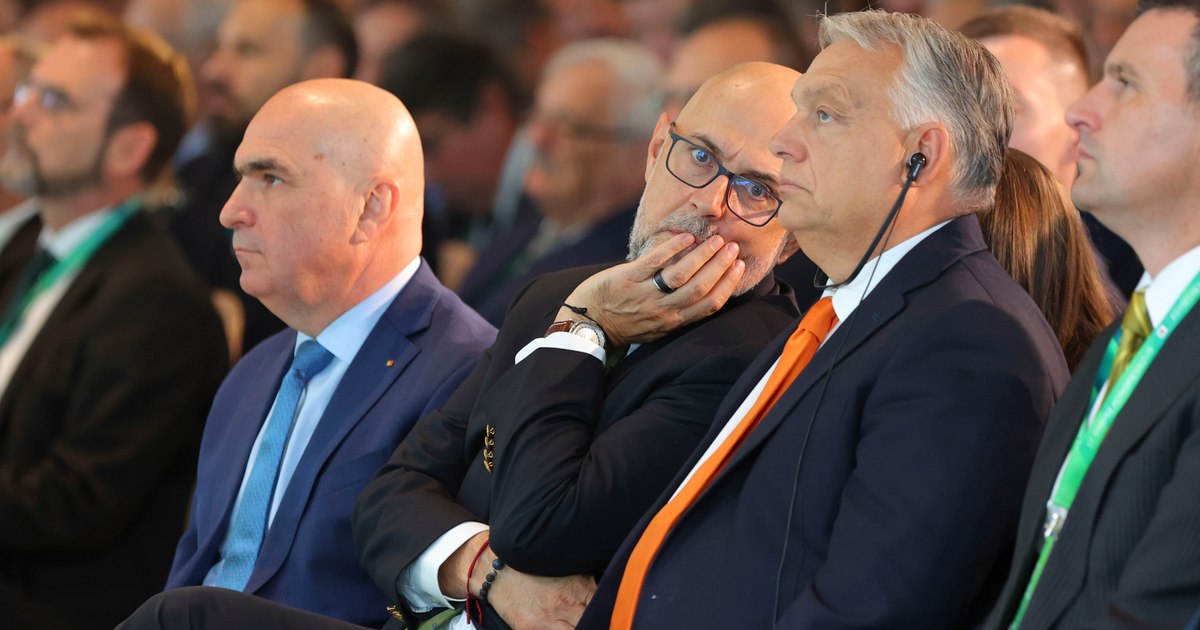
Ilie Bolojan, Kelemen Hunor and Viktor Orban at the UDMR Congress. PHOTO: Inquam / Simion Tataru
Hungarians everywhere will find out on Sunday, April 12, after the polls close, whether Viktor Orbán and FIDESZ will survive this election as well and stay in power, or whether Péter Magyar's TISZA will take over. A few hours before the opening of the polls, most of the opinion polls showed the opposition with a comfortable lead over the formation led by Orbán. That doesn't mean Magyar and his fans can already break out the chilled champagne.
However, there are also arguments in favor of the current Hungarian Prime Minister and FIDESZ. Hungary has a mixed system – first-past-the-post plus lists – which massively favors the largest party through “compensation votes” of the winners. Even with a close popular vote, FIDESZ could retain power due to the way constituencies are drawn.
Sorina Soare, specialist in comparative politics at the University of Florence, spoke to “Adevărul” about the Hungarian elections and explained how Romania may or may not be affected by their result.
Why polls are becoming increasingly irrelevant
“As far as I understand, the situation is very unclear at the moment in Hungary. There is a lot of mobilization, I would say, both in Orbán's camp and in Magyar's camp, but at the same time it is not very clear how to achieve a solid victory translated into seats, translated into an actual government”says Sorina Soare, an expert whose research interests also include political parties, democratization processes and European populism.
She reminds that more and more often the results of pre-election polls differ substantially from those of the elections. It's a detail, says Sorina Soare, easier to notice when voters mobilize and show up at the polls in large numbers, more than expected.
“This was also the case in Slovenia, not only in Romania. Until a few days before the elections, the radical parties, say, seemed to have an advantage, but then the liberals won. Participation is certainly a very important element. The more participation increases, the more difficult it is to predict what the results will be. Including in the situation in Italy two weeks ago, no one expected such a large turnout in the referendum and no one dared to say which field will win. For that you have no way of knowing who mobilized more. I think this is the situation in Hungary as well“, she adds.
Hungarians in Romania will vote for FIDESZ
As for Hungarians from other countries, but with the right to vote, Sorina Soare believes that most will vote with FIDESZ.
“What we know is that at the level of communities, of co-ethnics, Viktor Orbán's supporters will mobilize the most. You have also seen here, in Transylvania, including celebrities such as Laszlo Bölöni, but also football clubs and even UDMR have made public their support for him”says Sorina Soare.
Instead, the expected support across the Atlantic from Donald Trump and American conservatives remained declarative, even though JD Vance personally traveled to Budapest and made a series of pro-Orbán statements. This means that although the United States tried to provide some kind of support to Viktor Orbán, and Brussels supported his opponent, the support did not exceed certain limits.
“Sure, the United States, with the exception of Milea's Argentina, has not been involved economically in supporting other conservative parties nor in the campaigns, which at least seems to be the case so far, including Viktor Orbán. Yes, the Americans are present on the ground, they support them verbally, but they do not intervene more than that. Which means that there is still a very pragmatic dimension in politics, as far as the United States is concerned.”she explains.
Péter Magyar is even more nationalist than Orbán
As for Romania, it is not very clear whether our country would benefit and to what extent from the victory of one of the two, Viktor Orbán or Péter Magyar. The latter surprised to a degree with statements from which he wrested nationalism, a nationalism even more pronounced than in the case of Orbán. He also proved it with his march from Romania, when he reached Oradea and Arad, in an attempt to mobilize the electorate that voted in Hungary.
“It is true that Magyar also has a nationalist speech. This is one of the elements that could explain his political success in Hungary. And that is why it is easier for him to win the elections, perhaps, because he is credible on certain national issues“, points out the expert.
Besides, Péter Magyar showed his “fangs” towards Ukraine. Although he declares himself a convinced pro-European, and Viktor Orbán accused him of being Volodymyr Zelenski's man, Magyar stood out in several situations and with bellicose statements towards the Ukrainians. Moreover, Péter Magyar also said that Hungary will continue to be a pragmatic country, pursuing its interests, and if they ask for it, it will also collaborate with Russia.
What does Romania lack to go in the right direction? A political scientist from the USA puts his finger on the wound: “In Turkey, in 2004-2005, highways were science fiction for Romania”
“A possible victory of Magyar will not mean a complete break with Orbán's style. The only positive aspects would be that Hungary's connection with Brussels will be better, that he will accept that the European Union helps Ukraine, that he will no longer oppose. Magyar will be closer and more open to negotiate with Brussels. But we must not forget that in many issues he is perfectly aligned with Orbán“, Sorina Soare also affirms.
What can and cannot change in Hungary
“This alignment is also explainable by the fact that both also address a more nationalist electorate”, she explained.
But even so, Péter Magyar's Romanian sympathizers could be in for an unpleasant surprise.
“Magyar cannot be the friend of Ukraine “as a whole”, so to speak. And let's not forget that in Romania too, in parentheses, there is the issue of minorities, there are certain sensitivities. It is very difficult to be “friends” with someone in this area, because there were many historical traumas. And certain historical traumas continue to remain that are circulated politically. That's why I don't think we should expect a radical change from the point of view of the political agenda in Hungary, regardless of who will form the next government“, is the opinion of Sorina Soare.
Péter Magyar could instead take a different stance towards sexual minorities and respond favorably to requests from Brussels that Orbán has been generally reluctant to make.
“It will be a change from the basic rights of a liberal democracy, without a doubt, but not a change of radical content. And it is not only about nationalism, but also about a pragmatic position. This means that, given the campaign made by FIDESZ and Orbán against Magyar, a campaign that presents him as a friend of Zelenski and the Western world, Magyar is obliged to react in order not to lose the electorate. So there is also a strategic dimension there.” she says.
Viktor Orbán, between “Putinist” and model leader
Regarding the debate that exists regarding Viktor Orbán, in which his opponents accuse him of tilting Hungary to Putin's Russia, while FIDESZ voters claim that he is doing what he needs to do so that Hungary can survive in the difficult conditions now, Sorina Soare qualifies. In his opinion, Viktor Orbán's critics would be closer to the truth, even if he cannot be described exclusively in black and white.
His voters argue that Hungary cannot be the friend of a country like Ukraine, which oppresses the Hungarian community on its territory. And they also claim that Orbán only pursues the interests of his country and for this reason makes certain concessions to Russia, in order to have access to oil and gas without which his country's economy would go bankrupt and the country would be engulfed in chaos. Finally, political opponents accuse him of servility towards Putin. Sorina Soare explains:
“I think there is also a lot of strategy and it seems that Hungary cannot afford a complete break with Russia, it needs resources that otherwise we don't know who would provide them. Because Hungary does not benefit from natural resources. On the other hand, let's not forget, Orbán was one of the most critical when the wreath was laid on the grave of Imre Nagy in '89. Now I think he somehow forgot or doesn't want to remember. And if we we refer to those reported by the press, including the discussion between the Hungarian foreign minister, Péter Szijjártó, and Russia's Lavrov, there are many elements that show that Orbán is still too close to Russia”claims Sorina Soare.
The only scenario in which the US and Iran could lay down their arms in 2026 – Analysis of a Romanian expert in the Middle East
Suspense to the end
For the elections on Sunday, April 12, TISZA is apparently starting with the first chance in Hungary. Even so, the suspense will continue into the night, especially since Hungary's voting system can lead to a situation where a party wins the popular vote, but does not come to power and form a government, unless it obtains a two-thirds majority. This would be the minimum score, some analysts believe, so that Péter Magyar, if he were to win, could move to radical reforms and change something.
Last but not least, as seen in the Romanian elections, pre-election polls can be influenced by the social desirability effect, that is, by the tendency of the respondents – or some of them – to declare what, in a certain context, seems to be socially desirable.
The “spiral of silence” and the “shy voter”
Another detail that can influence elections and make the final result completely different from that of the polls is the so-called spiral of silence, that is, the tendency of some poll takers not to be honest when declaring their voting options, in order to avoid falling into some public opprobrium.
Romania, moreover, was not the only country where these effects made the paper result of the pre-election polls differ from the final ones. In the United States, political scientists talked about what they called the “shy Trump voter” (the shy voter of Trump, who hides his sympathy for the leader in the White House), and in Great Britain the “shy Tory voter” – the shy voter of the conservatives).


