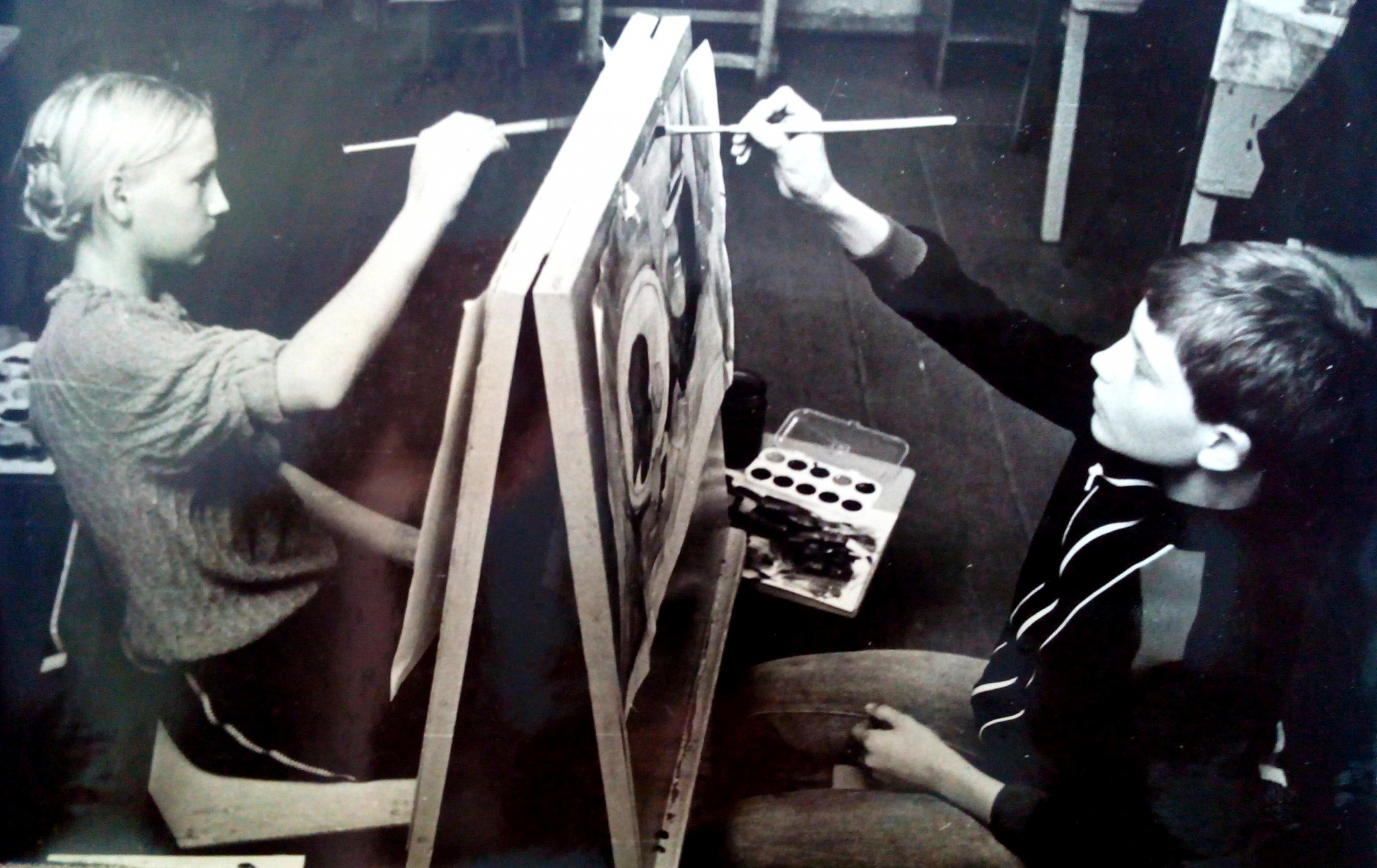
Classes at the Children's Art School in Birobidzhan
Photo: DHS archive
April 10, 1956
The newspaper “Birobidzhan Star” (12+) on April 10, 1956, in the section “Across our region” wrote that a new two-story building of the Birobidzhan city clinic had been put into operation. The new premises have 30 offices. The clinic received new medical equipment, which is installed in the physiotherapy and x-ray rooms. On the ground floor of the clinic there is a reception area and some offices. The surgical unit is located in the left wing. Three rooms in the clinic are occupied by a dental laboratory.
Newspaper “Birobidzhan Star”. Photo: Photo: Regional Library
The newspaper informs that 25 people are studying at the motorcycle courses at the primary DOSAAF organization of the Birobidzhan School of Locomotive Drivers. The cadets, having studied the rules of the street, move on to practical exercises. The primary DOSAAF organizations of the Khinganolovo plant, the Teploozersky cement plant and the Amurzet MTS run courses for training third-class drivers.
April 10, 1973
By decision of April 10, 1973 No. 139 of the executive committee of the city Council of Deputies and Workers of Birobidzhan, the Children's Art School (CHS) was opened. Due to the lack of a building, the location was determined to be the Palace of Culture. Since 1977, the art school has occupied premises in a building on the street. Lenina, 1, sharing it with the police.


In 1990, the children's art school moved to the wooden building of the kindergarten, also on the street. Lenin. In 2006, the Children's Art School moved to school building No. 14. Since September 2010, the children's art school has been located in the basement of a residential building on the street. Lesnoy 7. These studios, offices and utility rooms were built specifically for children's art schools.
In November 2012, an early creative development group “Multi-colored palette” was opened for preschool children from 6 to 7 years old. Famous artists and teachers worked at the Children's Art School at different times, such as: Zlakotin Vasily Grigorievich, Goryachev Valentin Nikolaevich, Vorozheikina Lyudmila Valentinovna, Kosvintsev Boris Yurievich, Fefelov Igor Gennadievich, Chernov Oleg Ivanovich, Yankovskaya Irina Sergeevna.
Since its inception, more than 1 thousand students have graduated from the school. Among them are laureates of the President of Russia Prize in the field of Fine Arts (0+); scholarship recipients of the Ministry of Culture of the Russian Federation “Rainbow of Young Talents” (0+).
April 10, 1975

Newspaper “Birobidzhan Star”. Photo: Photo: Regional Library
The newspaper of the Obluchensky district “Iskra Khingan” (12+) April 10, 1975 on its pages talks about Tatyana Vladimirovna Ilyushenko, a participant in the Great Patriotic War. After the war, Tatyana Viktorovna worked at the Obluchensky agency “Soyuzpechat” (12+), she was awarded the Lenin Jubilee Medal and holds the high title of shock worker of communist labor.
The same newspaper says that, on the initiative of progressive public organizations around the world, 1975 is celebrated as the International Year of Women. A gala evening (6+) dedicated to this event was held in the village of Bira, Obluchensky district. This evening was opened by the secretary of the party committee of the railway junction A. Evsyukova. Participants of amateur performances performed a good program for the audience; several performances were performed by students of secondary school No. 152. After the end of the evening, everyone left in high spirits.
Canteen worker at ORS village. Khingansk L. Ipatova writes to the newspaper about the attentive and responsive attitude of the staff of the Khinganolovo dispensary to vacationers and expresses gratitude to the employees of the dispensary.
April 10, 1997

Clippings from the newspaper “Birobidzhan Star”. Photo: Photo: Regional Library
The newspaper “Birobidzhan Star” on April 10, 1997, on the occasion of the 50th anniversary of the Birobidzhan confectionery factory, wrote on its pages about the history and development of the factory. In April 1947, Birobidzhan had its own confectionery factory, and soon city residents were able to taste its first products. And for 50 years, the Birobidzhan confectionery factory, and later JSC Confectioner, has been producing two to two and a half tons of sweets every day. JSC “Confectioner” produces more than fifty types of candies, cookies, marmalade, dragees and other sweets.