Commodity markets are reacting to another escalation of rhetoric from the US president. Donald Trump maintained Tuesday's deadline for Iran to open the Strait of Hormuz to free navigation.
The text continues below the video
Donald Trump gives an ultimatum. The price of oil is changing
If Tehran does not meet the demands by 20 American time (3:00 a.m. Polish time), Washington threatens a series of strikes against energy facilities and key infrastructure.
“The whole country could be destroyed in one night. That night could be tomorrow.” Trump said during a press conference on Easter Monday.
The price of oil reacts immediately
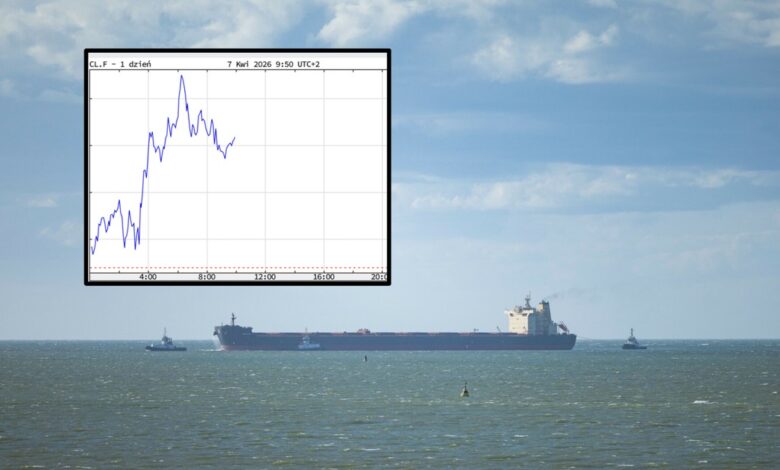
The US president's statements quickly had an impact on oil prices. On Tuesday morning, spot contracts for US WTI crude oil rose by over 3.5%, breaking the level $116 per barrel. Brent prices rose to $114.50 in the spot contract, and the May futures contract reached $111.50 per barrel.
The market is clearly pricing in the risk of supply constraints that could have global consequences for the energy market.
The Strait of Hormuz is crucial for the oil price market
The Strait of Hormuz, connecting the Persian Gulf with the Gulf of Oman, is one of the most important oil and LNG transport routes in the world.
- Read also: Traffic through the Strait of Hormuz is increasing. Iran strengthens control over the routem
Since the outbreak of the war on February 28, the prices of oil, jet fuel, diesel and gasoline have increased significantly, slowing only temporarily following signals of possible de-escalation. In recent days, however, the escalation scenario has dominated the market – the US is increasingly talking about possible strikes against Iran's critical infrastructure.
Negotiations in the background, but no breakthrough
Donald Trump signaled that talks were ongoing, although he did not provide details. “I can say that they are negotiating, in our opinion, in good faith. We will see,” he said recently, adding that the US is receiving support from “several amazing countries” that want an end to the conflict.
According to Reuters, the US and Iran are talking about a framework plan for ending the five-week conflict, but Tehran is in no hurry to fully open the strait. In turn, Axios reported that Iran rejected the American ceasefire proposal and presented its own 10-point plan.
However, the chances of reaching an agreement before the ultimatum expires are assessed as low.
- Read also: Countries are negotiating with Iran. Effect: ships sail through the Strait of Hormuz
Investors between de-escalation and war
Markets are trying to price in extremely different scenarios. “It is impossible to predict the result. We cannot rule out that Iran will resign. Either Trump will postpone the deadline again, explaining it by the progress of negotiations. Or the war will escalate.” – said Ed Yardeni, president of Yardeni Research, quoted by Reuters.
Meanwhile, traffic through the Strait of Hormuz is partially returning. According to S&P Global Market Intelligence, eight tankers were scheduled to transit it on Monday. However, the route remains available mainly to countries considered “friendly” by Tehran. Before Christmas, we wrote in Business Insider Polska that a ship linked to France had managed to sail through.
MarineTraffic data, analyzed by HFI Research, shows that Iran actively controls maritime traffic. On Monday, Iran's Islamic Revolutionary Guard Corps detained two Qatari LNG tankers heading outside the Middle East region.