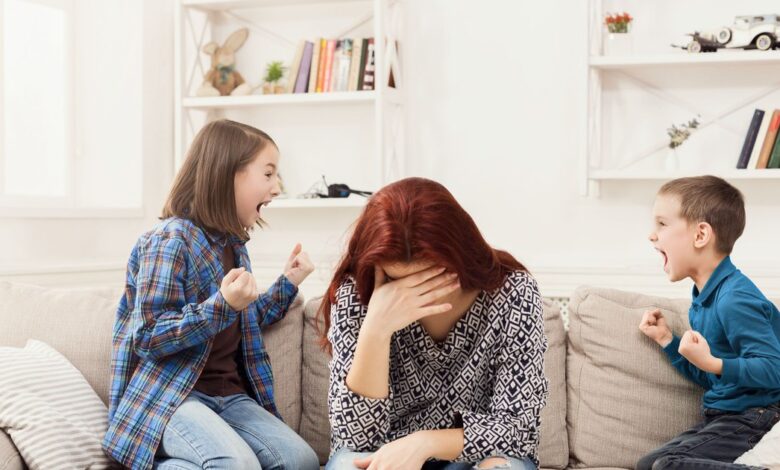
The arrival of a new baby should be a moment of joy. For the older brother or sister, however, it can mean confusion, jealousy, and even anger. Why do they react this way, and more importantly, what can a parent do?
Photo credit: Shutterstock
“The appearance of a new child in the family produces a profound reorganization on an emotional and relational level for the older child. Although externally this moment is associated with joy, for the child it can activate a much more complex internal experience, in which confusion, fear of loss, jealousy and sometimes anger are interwoven”, cognitive-behavioral psychotherapist Laura Găvan explains for “Adevărul”.
These reactions do not indicate a character problem, but reflect how the child is trying to understand and adapt to a major change in the structure of attachment relationships.
“For the child, parents represent the main source of safety, attention and emotional regulation. The arrival of a new member in the family can be perceived, on a subjective level, as a decrease in access to this source of security. Even if the parent remains available, the distribution of attention and the change in routine can be experienced as a loss”. says the specialist.
In the absence of a mature cognitive understanding, the child translates this experience through simplified interpretations, such as “I'm not as important anymore” or “I've been replaced”.
“These interpretations generate intense emotions, and the behaviors that occur afterwards have the role of restoring, unconsciously, the lost balance. Regression (returning to more childlike behaviors), opposition, excessive attention-seeking or even aggression can be understood as ways in which the child signals the need for reassurance and reconnection. From this perspective, difficult behavior is not an end in itself, but an emotional message that needs to be decoded.” continues Laura Găvan.
At this stage, the role of the parent becomes essential. More than the rational explanation of the situation, the child needs to feel seen and validated in his experiences. “Validation does not mean approving inappropriate behaviors, but acknowledging the emotion behind them. When the child's emotions are reflected and accepted, their intensity decreases and the child gains a sense of internal security.” supports the psychotherapist.
At the same time, maintaining a predictable relationship and moments of exclusive connection with the older child helps restore a sense of belonging. “The clarity of boundaries, combined with emotional availability, provides a stable framework in which the child can gradually integrate the new family reality. As time passes, the child can begin to redefine his role and, in some cases, develop an attachment relationship with his brother or sister as well.” complete this.
Sibling jealousy is more common than parents think
A study published earlier in International Journal of Health Sciencesconducted on parents of preschool children aged 3-5 at a kindergarten in Indonesia, shows that sibling jealousy and rivalry is more widespread than many families imagine. The data cited by the authors indicate that more than half of preschool children go through such episodes, and in the United States the phenomenon reaches about 55% among children between the ages of 10 and 15.
Conflict between siblings does not occur by chance, and the role of parents is decisive, the study also says. More specifically, when rules are imposed without explanation, children are compared to each other or treated differently, tensions rise quickly. Conversely, when the parent explains, listens, and treats each child as a separate person, conflicts occur less frequently and are easier to manage.
Equally important is how well parents understand what is actually happening to their child. A young child does not know how to clearly express his feelings, and his reactions may seem exaggerated or difficult to understand. When parents understand that behind the crises, jealousy or opposition of the little one there are real emotions – insecurity, fear of losing attention, need for closeness – they manage to manage situations more calmly and not turn every conflict into a fight.
Did he leave you “on seen”? The truth behind ghosting – Why people disappear without any explanation
In families where these things are understood, things calm down more quickly. The child feels listened to and no longer feels the need to attract attention through difficult behaviors. On the other hand, where the parents do not understand what is happening, the reactions come at the moment: there are comparisons between siblings, a tendency to favor one of the children or concessions made out of guilt.
At the moment it seems that they are calming the situation, but in reality they are only complicating it.
What actually works
For her part, clinical psychologist Andreea Ștefiuc points out that preparing the older child for the arrival of a brother or sister is not done in a single discussion, a few days before the birth. It is a process that starts early and is not only about explanations, but also about the game. She recommends activities adapted to the child's age, so that he can understand concretely what follows: why the parents decided to have another child, the fact that the mother will be away from home for a few days after the birth and, above all, that his place in the family does not change, and the parents' love remains the same.
But prenatal preparation doesn't solve everything. The problems actually come later, in everyday life, when the baby cries, the older child gets jealous, and the parent has to deal with both fronts. Andreea Ștefiuc is of the opinion that frustration cannot be completely avoided, because there will be times when children's needs overlap. What parents can do is keep it under control so it doesn't escalate.
This means, first of all, time given separately to each child, even for short periods. It also means giving the older one a role, giving him the chance to make small decisions about the younger brother, within the limits of his age. Equally important is that each child is treated as an individual, with their own needs and pace, not as part of a duo that is constantly compared.
Refuses to mature? The Truth About “Peter Pan Syndrome” You're Ignoring
More complicated cases: when one of the children has special needs
Things get even more complicated when one of the children has a disability. Andreea Ștefiuc draws attention to the fact that, in these situations, the pressure in the family increases, and the child without medical problems often ends up caught between two realities. He lives next to his brother or sister every day and needs clear explanations: why the other child behaves differently, how he should react in difficult moments and how he can manage his own moods. Most of all, he needs to feel that he has not been left behind.
One of the most common mistakes parents make is compensating with concessions. Because one of the children needs more attention, the parents end up allowing the other almost anything out of guilt. Andreea Ștefiuc clearly says that this approach does not help. On the contrary, it makes things more difficult to manage. Boundaries remain essential. They do not mean lack of affection, but provide the child with a stable and predictable framework.
Regarding the independence of the disabled child, the psychologist emphasizes that the evolution of the two siblings influences each other. Everyone needs time together as well as time apart. At the same time, the responsibility to socially integrate the child with special needs should not be placed on the shoulders of the brother or sister. It is a task that belongs primarily to the parents.