Business Insider's job rankings. It will be easiest to find a well-paid job here

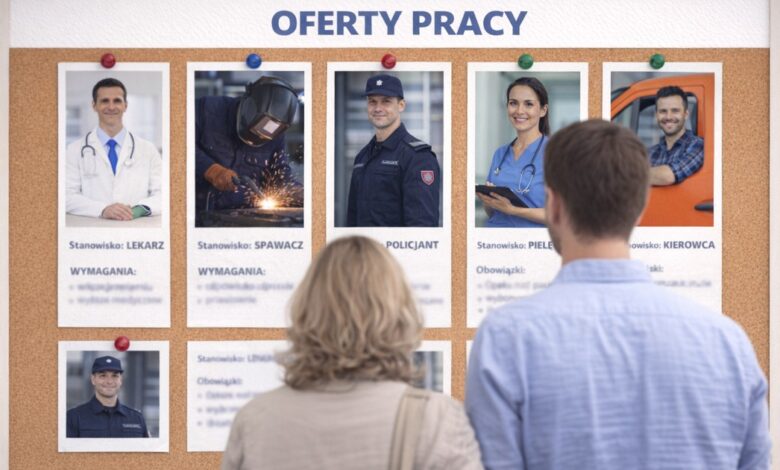
As every year, we have prepared in Business Insider Polska a ranking of professions that will be the best “job” in 2026. We took into account several criteria, including, of course, the salary, but also the number of available jobs in the industry and how difficult it is to get into the profession.
In this edition, there was a serious reshuffle at the top. We have a new leader, or rather co-leader. These are uniformed services officers who appeared in the ranking for the first time in 2024. Previously, there was practically no shortage of people to work in this sector. And now, not only are there not enough of them, but they can also earn quite well.
Below we present the ranking results and explain how the ranking was created.
Read also in BUSINESS INSIDER
First, the quick ranking rules, which we describe in detail at the end of this material. We took into account four criteria: earnings, scarcity, entry threshold and AI risk.
Based on them, we ranked the competitions from the best to the weakest. We then added up the values for each of them and thus obtained the final ranking. The fewer points a given position has, the better.
What can you see at first glance? The leader has not changed compared to last year. Still the most work awaits truck and tractor-trailer drivers. It is the most scarce profession in the country.
Logistics is still going strong, and the median salary in this industry exceeds PLN 8,000. PLN per month, so it is over PLN 1,000. PLN higher than for the entire economy.
New co-leader
The point is uniformed services officers joined the drivers. It is worth emphasizing that this position owes its high position in the ranking primarily to staff shortages.
In 2023, uniforms were not even among the “30” most deficient professions. Today, they are missing in 260 out of 380 poviats in Poland, which gives them sixth place in the country in this respect.
And the earnings are also okay, although of course a lot depends on the specific formation. There is a different salary in the army or customs service, and a different one, e.g. in the fire brigade.
According to data from the National Salary Survey by Sedlak&Sedlak, the median salary for customs officers is over PLN 10,500. PLN gross per month. In the city guard there are only 6.9 thousand. zloty. There are approximately 8.5 thousand policemen, border guards and prison guards. PLN median. The average for uniformed services is therefore 8,000. PLN 455 gross per month.
The difference between uniformed officers and drivers is that in the case of officers, the risk of being replaced by AI is relatively small. In turn, we can already imagine autonomous trucks, which puts this industry in a slightly more difficult position when it comes to employment.
For now, of course, this type of technology is in its infancy, but rapid development in this area cannot be ruled out.
The health service will also make money
The podium is closed by nurses. On the one hand, it is a profession with a higher entry barrier than drivers or uniform workers, but on the other – a chance for relatively better earnings.
Data from the National Salary Survey show that half of nurses currently earn at least PLN 9,000. PLN 368. Let us remind you that from July 1, 2026, minimum wages in health care will increase by 8.82%, which may raise the median even to PLN 10,000. zloty.
Moreover, nurses, like uniformed services officers, do not have to fear competition from artificial intelligence. Their positions should remain unthreatened.
Crowd just behind the podium
Fourth place was taken by three very distant competitions. First of all, doctors are not only sought after almost everywhere, but also earn the best salaries of all. The median here is as much as 12,000. PLN gross. They are also not threatened by artificial intelligence.
So why aren't they on the podium? All because of the very high barrier to entry into the profession. Long-term studies and specializations are definitely the most difficult possible career path.
Welders and electricians also have the same number of points, although for completely different reasons. In both cases, the earnings are quite good and the entry barrier is relatively low. There are still too few of them on the labor market. Hence such a high place in our ranking.
The next places are:
- psychologists (median: approx. PLN 7.5 thousand)
- operators and mechanics of earthmoving equipment (PLN 6.4 thousand)
- teachers of special schools and integration classes (PLN 7.7 thousand)
- teachers of vocational subjects (PLN 6.6 thousand)
- bus drivers (PLN 7.5 thousand).
Methodology. First, who are employers missing?
Our ranking is largely based – as in previous years – on the Occupation Barometer. This time we used the analysis prepared for 2026, published in early November.
Why did we choose this particular study as the core of the ranking? This is a comprehensive study of the labor market in Poland, commissioned by the Ministry of Family, Labor and Social Policy, which describes in detail the situation in approximately 170 different professions.
The analyzed professions include both highly qualified professions, such as architects, doctors and meteorologists, and more technical ones, such as pavers, bricklayers and warehouse workers. The list also includes less popular professions, such as glass craftsmen and debt collectors.
Importantly, the Occupation Barometer does not devote much attention to professions related to the broadly understood IT sector. Therefore, in our list you will not find such positions as a web developer, graphic designer or a specialist in big data, AI or data science.
The Occupational Barometer is developed at the local level, separately for each of the 314 counties and 66 cities with county rights in Poland. Analyzes are carried out by teams of experts at the turn of the third and fourth quarters of each year. These include, among others: representatives of district labor offices, private employment agencies and other institutions with excellent knowledge of the situation on the local labor market.
Experts assess the demand for employees in particular professions to develop a forecast for the next year. The latest analysis covers the year 2026 and this data was the basis for creating our ranking.
Statistical data, although important, do not always fully reflect the realities of the labor market. Therefore, experts involved in the preparation of the Occupation Barometer also take into account qualitative factors. For example, they analyze which job offers are submitted multiple times, where there is high employee turnover and what are its causes. They also take into account the seasonality of employment, which has a significant impact on the structure of the labor market in some industries. Thanks to such a detailed analysis, the Occupational Barometer divides positions into three categories.
The first group is surplus professionswhere the number of candidates is greater than the number of job offers. There are no such professions left on a national scale, which means that there is no widespread excess of workers in any profession. However, such a situation may occur locally, at the level of individual voivodeships or poviats.
The second group includes professions in which the number of job offers and the number of applicants are similarwhich means balance in the labor market. This category includes, among others: beauticians, pharmacists, bakers, lawyers, veterinarians and educators. In total, this group included 145 different positions.
The third group is the so-called shortage professionsi.e. those in which the number of available job offers significantly exceeds the number of people willing to take them. In 2024, there were 29 such positions. A year ago, there were 23 such professions, and in 2026 there will be 17 of them.
They are the basis of our ranking, which we have narrowed down to the 15 most scarce professions in Poland. When choosing, we took into account those professions that were in short supply in the largest number of counties – in some cases, staff shortages were reported by as many as 326 out of 380 local governments surveyed.
How much can you earn?
However, scarcity alone is not enough to consider a given profession attractive. Salaries have also become a key criterion. We took the earnings data from National Salary Surveywhich is regularly maintained by nazwa.pl.
This study collects information on salaries in Poland based on anonymous reports from employees. To better reflect the real distribution of wages, we do not take into account average earnings in the analysis, which are susceptible to distortions by single extreme values. Instead we use the medianwhich shows the amount above and below which half of the employees in a given group earn.
Why is the median a better indicator? Let's imagine a team of ten people, nine of whom earn PLN 5,000. PLN, and the tenth 30 thousand. zloty. The average here is 7.5 thousand. PLN, which does not reflect the situation of the majority of the team. The median in this case will be PLN 5,000. PLN, which better illustrates the typical salary in the group.
Required qualifications
The third aspect we took into account was very subjective. This is what we called the “entry threshold”. It includes, among others: required qualifications, time and costs of education. It is difficult to compare the profession of a doctor, which requires many years of study and high financial outlays, with the work of a warehouse worker, where short training is often enough.
The subjectivity of this criterion is that there is no objective framework to compare whether the barrier to entry is greater in the case of a rank-and-file policeman or city guard, or perhaps a bus driver.
In both cases, training or special qualifications are required, but in addition to the costs incurred, there is also the argument of time spent on preparation for the profession. In such cases, the author's judgment came into play.
Work in the era of AI and the technological revolution
In 2026, we decided to take into account one more aspect that was not so important in previous years, but now constitutes a serious argument when choosing a career path.
It's about technological development, especially artificial intelligence. There is no point in educating yourself for a profession that may soon disappear and be replaced by AI.
That's why we assessed each of the 15 professions in terms of the risks posed by technology. If it does not exist (e.g. in the case of doctors or uniformed services), we did not add any points. For moderate risk (e.g. truck drivers – the autonomous car sector is developing faster and faster), we added 3 points, and for high risk (e.g. warehouse workers) – 6 points.
Final ranking
However, the final ranking is based on three key criteria: deficit, median earnings, technological threat and the so-called entry thresholdi.e. the level of difficulty associated with taking up work in a given profession.
Each criterion was assessed separately, creating four mini-rankings. We ranked the competitions from 1st to 15th place – the highest scoring were those with the best results in each category. We awarded one point for first place and eight for eighth place. And so on.
Finally, we added up the points from all mini-rankings. The profession that scored the fewest points (i.e. obtained the best overall positions in each criterion)was deemed the most attractive in our ranking.