The conclusions of the control of the Ministry of Culture at the “George Enescu” Museum: an object from the degraded Treasury. The report will be sent to the Prosecutor's Office

The control carried out by the Ministry of Culture at the “George Enescu” Museum confirmed the degradation of a cultural asset from the Treasure category. In addition, problems were also revealed in the storage of heritage, and this after, following a first check, the institution announced that no destructions had been identified. Now, the ministry has announced that the report will be sent to the Prosecutor's Office for investigation.
The control was triggered after the information published by Cultura la Dubă regarding the conditions in which the museum's goods are stored, moved in containers during the restoration works.
In the preliminary checks, the Ministry of Culture reported that “no cases of destruction of classified cultural assets were identified”. The control report now sent to the media shows, however, that there is “degradation of a mobile cultural asset listed in the Treasury of Mobile National Cultural Heritage (…) caused by water leakage from the air conditioner in the storage container”.
It is a wooden desk with a leather top and inlays, made by Émile Gallé, affected on a surface of about 20 centimeters, according to the document.
After this finding, the report will be sent to the Prosecutor's Office. The document specifies that “it will be forwarded to the prosecutor's office to carry out in-depth investigations regarding the aspects related to the degradation of a cultural asset classified in the Treasure category”.
The report also invokes the law in this case, specifying that “degrading, rendering unusable or destroying, through fault, a listed movable cultural asset constitutes a crime”, an act which is punishable, according to the law, with imprisonment from one month to one year or with a fine.
Goods were moved in containers without a formal plan
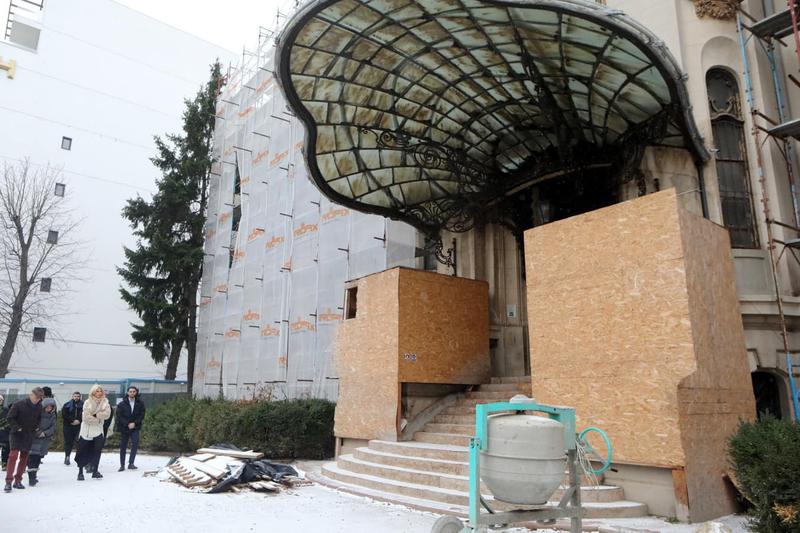
In the context of the restoration works of the Cantacuzino Palace, the museum moved a large part of the heritage into six containers located in the courtyard. The report shows that the institution “did not present evidence of the request for inter-institutional support to find suitable premises, opting directly for the rental of containers”.
At the same time, the heritage move was made “in the absence of an approved strategic document that would regulate the stages, responsibilities and conditions of preventive conservation”. The commission considers that this situation “constitutes a major planning deficiency and a failure to comply with the conservation rules specific to museums”.
Microclimate problems and lack of essential equipment
Although container storage is not prohibited, the report shows that the necessary conditions were not consistently provided. In the containers “there are no devices for regulating humidity, respectively humidifiers and dehumidifiers”, and the measurements indicate “fluctuations in temperature and humidity values, including outside the values provided by conservation and restoration norms”.
In some periods, the temperature dropped “below 0 degrees Celsius for several days”.
The report also records problems such as water seepage, condensation, faulty air conditioning, cracked floors or deformed containers.
Hazardous placement of containers
The report also points to problems with the placement of containers. In 2024, “a tree in the yard fell on container #1”, affecting the structure and facilities inside.
The commission concludes that “the placement of the containers for heritage storage was carried out without a prior expertise of the dendrological vegetation in the vicinity” and qualifies the situation as “negligence in exercising the duties of protecting movable cultural assets”.
Costs of over 500,000 lei
The museum paid for the rental of the containers, during the period 2021-2026, “an amount of approximately 539,628 lei”. The report shows that “no initiative was made available to the control committee (…) to try to purchase containers” and the management “did not perform an efficiency calculation (rent vs purchase)”.
The report also mentions the existence of tensions between the management of the museum and a conservator who pointed out the problems related to the storage of the heritage.
According to the document, these reports were classified by management as “unfounded accusations” and “permanent harassment”.
But the control commission writes that such a reaction may represent “a form of management by intimidation, intended to discourage future reporting of non-conformities”.