The epic of the golden helmet from Coțofenești: a lesson on how bureaucracy can bury history

Romanian history and heritage experts say the story of the Dacian helmet and bracelets stolen and recently recovered by the Dutch authorities should represent an important lesson for the authorities.
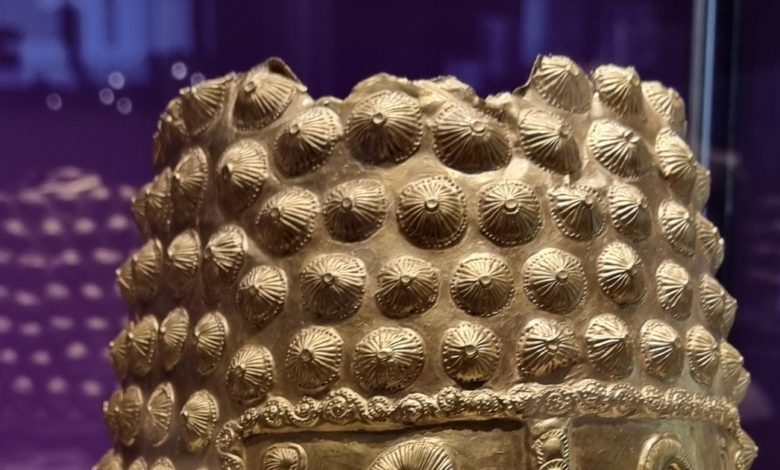
The golden helmet from Coțofenești PHOTO Ovidiu Udrescu
The golden Getic helmet from Coțofenești, but also two of the three Dacian bracelets, stolen in January 2025, were recovered after 14 months of searching, by the Dutch authorities. The objects were publicly presented to journalists at a press conference at the Drents Museum in Assen, Holland.
The prosecutor's office stated that the objects were recovered following procedural agreements with the suspects.
An unpleasant and unhappy epic, but one that ultimately had a happy ending. Especially since the treasure objects are not irreparably damaged and can return to Romania, to the National History Museum. Romanian heritage specialists say, however, that this incident should be a lesson for all those involved in organizing exhibitions with such valuable heritage objects and that their delivery to museum exhibitions, but also the exhibition, should take place according to better protocols that limit the chances of success of treasure hunters.
“This episode should give us food for thought”
“This is the happy end of an unhappy epic. But this episode must give us food for thought and draw some lessons. Especially about the way in which the organization and conduct of these exhibitions must be regulated in which important values for the Romanian identity, for the Romanian cultural heritage are presented. The procedures must be well regulated and respected”states Dănuț Huțu, historian and director of the Botoşani County Culture Directorate.
He testifies, based on numerous examples, including from prestigious museum institutions in the world, that the risk of robbery at any exhibition cannot be completely eliminated. However, through revised and enhanced protocols the risk can be substantially reduced. “Of course, the risk is there and always will be, that's why there are rules that provide for some very certain things, some steps to follow, insurance of the objects. There will always be treasure hunters who will try to make money with such works of art”adds Huțu.
“Some deficiencies were found in the way that exhibition was organized”
Specialists say there were definitely deficiencies in the way the exhibition in the Netherlands was organized, which allowed the theft of the four treasure objects. That is precisely why those deficiencies must be identified, assumed and corrected. Also, based on this experience, Romanian protocols can be improved, which may require specific security measures when sending heritage objects. “Of course, some deficiencies were found in the way that exhibition was organized, but I think it's good that the objects were recovered and that they will return to the Heritage of the National Museum. I just need more attention, I think, to avoid such incidents”adds Dănuț Huțu.
And indeed, a month before the opening of the exhibition at the Drents Museum in Assen at the end of 2024, the museum's underwriters warned of the existence of weak points. It was about the low resistance of shop windows to burglary. Practically, the one in which the Helmet from Coțofenești was located gave way almost immediately. At the same time, the emergency exit of the museum, the one through which the thieves came out, was also discussed. It was strengthened at the recommendations of specialists, because initially it did not present a security guarantee, but not enough. And this was proven by the fact that the thieves broke it quite quickly and managed to get out of the museum with the loot. For their part, the Romanian representatives would have relied only on the assurances of their Dutch counterparts that the showcases are secured.
The ornaments that escaped unstolen from the exhibition at the Drents Museum have arrived in Romania. The Dacian helmet and bracelets, to be found
“Art and heritage are to be seen, admired”
Despite all this confusion, a part of the Romanian public opinion recommends that heritage goods from the treasure category should no longer be taken out of the country and that only copies should be sent to museums around the world that request them as part of various exhibitions. This, however, is strongly rejected by specialists, who say that the risks must be assumed, possibly with greater attention and increased conditions regarding the security of objects. “There is no such thing. Shall we go with some children? What is this? It must circulate, we cannot limit ourselves to certain spaces”, adds Dănuț Huțu. “Heritage assets should be seen by everyone. There are risks but that doesn't mean they should be hidden or not exposed to the public everywhere“, adds Iulian Nechifor, doctorate professor in history.
The third bracelet is missing and the helmet is damaged
Of the four stolen objects, three were recovered. That is, the golden helmet from Coțofenești and two Dacian bracelets. The bracelets are in pristine condition, but the helmet is damaged. Incidentally, at the presentation at today's press conference, at the Drents Museum, the helmet was displayed in a horizontal position, not vertical, as we are used to.
And that's because it was probably deformed during theft or improper storage for 14 months. The director of the Drents Museum stated during today's press conference that it is not a serious problem, the helmet can be repaired.
“I came to be glad that the helmet was stolen.” Director of the Library in Sibiu, harsh irony: “They found out that Romania has cultural heritage”
Van Langh also says that an old restoration at the level of the helmet has come off. The director of the Dutch museum specified that it was an older restoration with an equally old adhesive. So it didn't take long for the glue to fail”said Van Langh.
At the same time, the Dutchman said that Romania will decide who will restore the helmet. That is, if it will be brought home to be handed over to Romanian restorers, or it will be repaired by the Dutch before being sent home.
Nothing is known about the third Dacian bracelet, and Dutch investigators have refused to give more details. Moreover, where the helmet was hidden and how it was kept for more than a year were not made public either. The prosecutor's office stated that procedural agreements were made with the suspects. Jan B. (21), Douglas Chesley W. (37) and Bernhard Z. (35) will be tried on April 14, 16 and 17 at the court in Assen.
The helmet dates from the 5th century
The helmet from Coțofenești is Getic and dates from the 5th century BC, while the bracelets are Dacian and date from the 1st century BC. It was stolen on the night of January 24-25, 2025 when three suspects broke into the Drents Museum of Art and Archeology in Assen, the Netherlands.