Easter Budget 2026. Romanians, between tradition and austerity. How much the “minimum basket” for the holidays ended up costing

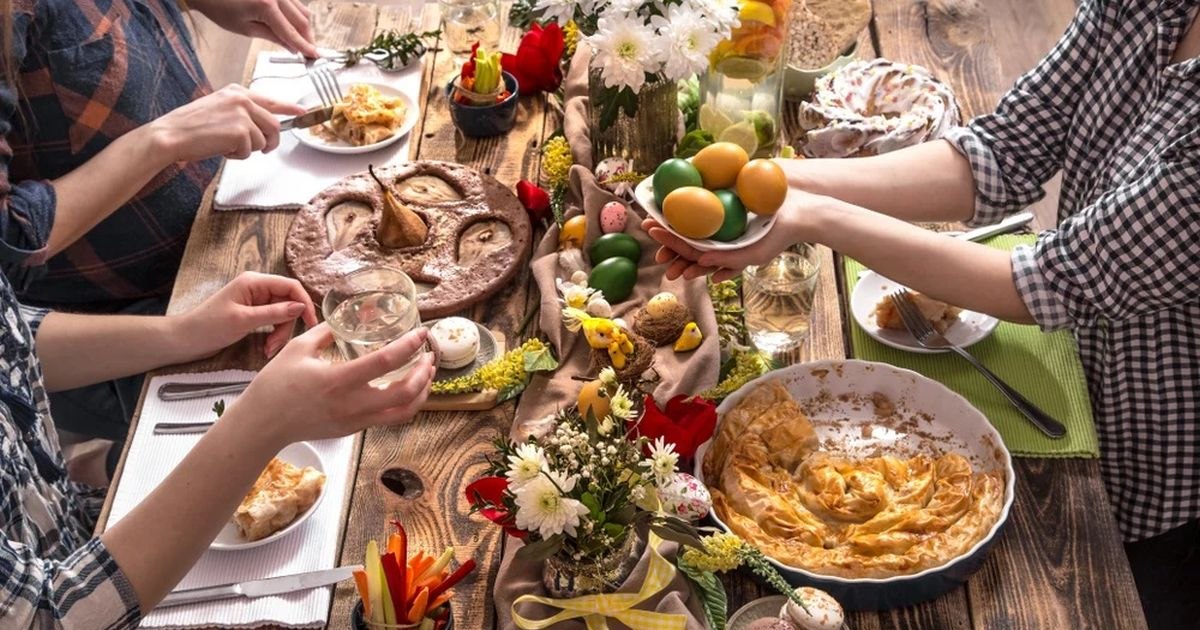
In 2026, the Easter meal in Romania has become significantly more expensive, and the prices of traditional foods have registered notable increases, which makes many Romanians tighten their belts and be extremely careful and pragmatic about the products they buy.
The Easter meal is more expensive this year. Photo by Shutterstock
According to the information consulted by “Adevărul”, lamb meat, indispensable on Romanians' tables, is sold at prices between 55 and 65 lei per kilogram in markets and stores, and for premium pieces the price can be even higher. Eggs, indispensable for dyeing and consumption, reach over 1 lei per piece, and large forms frequently exceed 35–40 lei, while organic or local variants can cost even 1.5 lei/piece.
Cozonac and pasca, central elements of the Easter dessert, start from 15–20 lei for supermarket products, but in bakeries or artisan confectioneries, prices rise between 50 and 120 lei/kg, depending on quality and complexity. Other preparations, such as the ready-made Easter drob, are between 100 and 120 lei/kg, and the sets of already dyed eggs can reach 35–40 lei. In total, for a family of four, the estimated cost of a complete Easter meal can vary between 740 and 1,000 lei, depending on the quantities, assortments and type of dishes chosen.
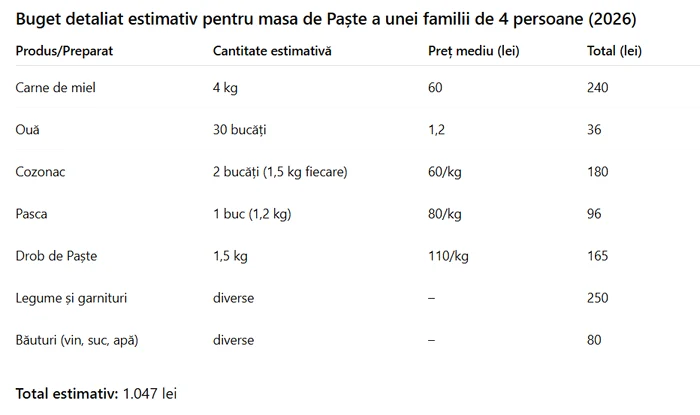
“True” estimate, based on current prices of traditional foods published in the Price Monitor. Price variability can be influenced by store, product quality or geographic area, and organic or artisanal options can significantly increase the final cost.
The consumption behavior of Romanians in 2026
Because of these high prices, Romanians are becoming more and more calculated in their Easter expenses. Price has become a dominant criterion for 92% of respondents, up from 82% in 2025, and interest in promotions is at a record high: 65% are actively looking for discounts. Budgets are rising under the pressure of inflation, and decisions are increasingly based on comparisons, reviews and direct recommendations, according to the EY Consumer Index 2026 study.
“Romanians' Easter behavior is increasingly oriented towards information, comparison and calculated decision. Consumers no longer buy on impulse, but base their choices on data, opinions and comparative analysis. The Easter holidays cause Romanians to be pragmatic and oriented towards optimizing the budget, but without generating major changes in the consumption style”, explains Georgiana Iancu, EY Romania Partner.
Moreover, Romanians increasingly combine the search for online promotions with that in physical stores (63% in 2026, compared to 39% in 2025), and the share of those completely disinterested in discounts fell below 1%. Women are more active in searching for promotions (69%) compared to men (58%), and young people under 40 are most actively looking for discounts and offers.
The price criterion has become almost as important as quality: 95% of Romanians consider quality essential, and 92% pay attention to price, the smallest gap between the criteria ever recorded in the EY study series.
Budgets between 500 and 999 lei for a third of Romanians
Easter shopping budgets adjust under inflationary pressure. 34% of Romanians estimate expenses between 500 and 999 lei, and 30% will exceed 1,000 lei. Women are more willing to allocate larger amounts: 31% of them intend to spend more than 1,000 lei, compared to 25% of men. In total, 40% anticipate higher spending than in 2025, and 38% estimate similar amounts.
Food products remain the main expenditure category, with almost 40% of Romanians planning to spend over 500 lei. This is followed by gifts for family and friends (47% spending over 300 lei) and holidays (14% over 1,000 lei). Alcoholic and non-alcoholic drinks, as well as cleaning products, remain in the area of reduced budgets.
To maximize the value of purchases, Romanians rely on reviews (60%), online price comparison (55%) and recommendations from family and friends (53%). Sustainable procurement and AI tools for holiday planning remain secondary.
“Romanians demonstrate an accelerated maturation of consumption behavior. In a volatile economic environment, they become more pragmatic, prioritize the essentials and look for effective solutions. The significant increase in the importance of price – from 82% to 92% in just one year – shows the pressure exerted by the rising cost of living. However, quality remains in first place, a sign that Romanians do not give up standards, but look for them the best quality-price ratio”, emphasizes Georgiana Iancu.