The unemployment rate remained at 6% in February. Young people, still the most exposed group


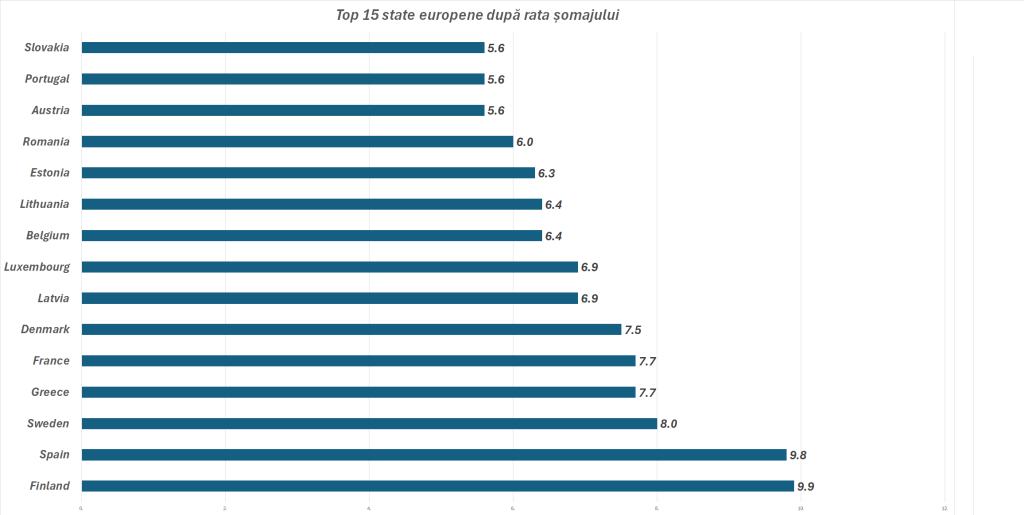
The unemployment rate in Romania remained at 6.0% in February 2026 — identical to the previous month and slightly lower than the same period last year, when it was 6.1%. At first sight, the labor market seems to have entered a level of stability. The reality, however, is somewhat more nuanced.
The total number of unemployed increased compared to January, from 490,500 to 494,700 people. The increase is small and within normal seasonal fluctuations, but it reverses, at least for one month, the downward trend of the past year. It should be noted that compared to February 2025, Romania still has about 7,000 fewer unemployed.
In Europe we are above the average (5.8% is the EU average), in 12th place.
The figure that raises questions is not the overall rate, but that of young people: 28.2% among those aged 15 to 24 — more than one in four young people in the labor market is without a job.
A subtle but persistent gender difference
The difference between men and women remains marginal on an aggregate level — 6.1% versus 6.0% — but hides patterns relevant to employers. Female unemployment among young women aged 15–24 reached 29.5% in the last quarter of 2025, compared to 27.4% for men in the same age group. That's a difference of nearly two percentage points worth watching.
When it comes to explanations, many sociologists shrug, saying that perhaps the high number of housewives not included in the International Labor Office's accepted definition of the unemployed could be to blame.
“In the 2000s, something really important happened in Romania's economy. The entire labor market changed in a structural way. Until then, Romanian men worked in steel or mining, and these branches were either abolished or restructured, says researcher Cătălin Ghinăru.
“Therefore, many jobs that required predominantly male labor disappeared as a result of industrial restructuring. Those jobs disappeared and will not appear from now on. On the other hand, many jobs appeared in sectors intended for the female population: I mean trade, the medical field, etc. In addition, we must take into account that the number of unemployed in Romania has decreased a lot in the last 20 years. People either went abroad or migrated internally and found a job occupation. It is certain that there are relatively few unemployed in our country, this must also be taken into account”, explains the Romanian specialist.
Also, people familiar with the European labor market say that Romania is somewhat atypical.
“In the UK and in 3-4 other countries, we encounter this situation where male unemployment exceeds female unemployment. But in most European states, things are the other way around. Everything depends on the structure of the economy. If the labor market is more open to services, where women reach more easily, there will be more unemployed men. Where industry dominates, the unemployed will be the majority among women,” say EU experts consulted by HotNews.ro.
In the category of adults between 25 and 74 years old, the values are practically identical by gender: 4.6% for men, 4.5% for women. This category represents 71.6% of the total estimated unemployed and is largely stable.
The structural problem behind the figure
Market analysts have been warning for some time that the high unemployment rate among young people is not temporary. It reflects a structural mismatch between the education system and the demands of employers. Romania is among the EU countries with the highest rate of young people neither in employment nor in education or training — the NEET indicator — a problem that is exacerbated in extra-urban regions, where vocational training alternatives are almost completely lacking.
For adults with work experience, the 4.6 percent rate is consistent with what economists call “natural unemployment” — that residual level that reflects normal transitions between jobs, not systemic dysfunction. The real pressure comes from the other end of the age spectrum, and without targeted interventions in education and vocational training, the figure for young people risks remaining high regardless of the evolution of the economy as a whole.
- School does not prepare for the labor market. The mismatch between what the educational system produces and what employers demand is chronic. Young people with little education are three times more likely to become NEET than those with higher education.
- Emigration empties the reservoir of active young people. Many qualified young people are leaving for the west. Those who remain without sufficient qualifications fall into the informal economy or into inactivity. NEET statistics measure the national market — no surprise that an “inactive” young person in Romania is actually working in Germany.
- The urban-rural gap is huge. The difference between big cities and rural areas is almost 18 percentage points — among the biggest in the EU. Vocational training alternatives are almost completely absent in rural areas.
- Young women are doubly disadvantaged. The NEET rate for young women aged 15-29 is almost double that of men — partly because of informal and seasonal work, partly because caregiving burdens fall disproportionately on young women's shoulders.
- Vulnerable communities are caught in a vicious circle. Young Roma, in particular, often grow up in areas with poor schools and face discrimination in the labor market — dropping out of school, under-qualifying, unemployment, and all over again for the next generation.
The result is that Romania has been in the first place in the EU for years in the NEET rate — around 20% compared to a European average of 11% — without any government having addressed the problem in a coherent and sustained way.