Three of the most cynical US secret projects. They triggered huge scandals especially regarding morality and civil rights


The history of the United States, especially that of the 20th century, has been marked by numerous scandals caused by experiments and secret operations coordinated directly by government institutions.
The Tuskegee experiment PHOTO wikipedia
Over time, many secret experiments or projects were carried out that were eventually revealed and caused huge scandals. The most resounding and well-known took place in the United States in the 20th century. It is enough to recall the scandal of Watergate (1973) or the “Pentagon Papers” of 1971. Besides these there were some less known to the general public, but which had a special impact in society and politics.
A cynical medical experiment
One of the most terrible secret experiments in the history of the United States took place over several decades starting in the 1930s. It has remained known in history as the “Tuskegee Syphilis Study.”
In short, it was about observing the effects and evolution of untreated syphilis on patients. Specifically, all stages of the degradation of the human organism under the impact of syphilis were observed with real human subjects. The point was that these subjects didn't even know they were part of an experiment and weren't even told they had syphilis. The tests were done only on African-American men, a segregated, marginalized and disadvantaged category.
Here is the story of this cynical experiment. In 1932, in the midst of a segregated America marked by profound social inequalities, the United States Department of Public Health began a medical experiment that would become the symbol of violated ethics in scientific research.
It was called the “Syphilis Study” and was implemented at Tuskegee, Alabama, for more than four decades. The subjects of the experiment were 600 African-American men, of whom 399 were diagnosed with syphilis and 201 were healthy, used as a control group. The original stated purpose was to observe the evolution of untreated syphilis. The research was totally unethical because there was no consent from the subjects. In other words the selected African Americans did not know what they were participating in. They were effectively, cynically, left to die or suffer without treatment, not knowing they had the disease, just to see the effects. Participants were told they were getting free treatment for “bad blood”, a made-up disease but in fact the men were monitored until death and their families suffered the effects of the undiagnosed or untreated disease. “We were told we were getting treatment to help us, but in reality they were letting us get sick for science”stated an anonymous witness, participant in the study.
The impact of this study was devastating not only for the participants, but for the entire African-American community, generating deep distrust of the medical system. In 1972, this experiment came to light. And the scandal was just right. The study has remained a painful lesson in the history of medical research. He illustrates how racial prejudice and lack of ethical responsibility can endanger people's lives. Following the scandal caused by the shocking revelations of the experiment, legal provisions have appeared regarding the introduction of rules of informed consent and the protection of participants in clinical research. “Tuskegee was not just a medical error; it was a flagrant violation of human rights and human dignity” argues Susan Reverby, medical historian.
US officials later apologized. “We sincerely and deeply apologize for the mistakes made in this study”stated President Bill Clinton on May 16, 1997.
Operation Paperclip: How the US Recruited the Minds of Nazi Germany
Another covert operation that caused a later scandal in the United States was codenamed “Paperclip”. It was more a matter of ethics. In the early years after World War II, the United States faced a major strategic dilemma. More specifically, how to take advantage of German expertise in technology and science without letting these resources fall into the hands of the Soviet Union. It was the period when the Cold War had started. The USA and the USSR were fighting for supremacy. They were the main world powers and had divided their world into spheres of influence.
The battle was not only for territories and satellite states but also for enlightened minds and technology. And the Germans held many scientific secrets developed during the Third Reich. The Americans wanted to win this competition for the “intelligentsia” of Nazi Germany. They were in danger of falling into the hands of the Soviets, after the Second World War, so the Americans thought to act. Thus was born a secret program called “Operation Paperclip”. It was launched in 1945 by the Office of Strategic Services and later continued by the CIA and the US Air Force.
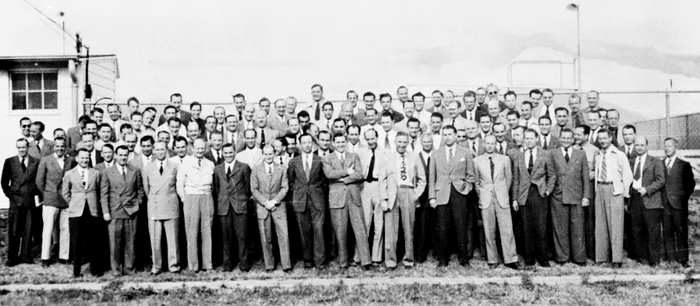
German specialists brought in by Operation Paperclip PHOTO wikipedia
The official purpose of the operation was to recruit German scientists to support the development of American technologies, particularly in the fields of rocketry, aeronautics, and armaments. Apparently it was a natural strategic matter and an “import” of expertise and natural intelligence for the Americans. However, controversies arose. Especially since among the specialists brought in, with false names, were members of the Nazi Party, collaborators of Adolf Hitler directly involved in Nazi programs of mass destruction.
The US attacks Germany in three economic scandals with geopolitical stakes
One of the most famous beneficiaries of “Operation Paperclip” was Wernher von Braun, the lead engineer who developed the V-2 Rocket. He later became the central figure of the American space program and contributed decisively to the launch of satellites and the Apollo missions. Other recruited scientists worked in American laboratories, contributing to the development of ballistic missiles and military technologies. All in complete confidentiality.
“Operation Paperclip” raised complex ethical issues. Especially because of the involvement of German specialists, close collaborators of the Nazi regime in the Cold War. They accelerated the technological superiority of the USA but were practically “pardoned” for crimes against humanity, only because they were useful in the context of the space race, for example, with the USSR.
Through this operation, more than 1,600 German Nazi scientists, engineers and technicians were brought to the US with false documents between 1945 and 1956. All of them worked for the US government with the knowledge of the authorities. The existence of “Operation Paperclip” gradually began to emerge several years after the end of the war as information was declassified. Important details about the extent of the program have become public mainly through investigative articles and declassified documents. One of the most important works on this topic is by journalist Annie Jacobsen, called “Paperclip. Operation Paperclip”
When the state wanted to know everything
In the 1950s–1970s, the United States was going through a period of intense social and political tension, marked by the civil rights movement, protests against the Vietnam War, and radical activism. It was the hippie or “flower power” era of African-American racial emancipation movements and feminism.
In this context, the FBI, under the leadership of the famous J. Edgar Hoover, launched COINTELPRO (Counter Intelligence Program), a secret program designed to neutralize organizations considered subversive. Initially, COINTELPRO was directed against the “American Communist Party” and organizations of a declared subversive character that could produce serious social and political unrest.
A year of scandals at the White House INFOGRAPHIC
But later the program expanded to target African-American civil rights movements. That is, leaders like Martin Luther King Jr., feminist groups, immigrant rights organizations, and even Vietnam War protesters came into the crosshairs of FBI agents. The methods used were highly controversial and often illegal: infiltration, disinformation, espionage, harassment, smear campaigns and even attempts to publicly discredit the leaders of the various factions.
Obviously, those under fire for discredit were the most charismatic leaders. “The purpose of the program is to expose, disrupt, misdirect, discredit or neutralize the activities of organizations and leaders”a declassified FBI document from 1967 showed.

A headquarters used by the FBI in the Cointelpro story PHOTO wikipedia
The best example of the subversive actions of COINTELPRO was the harassment of the leaders of the group “Black Panthers” (a political and militant organization for the rights of African Americans, founded in 1966). The FBI created internal tensions and conflicts between members to destabilize the organization. Other tactics included sending anonymous letters to cause misunderstandings or directly intimidating participants' families.
The entire covert operation by the FBI was exposed in 1971 and caused a shock wave in the United States. Later, official investigations were organized through the “Church Commission” which confirmed serious violations of civil rights. “COINTELPRO involved a wide range of illegal and abusive activities”stated the “Church Committee” commission from 1975. At the same time, Tim Weiner, an American historian and journalist stated that “COINTELPRO was one of the most extensive programs of domestic surveillance and repression in US history”.