Who taught the Turks to play football? The story of the sport forbidden to the Ottomans and the football destiny that linked the Romanians to the Turks

Turkey was the first predominantly Muslim country where youth gained the right to play football. The ones who taught the Turks how to practice this sport were the English, and the first official match of the Turkish national team was in the company of Romania.
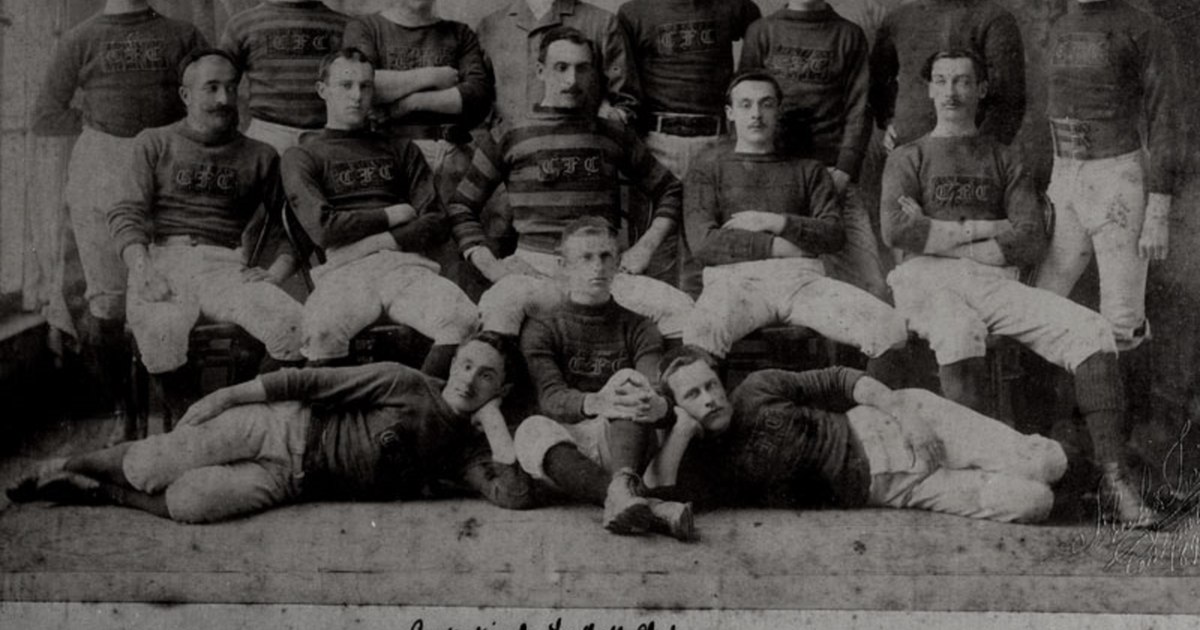
Constantinople FC in 1889 PHOTO wikipedia
Turkey has a special tradition of playing football, being the first Muslim nation to allow its population to practice this sport. In addition, the football connection with Romania is a deep one at the level of national teams. And this in the conditions in which the first official match in the history of the Turkish national football team was played against Romania. Then, the Turks also scored the first goals in the history of their national team. It was the English who taught the Turks how to play football, helping them develop a distinctive style of play that combines hard contact and tactical discipline with Mediterranean and Oriental passion and exuberance.
The English sailors and soldiers were with football and the Turks only with their eyes
The practice of football has deep roots in Turkey. More precisely, from the end of the 19th century. Those who brought football to the Ottoman Empire were British sailors and soldiers who arrived in Turkish ports or were stationed in the area. They were the ones who also established the first football teams on the territory of Turkey today. The locals saw how it was practiced, and even learned how to play, but they were not allowed to participate in the matches. In short, the Turks were only watching, on the sidelines.
And this despite the fact that strict interpretations of Islamic law at the time state that the Aurat (the part of the body that must be covered, usually between the navel and the knees for men) must be covered. Soccer shorts often violated this rule, leading some theologians to consider the sport inappropriate for Muslims. Other conservative Islamic theologians believed that football could lead to a distraction from prayer and religious obligations, drawing attention away from the mosque. Last but not least were the concerns about the passion that the game of football aroused, considered as haram (ie forbidden, inappropriate).
In conclusion, the first football match on the territory of the Ottoman Empire took place in today's Thessaloniki (which is currently on the territory of Greece) between two Turkish teams, but only with English footballers (obviously they were amateur players, mostly English sailors). The first football team on the territory of the Ottoman Empire was also founded in 1875 and was called FC Smyrna. Another club was later established in Izmir and finally in Istanbul in 1895.
The first matches between Izmir and Istanbul clubs took place in 1897, 1898, 1899 and 1904. The Izmir team was the strongest, winning every match. As I mentioned, the players were mostly British, but French, German, Greek, Armenian or Jewish sailors were also selected. Muslims participated in very large numbers as spectators. Basically, football has enchanted the Turks since the first touch of the ball between sailors and English soldiers.
The passion of the Turks for football is greater than the fear of the authorities
Football has stirred deep passions among Turkish spectators. They supported one team or another and were ardent fans. Tired of sitting on the sidelines, the Turks formed the first illegal team in 1899. It was the first all-Turkish football team and was called Black Stockings FC. Fuat Hüsnü Kayacan, a soldier from Izmir who learned to play from the English, also played in this team.
At the first official match, however, law enforcement from the Ottoman Empire entered the field directly and arrested several players. In short, this is how the Turks' first football adventure ended. Football continued to be played in the Ottoman Empire, but only by Christians. On 14 January 1889, a Smyrna team consisting mainly of English and French players traveled to Constantinople to face Constantinople FC, another English team. The latter beat the former 3-0 at Yaourt Tchesme in Moda in front of 1,000 wild Turkish fans. Other teams were established fairly quickly throughout the Ottoman Empire. The first football league on the territory of the Ottoman Empire was created in 1904.
Turkey – Romania 1-0, the tie for the World Cup. In Istanbul, the tricolors made a game of sacrifice, but the class of a player from Real Madrid made the difference
Based in Istanbul and titled the “Football League of Constantinople”, it consisted of four clubs: Cadi Keuy FRC, Moda FC, Elpis and Imogene FC. Obviously, Turkish players were still banned from competing. After 1908, however, things changed radically. The young Turks and the large number of fans of the sport with the round ball put a lot of pressure on both the Sultan and the religious leaders. So in 1908, the “Committee of Union and Progress” gave football the go-ahead. Immediately, football clubs formed exclusively of Turkish players appeared. This is how great Turkish clubs such as Fenerbahçe, Galatasaray and Beşiktaş were born. Among them, the oldest was Galatasaray, founded in 1905 by the students of Galatasaray High School and representing the westernized elite of Turkish society.
On the other hand, Fenerbahçe, founded in 1907 in Kadıköy (the Asian side of Istanbul) was a symbol of Turkish nationalism. Beşiktaş, although founded in 1903, began as a gymnastics club, later embracing football until 1911.
The Republic of Turkey and football as a symbol of unity and modernization
After 1908, several football leagues were established in the Ottoman Empire, in which both Turkish teams and foreign teams, whether English, French or Greek, participated. As early as the 1908-1909 season, there was a league organized in Izmir, then known as Smyrna, where matches were played between Greek, Armenian and Levantine teams, such as Apollon Smyrna, Panionios, Bournabat Football Club, Maccabi de Futbol, Wanderer.
This league ended tragically with the burning of Smyrna in September 1922, marking the end of the Greco-Turkish War (1919-1922) and the Greek presence in Asia Minor. A new league for Turkish teams was created in Smyrna in 1915 to 1917 between Altay SK, Karşıyaka SK, Turan and Tripoli. Altay SK won 3 championships.
However, the strongest league was founded in Istanbul in 1912. The league was called the “Friday League” because all matches were played on Fridays. The league consisted of Darülfünun SK, İstanbul JK, Anadolu SK, Sanayii FK, Şehremini SK and Fenerbahçe SK There was also a “Sunday League”.
Both leagues later merged, developing a single Turkish league comprising teams from multiple cities. The proclamation of the Turkish Republic in 1923 gave an exceptional boost to Turkish football. This is how the Turkish Football Federation appeared on April 23, 1923 under the name of Futbol Hey'et-i Müttehidesi. Football had become a bond of the Turkish nation and a symbol of the road to modernization. Football leagues were created in many cities in the country, and in 1937 the Milli Küme, a competition between the best clubs in Ankara, Istanbul and Izmir, was born.
Mircea Lucescu scolded his players and is satisfied with Hakan Calhanoglu's gratitude: “I learned football with you”
The first professional leagues were established in 1952 in the three big cities and in 1959 the first national professional league was born under the name Milli Lig. Fenerbahçe was the champion of the first Milli Lig and Metin Oktay from Galatasaray was the first goalgetter of the Turkish League.
Romania, the first international opponent
After the founding of the Turkish Football Federation on April 23, 1923, the first match of the Turkish national team took place. It took place in the company of Romania, on October 26, 1923. To top it off, the match was also organized at the home of the Turks, at the Taksim stadium in Istanbul and ended in a tie, 2 to 2.
Zeki Rıza Sporel scored the first two goals in the history of the Turkish national football team. Isidor Gansl also scored twice for the Romanian national team. At the same time, as part of the protocol concluded between the two federations, club matches were also held between representatives of the Turkish and Romanian leagues.
Over 7,500 spectators attended the game in Turkey, in an atmosphere specific to Turkish stadiums. Turkey's technical director was Ali Sami Yen. The rematch between Romania and Turkey took place on May 1, 1925 in Bucharest, with the Turks winning 2-1.