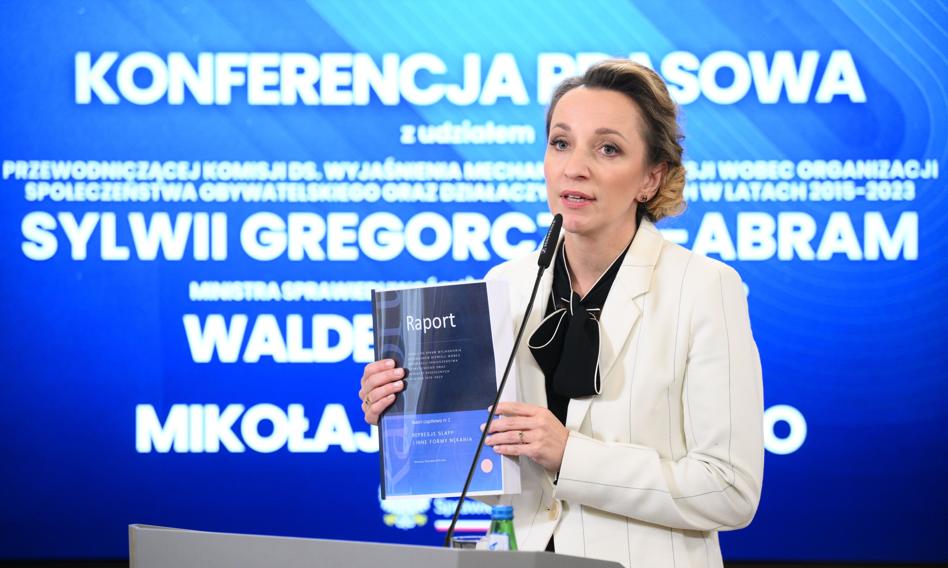
In the years 2015-2023, there was a coherent state-created pressure system used against, among others, activists or journalists – said attorney Sylwia Gregorczyk-Abram, head of the committee operating at the Ministry of Justice for explaining the mechanisms of repression by the previous government.
On Monday, the second “partial report” prepared by the commission, established in April last year, was presented at the Ministry of Justice. The presented report has over 500 pages and describes how it was defined, among others: SLAPP repression and other forms of harassment of civil society.
The full content of the report was posted on the ministry's website on Monday afternoon.
Żurek and Gregorczyk-Abram about “destroying people” without evidence
During Monday's press conference, the head of the Ministry of Justice, Waldemar Żurek, emphasized that the concept SLAPP (Strategic Lawsuits Against Public Participation) refers to the abuse and exploitation of existing legal institutions, among others through: lawsuits, or prosecutors' actions in the form of “fictitious but very serious indictments.”
– So we don't have evidence, but we are starting proceedings. We have no grounds to initiate a lawsuit, but we want to destroy a given person, so we use various legal means to ensure that this person is harassed – emphasized Żurek.
He said that the report presented on Monday describes in detail this type of practice. – The report also contains a number of detailed instruments intended to strengthen the democratic rule of law. We will analyze these proposals, some are already being implemented – assured Żurek.
“It was a duel between David and Goliath.”
Attorney Gregorczyk-Abram, who headed the commission's work, said that “the history of 2015-2023 was truly a duel between David and Goliath.” – This David was, of course, activists who boldly spoke out, criticizing the state. In response, all instruments of repression were launched against them at the criminal, civil, administrative and control levels, she added.
As she said, initiating proceedings against these people was not intended to clarify the matter, but to intimidate a citizen who takes part in public debate, “who disturbs this authority, someone who criticizes this authority.”
She assessed that such actions by the authorities were intended to make citizens – instead of taking an active part in public life – invest their time, strength and money in defending themselves in court. – It was a coherent system of pressure created by the state, used against specific individuals – said attorney Gregorczyk-Abram.
– The state, which was supposed to be a guarantor of security, simply became a source of danger for these individuals – said the chairwoman of the commission.
Pressures on specific media
As the chairwoman of the committee operating at the Ministry of Justice said, the report included, among others: issues of pressure on specific editorial offices and mediawhich were heavily burdened with SLAPP lawsuits in the period under review, as well as individual journalists – including local ones.
The report – as Gregorczyk-Abram mentioned – also raised the issue of pressure on activists who acted, among others, for the LGBTQ+ community. A separate chapter of the study was devoted to repression against teachers who “decided to support their students in civic activities” at a time when schools were “tracking (…) various types of activities related to involvement in equality issues”, such as the so-called Rainbow Fridays.
Institutional fight against lawyers
The chairwoman of the committee said that the report also included, among others: issues related to the institutional fight against specific “independent judges and prosecutors(…) who criticized the then so-called reforms of the justice system” or issues of repression against the Polish cultural world.
The committee also includes, among others: criminal law specialist from the Jagiellonian University, Mikołaj Małecki, who informed about the recommendations prepared during the press conference. – They can be divided into three subgroups, which, in our opinion, will ensure better compliance with the rule of law within what we call civil society – he said.
How should you react?
– The first group of recommendations are the ways in which a democratic state should respond to SLAPP cases. (…) One of the recommendations in this regard is the implementation of the “anyslapp” directive – he noted. According to information from the Ministry of Justice, the project on these issues is to be considered by the Standing Committee of the Council of Ministers this week.
As Małecki added, the next group of recommendations is “restoring the institutions that are supposed to protect freedom and civil rights to their constitutional characteristics, i.e. restoring the operation of the Constitutional Tribunal.”
– The third group of detailed recommendations (…) is, for example, adding a stipulation to the provisions on defamation that there is no defamation when the information concerns a person performing a public function, and full reliability has been maintained in the collection of materials and publications – Małecki pointed out.
In April 2025, the then head of the Ministry of Justice, Adam Bodnar, announced the commencement of the work of a commission established to explain the mechanisms of repression against civil society organizations and social activists in the years 2015-2023. Gregorczyk-Abram serves as its chairman.
The subject of the committee's analysis is, as announced, among others, the activities of public media, restrictions in the context of organizing and conducting legal meetings, and the issue of the application of legal actions – civil actions, disciplinary and criminal proceedings – pending against civil society.
As announced, the committee is yet to prepare a third “partial report” and – at the end of its work – a final report.
The first “partial report” – nearly 400 pages long – regarding the activities of public media at that time, was presented in September 2025. Then Minister Żurek said that the report “is not only a chronicle of the described cases, but above all a signal that state authorities should take action to protect and support civil society to ensure its security and independence.” He also declared further support for the commission's work. The report presented at that time also included recommendations for public authorities at the systemic and institutional level. It was handed over, among others, National Prosecutor's Office. (PAP)
mja/ nl/ ef/