Between the fights and the hive. The story of Eduard, the 18-year-old from Slatina who turned beekeeping into a lifelong passion

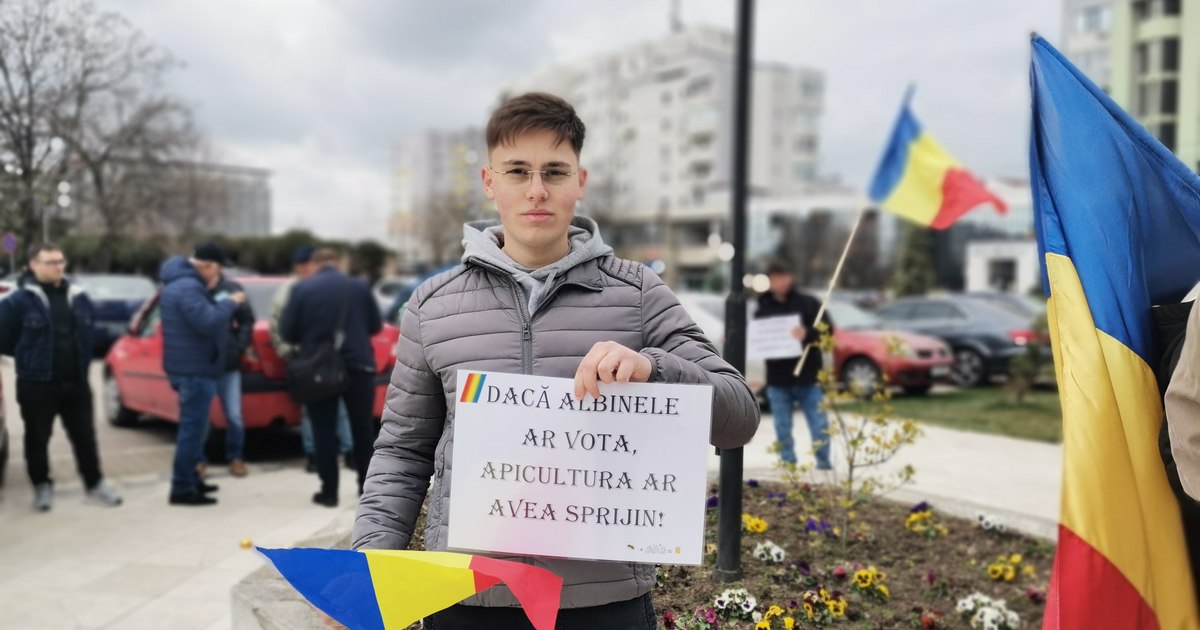
He is 18 years old, soon to graduate from high school, and has an uncommon passion among teenagers: beekeeping. “I don't know how much my colleagues understand, it's not very fashionable.”
The young beekeeper came to support the cause of beekeepers PHOTO: A. Mitran
Marian Eduard Andronăchescu is 18 years old and has a rather unusual passion for his age: beekeeping. He lives in Slatina, he has concerns like all young people of his age, he also does performance sports (Greco-Roman wrestling), but when he feels the need for peace, he goes to the apiary.
His father, a firefighter by profession, bought his first beehives 20 years ago. Eduard grew up seeing how absorbed his father was in everything involved in keeping the apiary, and as he could help, he got involved. “About six years ago, maybe even more, I started getting involved. It's basically a family heirloom. It left my father and I started to like it too. About 2016-2017 I started going with it”the young man begins to tell.
We are talking in Slatina, after a few dozen beekeepers who came to express their grievances have finished the protest, but they don't have the patience, if they still met, to leave before they tell each other more. I'm not talking about how hard it is for Romanians, as happens during protests, they generously share their secrets in the field that unites them like a brotherhood.
Eduard Marian came to represent his father, who was at work and could not participate. He admits that he is not very involved in selling honey. Instead, he knows that it's a lot of work, that they and the bees are doing a good job, but that the price of honey is very low.
“I would have liked to expand them, but it's better to stay with 80-90 and keep them strong”
Beekeeping is not an old family heirloom. The father is the first infected by this passion. “He went to visit someone, a colleague, saw the boxes and said: come on, what is this? He liked it at first. And he's been doing that ever since.” explained the son in few words.
Today they have reached 90 bee families, he says, they have the apiary installed in Bălteni, a locality located not far from the municipality of Slatina. “In a way, I thought, I would have wanted to expand them, but I think it's better to have 90 families, or 80, but to be strong, not to have problems with the hives, to be able to produce quantity and quality at the same time”, the young man already speaks skillfully.
He was constantly learning. At first he was afraid of the stings, but it didn't last long. Today he does almost everything his father does. One thing he does not do so well: mounting the frames. It's an operation that the father usually does in the winter, when he's at school, and he didn't have the opportunity to “steal a job” in this segment as well.
“I give them food, loaded – I've been loading with it for about four years, before I was small, I didn't really have the strength to lift the 100 kg hive. And I load, unload, extract, prepare frames… I'm not very good at joining frames, dad makes the frames in the winter and it happens when I have school and I can't really help. Now, I got my license recently, I can go after it. I sit behind him, because I like him too, he calms us down. When I go to the beehives I calm down completely, it's relaxation. That is if they don't have nerves. When they have nerves and start shooting at us with those…”says the high school student.
Why do beekeepers live longer? The surprising ingredients of bee stings
This usually happens at the end of summer, in August, when the bees finish harvesting. “Either it's too hot, or it's not picked anymore, and then the trick ends. They start to be more aggressive, especially since I have multi-story hives, they have 3-4 stories, and when millions of bees have no food left to collect, it's hard to get close to them. You approach them with water, sprinkle it like it's raining, let them come in, in case they're restless and we can't get close to give them food”, the young man also lets us learn from the secrets of life as a beekeeper.
From his father he learned, he says, the best advice: after each extraction to leave 10-15 kg of honey in the hive, honey from the work of the bees.
“Every winter I don't really add the supplements for them, it actually takes away from their work”, completes the young man.
When it's time to start the work, he and the father start, each from a different end of the hive.
“Usually we start from one end to the other, we have them in a line and at the end we have two parallel lines. I also did a contest once, which ends faster, and I passed with a hive after him. I was also lucky, I had lighter hives”admits the young man.
“Manna honey sells best, who knows the secret”
Eduard says that he has stopped consuming commercial sweets for some time, he likes honey a lot and knows that it is much healthier than sugar. He also managed to convince his friends and colleagues. Acacia honey is their favorite, polyflora honey is sold more in confectionery. The queen, on the other hand, is manna honey, “it sells best, but who knows the secret (n. ed. – to produce it)“adds the young man.
If selling in the circle of friends didn't work anymore, things probably wouldn't be very good. The family has a place for sale in the Progresul Food Market, in Slatina, customers know they can find them there, but they don't sell large quantities.
“What would I like? For this Romanian state to sponsor us as well, as it does with other branches of agriculture. Because the purchase price is low, although we produce honey of the best quality. For everyone to understand that we need bees, to encourage us to grow them”. says the young man firmly.
I ask him what bees mean to him. He answers looking at the placards they just left after the protest: “Bees mean life, without bees we can't really do anything, there is no pollination”. He is aware that he learned all these things because he had the opportunity to be around his father. He admits that among friends and colleagues, on the other hand, such information is of little importance.
“Those who are involved in agriculture realize this. But otherwise they don't really behave, it's not fashionable”, says Eduard.
He still makes time for the bees, although in the summer he is waiting for the Baccalaureate exam and, after that, the admission. He would like to follow his father and become a firefighter. It's a dream, he's doing everything he can for it, but he won't give up on bees, says the young man, confirming what beekeepers with much more experience also support, namely that beekeeping is “addictive”.