Social media is no longer just a technical communication infrastructure. Today, they have become one of the main environments where people receive news, discuss politics and form their opinions on current events. That's why I've been wondering for a long time: are social media just a mirror of society? or are they a tool capable of changing people's views?
This question is particularly important because modern platforms have long stopped presenting news to us only in the order in which it was published. The chronological stream is increasingly being replaced by an algorithmic stream of recommendations.
This means that the user sees not only the entries of the accounts he follows, but above all the content that the system considers the most likely candidates for his attention. In other words, the algorithm doesn't just sort information – itactively determines the order of their visibilitybringing some messages to the foreground and making others almost invisible, even if they come from accounts that a person consciously follows.
Such algorithms are not created to provide the user with the most balanced or most useful information environment. Their main goal is engagement. They optimize the number of clicks, likes, replies, shares, time spent on the platform, and sometimes also purchases.
That is why there is every reason to assume that they can have social and political effects. If a system is designed to attract our attention, it may systematically favor others more emotional, conflictual, provocative or polarizing content. And if, day after day, a user encounters certain topics, tones and interpretations of events more often than others, it is difficult to assume that this will not in any way influence his/her perception of politics.
The article continues below the video
This is why concerns about recommendation algorithms have never seemed exaggerated to me. They can reinforce existing beliefs, including false ideasintensify attention to extreme positions and build a polarized information environment that is often referred to as “filter bubbles.”
However, despite these rather intuitive concerns, previous research has shown that turning off recommendation algorithms does not affect political beliefs. This was an important, if not fully understood, result.
Our hypothesis was confirmed. Unfortunately
Many took this as evidence that concerns about the platforms' political influence are overblown. More far-reaching conclusions were sometimes drawn from this: since turning off algorithms doesn't change anything, it makes no sense to say that Facebook could have played a significant role in electing Donald Trump in 2016.
However, such a conclusion from an earlier study published in Science was, in my opinion, premature. If we only look at what happens when the algorithm is turned off, slower and deeper mechanisms of its action may be overlooked. It is very possible that the effect does not manifest itself immediately and does not disappear immediately, but increases over time – gradually, by changing the information environment in which the user lives.
This is the hypothesis we decided to test in the study I conducted with my team. We analyzed the X platform (formerly Twitter) in the US in the summer of 2023 – then users could choose between two types of stream: chronological “Subscriptions” and algorithmic “For You”. This gave us a unique opportunity to directly compare two ways of organizing the same digital environment. (From January this year, “Subscriptions” also display an algorithmic line, unless we manually select a special chronological mode in the settings).
We randomly assigned participants to one of these modes and paid them to maintain the assigned configuration for seven weeks. Some people moved from one line to another, others stayed in the original one. Thanks to this we could separately observe the effects of turning the algorithm on and off — in terms of content consumed, engagement, political views and choice of new subscriptions.
Elon Musk. owner of platform X, and Donald Trump, president of the USA, in the Oval Office. Washington, May 30, 2025POLITICO POOL / PAP
We were interested not only in what exactly users see in their stream, but also whether their views change as a result. The results proved important both for understanding the impact of algorithms and for interpreting previous research. We discovered that moving to an algorithmic lane shifts some political beliefs towards a more conservative side.
Users who were shown algorithmically curated content began to become attached greater attention to topics traditionally emphasized by Republicans — such as inflation, immigration and crime — and less on issues that Democrats emphasize more often, such as health care and education. They were also more likely to support positions favorable to Donald Trump and assessed US support for Ukraine less positively.
There is no return to the state before algorithms
However, it is important to understand that this is not about primitive or intrusive propaganda. The effect of the algorithm works much more subtly. It does not impose ready-made views on the user, but systematically changes their information environment. The algorithmic X-line contains a higher percentage of political content than the chronological stream. Moreover, as part of political content, it much more often promotes materials with right-wing overtones. It also shows more content from political influencers and activists and less from traditional media.
In other words, the algorithm doesn't simply make the stream “more interesting” or “vivid.” It changes the structure of public visibility: which topics seem urgent, which interpretations of events are repeated more often, whose voice is louder and whose falls into the background.
This is also important because traditional media play a special role in a democratic society. Of course, they are not perfect and free from errors or biases. But that's what they are typically provide more stable standards for professional fact-checkingseparation of messages from comments, responsibility for publication. When an algorithm systematically displaces such content and replaces it with emotional, activist and conflict messages, it changes not only the style of the stream, but also the quality of the information environment in which the user orients himself in politics.
The most important result of our study, however, is that the algorithm affects not only what a person sees today, but also what his information environment will look like tomorrow. Users who were moved to the algorithmic lane were more likely to start following new accounts — especially accounts of political activists, especially those with right-wing views.
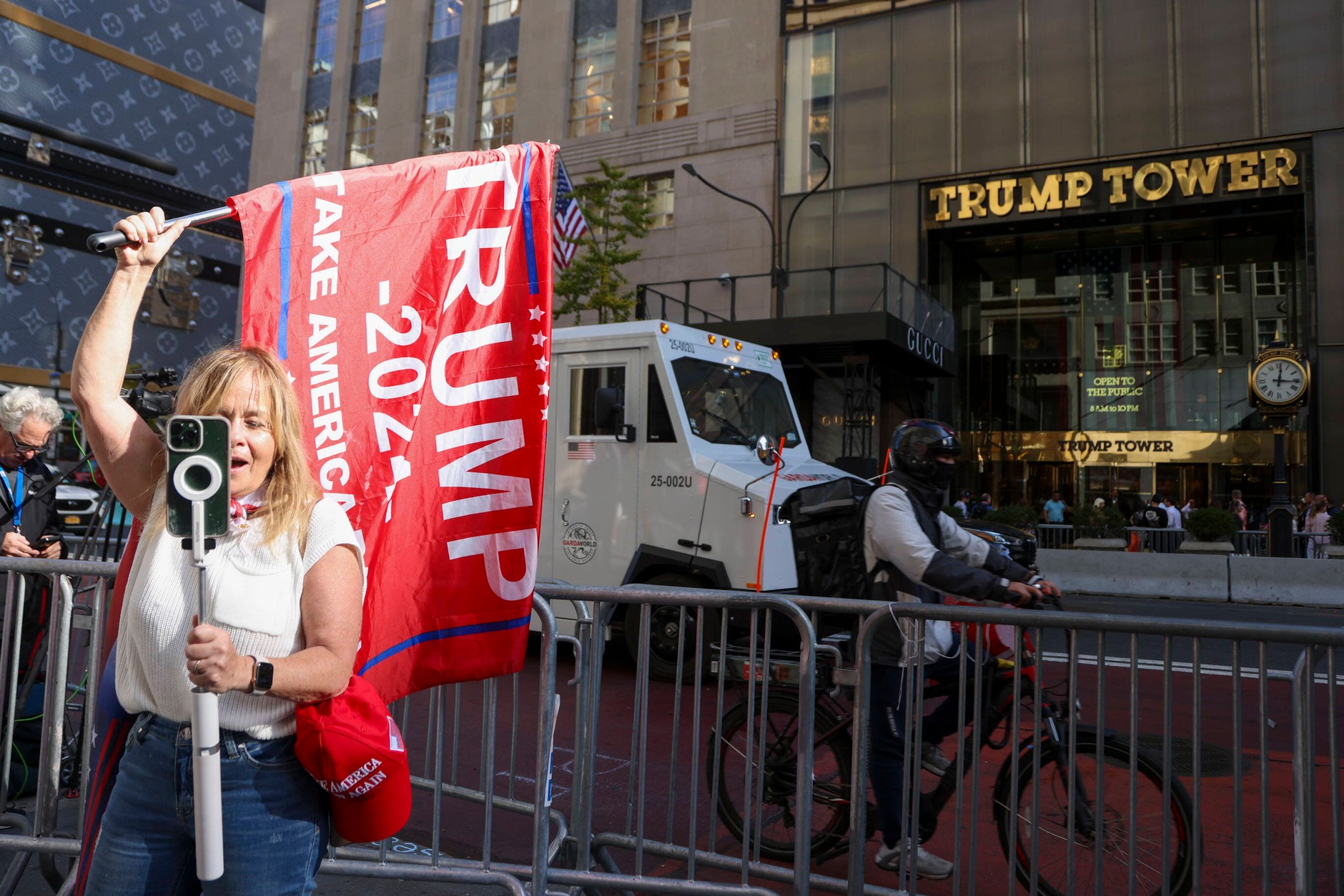
A Donald Trump supporter in front of Trump Tower in New York, November 6, 2024.epa / SARAH YENESEL / PAP
This means that the algorithm does not only temporarily suggest specific content to the user. It encourages him to use new sources of information, thereby gradually rebuilding his further media environment. And when the algorithm is then turned off, this new information structure remains. Users do not automatically stop following accounts they started following under the influence of the algorithmic line. Hence we observe an asymmetry: turning on the algorithm changes the views, and turning it off almost does not bring back the initial state.
Democracy is at stake
It is this result that I believe provides a new understanding of previous research, including the Meta study, which many have interpreted as evidence that algorithms have no political relevance. If the algorithm has already managed to change the circle of sources on which the user relies, then the usual one returning to the chronological stream does not remove the effects of previous influence.
The algorithm leaves a trace – not only in what someone sees, but also in what someone sees who he follows, who he trusts, what topics he considers important and what interpretations come naturally to him. Therefore, the mere fact that turning off the algorithm does not have an immediate “reverse effect” does not mean that the algorithm itself does not change anything.
For me, the key takeaway is that algorithms are not a politically neutral architecture. They shape the space of attention. They decide which topics go to the center of public debate, whose voices are heard more clearly and which are marginalized.. They do not directly dictate to the user what to think, but they largely influence what he thinks about most often, what arguments he encounters, what emotions he experiences and which sources gradually take the central place in his information world. And this is one of the most important mechanisms for shaping political attitudes.
Social media has become a key source of information for millions of people. And the principles according to which the algorithm works determine not only the way we use the media, but also the political dynamics as such. That's why today we need a serious debate about the transparency of algorithms and the principles of their regulation in democratic societies.
Particularly disturbing is the fact that recommendation systems may systematically replace the content of traditional media, leaving many users without reliable reference points amidst the information overload. This way of organizing public space cannot be considered a neutral technical solution. It is a question of social order – and ultimately a question of democracy.
I’m Ashley Davis as an editor, I’m committed to upholding the highest standards of integrity and accuracy in every piece we publish. My work is driven by curiosity, a passion for truth, and a belief that journalism plays a crucial role in shaping public discourse. I strive to tell stories that not only inform but also inspire action and conversation.