publication
2026-03-23 21:05
Contradictory statements regarding the war with Iran did not prevent Wall Street investors from making a solid recovery from multi-month lows. However, it is not known whether the next TACO will generate the same profit as last year.

Monday in the financial markets began with a wave of sell-offs in stock markets. Stock exchanges in Asia were sinking with an absolute advantage of sellers. Even precious metals were not a safe haven in the face of the increasing risk of uncontrolled escalation of fire in the Middle East. On Saturday, the US president gave Iran a 48-hour ultimatum to unblock the Strait of Hormuz. He threatened to attack the critical infrastructure of the entire region. Israel, which attacked Tehran, was still pursuing its goals.
Everything changed almost exactly at noon when President Trump made a powerful announcement. He announced that the US was conducting “good and constructive” talks with Iran and ordered a 5-day halt to the previously announced attacks on Iranian power plants. This dramatically changed the mood on the markets. Investors treated this as another TACO (Trump Alwaus Chickens Out) and began to rush into buying discounted shares. Crude oil immediately became cheaper. US Treasury bond yields fell
Advertisement
Investors were not particularly bothered by the fact that the Iranian authorities strongly denied reports of any peace talks, while Donald Trump consistently claimed that negotiations were ongoing. Someone must be lying here and sooner or later it will be revealed who. Clearly, markets are already so oversold and panicked that they are clinging to any hope of de-escalating the conflict in the Middle East.
– You never know who to trust here. But Trump appears to be trying to open a dialogue with someone in Iran about resolving the war despite strong resistance within Iran itself. This has caused a significant surge of optimism in the stock markets today. The market rose sharply despite Iran's denials, Tim Ghriskey, senior strategist at Ingalls & Snyder in New York, told Reuters.
Perhaps if it were not for Tehran's denial, the increases on Wall Street would have been more impressive. But it should still be appreciated that the S&P500 gained 1.15% and ended Monday at 6,581.04 points. Before Trump's statement, another 2% decline in this index would not be a surprise. And so the most important American stock market benchmark rebounded from its lowest levels since September.
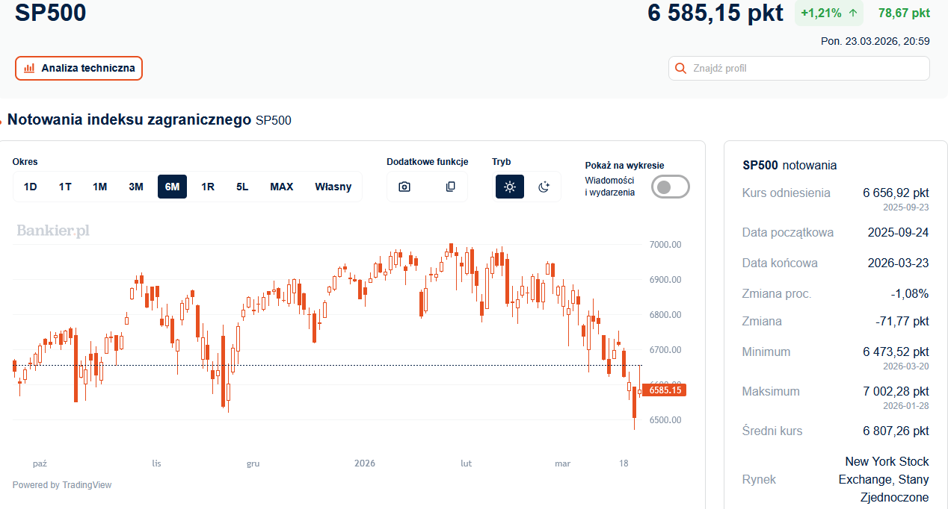
The Nasdaq Composite increased by 1.38% and reached 21,946.76 points. The Dow Jones industrial average increased by 1.38% and finished with a score of 46,208.59 points. The VIX volatility index fell by almost 5% and crude oil by almost 10%. Particularly important is the sharp decline in the prices of “black gold”, which gives hope for the easing of stagflation pressure in the world.
It seems that the market is still hoping for a repeat of the scenario from a year ago. Back then, there was a more than 20% decline in stocks on Wall Street after President Trump announced draconian “reciprocal tariffs.” Less than a month later, the host of the White House backtracked on those threats, sparking euphoria in stock markets and pushing the S&P 500 and Nasdaq to new highs. However, this time a lot depends not only on the unpredictable Donald Trump, but also on the equally unpredictable and determined regime in Tehran. And the Strait of Hormuz remains essentially closed to tankers.
At the same time, futures market investors basically withdrew from the Federal Reserve interest rate cuts expected a month ago. The market estimates the chances that the federal funds rate will remain unchanged until the December FOMC meeting at 70%, according to FedWatch Tool calculations. What's more, even pay rises are timidly discounted. The chances of which are currently valued at 13%, although on Friday it was approximately 25%.
The publication contains affiliate links.