March 23, 1935
The First Congress of Collective Farmers-Shock Workers of the Jewish Autonomous Region opened. It was held in the building of the former House of Pioneers and Schoolchildren. The congress was attended by 111 delegates representing 60 collective farms and three MTS. Delegates gathered to approve the Model Charter of the Agricultural Artel, adopted by the Second All-Union Congress of Collective Farmers-Shock Workers in February 1935 in Moscow.

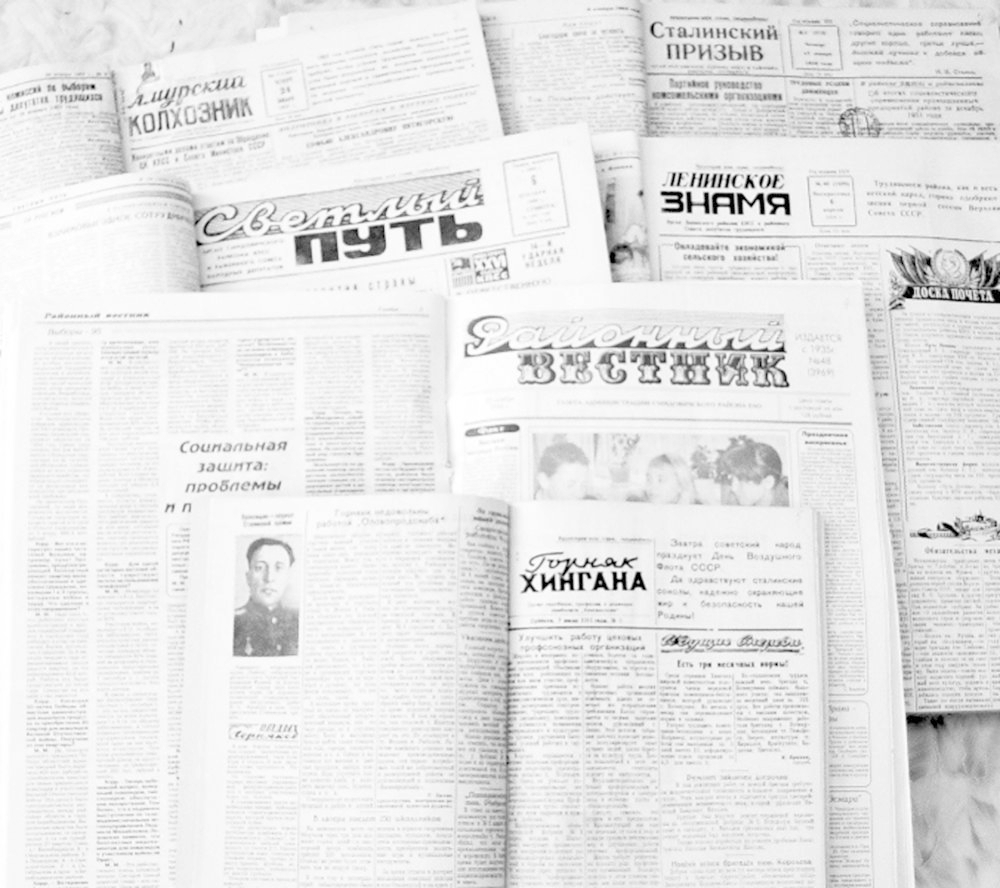
Clippings from the newspaper “Birobidzhan Star”. Photo: Photo: Regional Library
The chairman of the regional executive committee, I. I. Liberberg, made a report at the congress. The congress delegates emphasized in their speeches that enormous and painstaking work remains to be done to provide food for all residents of the region. At the congress the names of leading workers were announced. The congress obliged to achieve a radical change in the development of livestock farming, to ensure the complete preservation of the offspring of young animals in 1935, and to increase the milk yield of cows. The congress called on all agricultural workers to skillfully use agricultural machinery, increase responsibility for maintaining machines, and strengthen the national economy. At the congress the task was set: by 1938 – not a single lagging collective farm.
March 23, 1935
The newspaper “Birobidzhan Star” (12+) wrote that on the day of the opening of the regional congress of collective farmers-shock workers, the first issue of the newspaper “Stalin's Way” (12+) was published in Amurzet. The first issue of the newspaper opens with an article by the secretary of the district committee of the All-Union Communist Party of Bolsheviks, Sais. The second page of the newspaper is devoted to the issue of class vigilance. The newspaper informs about the construction of a metro in Moscow and provides brief news about the international situation. In the first issue of the newspaper “Stalin's Way” there is not a single line in Hebrew.
March 23, 1950
The Bureau of the Regional Committee of the All-Union Communist Party (Bolsheviks) and the Executive Committee of the Regional Council of Working People's Deputies accepted the steady leadership and implementation of the requirements of the Council of Ministers of the USSR and the Central Committee of the All-Union Communist Party of Bolsheviks for the preparation of collective farms, state farms, and MTS for spring sowing and determined the tasks for its implementation.
March 23, 1981
The party organization of the Birobidzhan Power Transformer Plant determined the tasks of the communists arising from the decisions of the 26th Congress of the CPSU. The adopted resolution noted that production output during the tenth five-year plan increased by 50.9%, its sales by 54.3%, and labor productivity increased by 27.5%. Consumer goods worth 3.7 million rubles were produced in excess of the plan. Savings of 2.5 million rubles were obtained from the implementation of technical progress measures. 210 workers completed the plan for two months in 1981 ahead of schedule. Among them are communists V.V. Voron-Kovalsky, R.I. Akimovich, M.V. Kelis, A. I. Revich, V. A. Olkhova, R. Sh. Sheiman, V. I. Vulfson and others.
The meeting of the party organization recommended supporting the initiative of the deputy of the Supreme Soviet of the USSR, soldering worker of workshop No. 2 of the plant R. G. Geller and charger M. V. Kelis, to complete the annual task for the 64th anniversary of the Great October Socialist Revolution.
March 23, 1985
The plenum of the regional committee of the CPSU discussed the tasks of the regional party organization to further improve work with personnel in the light of the requirements of the XXVI Party Congress and subsequent Plenums of the CPSU Central Committee. It was noted that about 6 thousand specialists with higher education and 14 thousand with secondary specialized education work in the national economy of the region. About 80% of the secretaries of the city committee and district committees of the CPSU are specialists in industry and agricultural production, more than 60% of them have party political education. 86% of the communists of the regional party organization are employed in the national economy, of which more than two-thirds are directly in the sphere of material production. Every fourth engineer, every third teacher and doctor are communists. The Plenum noted the shortcomings in this work, outlined measures aimed at further improving the system of selection, placement and training of personnel, increasing their responsibility for the assigned work.

March 23, 1994
Based on the decree of the head of the administration of the Jewish Autonomous Region dated March 23, 1994 No. 711, a regional service for the protection of people’s lives on the water was formed.
Main functions of the service: training of rescuers; organizing training for the population in swimming and rescue skills; control over the use and safe navigation of small vessels with stationary engines.
March 23, 2005


The parish in the name of St. Simeon the God-Receiver in the FGU IK-10 village of Budukan, Obluchensky district, has its own history.
The idea of building the temple came from the prisoners themselves, who expressed a desire to build it with their own hands. Many of those who put their labor into creating the monastery over the years have now been released. On March 23, 2005, Bishop Joseph consecrated the cross at the construction site.
The building of the church in the name of St. Simeon the God-Receiver in the village of Budukan is rightfully considered a masterpiece of wooden architecture. The wooden five-domed temple was made with amazing care, accuracy and love. All work, including the production of the carved iconostasis, was carried out by the convicts themselves. Philanthropists helped purchase materials and utensils for the temple. On April 22, 2010, the great consecration of the church building took place. Spiritual literature was transferred to the colony library.