The British calculated the “Hevelius” effect. This is how the Netflix hit affected Poland's GDP

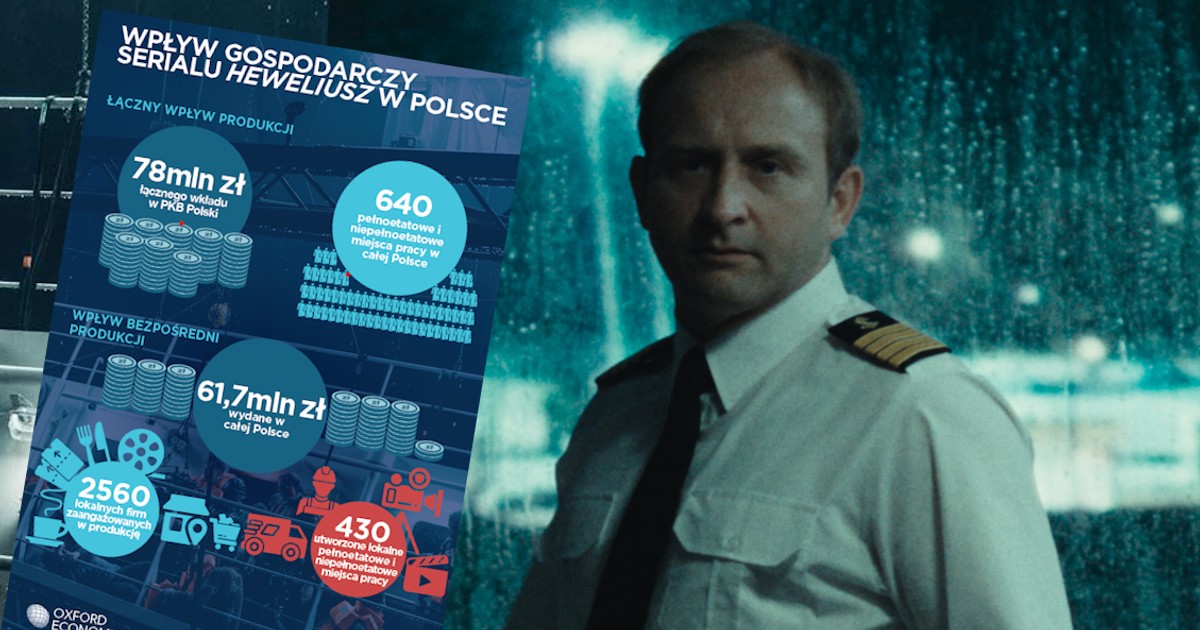
Production of the series “Heweliusz” for Netflix it brought PLN 78 million of GDP to the Polish economy and created 640 jobs – states the Oxford Economics report prepared for the Motion Picture Association. Not much on the scale of the entire country, but quite a lot for local government officials commenting on the impact of the series on their cities.
The five-episode production directed by Jan Holoubek, filmed from January to August 2024, involved 2,560 companies from all over Poland. The implementation involved 430 people directly employed in production, and the multiplier effect brought another 210 jobs in the supply chain and the wider economy.
Economists calculate that expenditure on the production of “Hevelius” in Poland amounted to PLN 61.7 million in 2024-2025, which means that it is the largest television production in the history of the country. In total, the production of the series lasted four years, and the filming was carried out, among others, in Belgium.
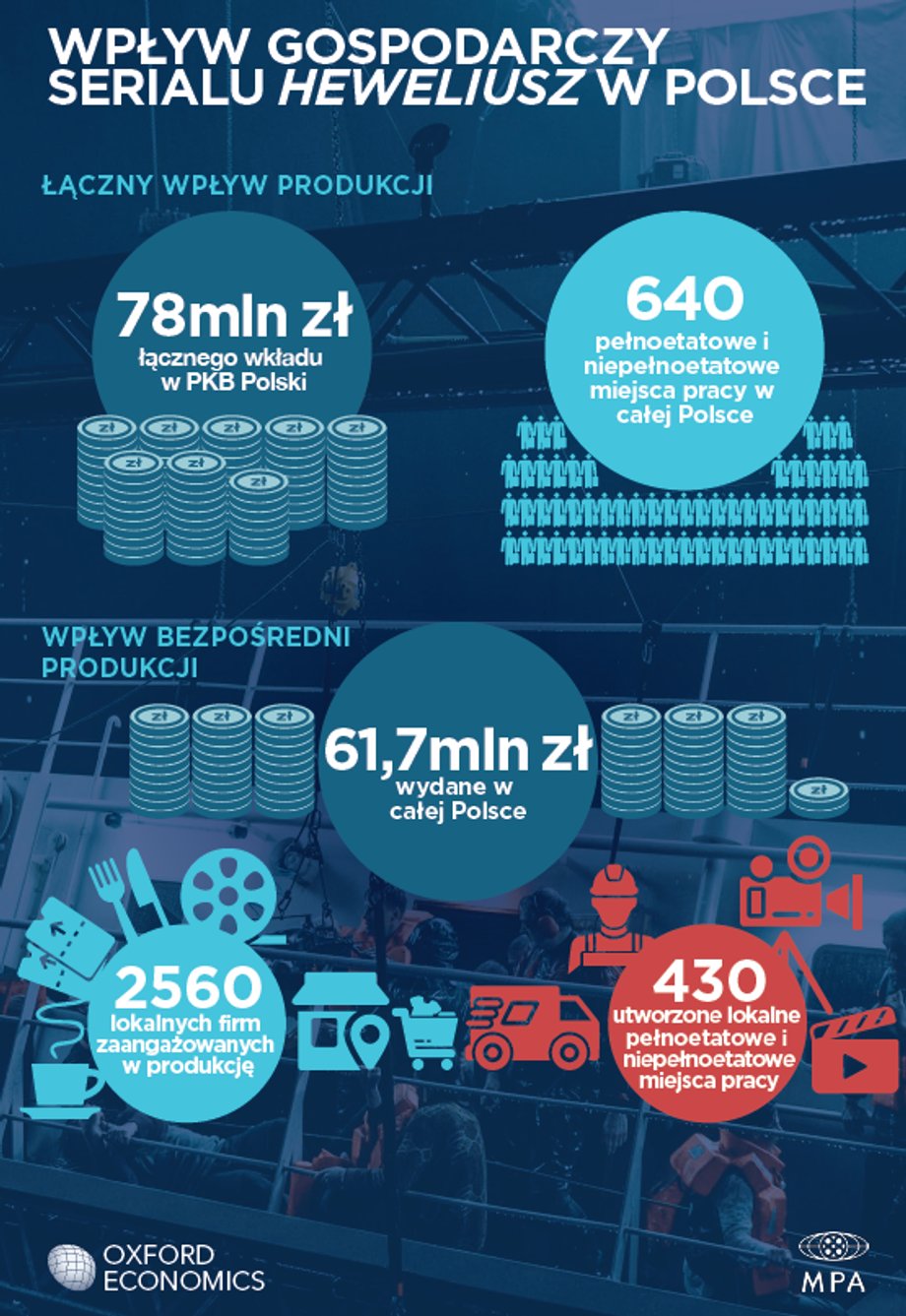
Oxford Economics calculated the impact of expenses during the production of “Hevelius” on the economy
|
Oxford Economics / Oxford Economics
The expenditure was allocated, among others, to: for remuneration for the local production team and cast, as well as goods and services provided by Polish companies. Oxford Economics estimates that the total benefits may be even greater – every PLN 1 million directly contributed to GDP generated an additional PLN 1.8 million of economic activity within the supply chain and through the payment of wages..
Encouragement helped “Heweliusz”.
Oxford Economics analysts argue that the tax preferences adopted by Poland in 2019 encourage people to spend money in Poland. “The adopted regulations introduced incentives in the form of a 30% refund of costs incurred for eligible expenses in the country, giving producers a strong reason to locate projects,” it was assessed.
Netflix periodically releases data on the economic impact of its selected productions. For example, the series “Bridgertons” was supposed to contribute approximately 275 million pounds to the British economy, and the Argentine “Eternauta” added approximately 70 million dollars to the Argentine GDP. In turn, just after the premiere of Squid Game in 2021, the Korean branch of Deloitte calculated that the activity of the American giant on the local market translated into USD 4.7 billion within 5 years. in GDP.
“Heweliusz”. What was the most expensive part of producing the series?
The expenditure structure outlined by Oxford Economics shows how complex film production is. Experts pointed out three layers in which the impact on GDP is visible: direct (employment and taxation of the company), indirect (orders to suppliers and sub-suppliers) and induced (expenditures of employees and suppliers in the broader economy).
According to the report, visual effects production expenses were the largest single cost categoryreaching 23 percent all expenses for local companies, which translates into PLN 7.6 million. Next came expenses related to shooting locations – PLN 4.5 million, travel and accommodation – PLN 3.3 million, and vehicles and animals for shooting – also PLN 3.3 million.
The rest of the article below the video:
As part of the indirect impact, which amounted to a PLN 28.3 million contribution to GDP, the business services industry, including rental services, gained the most with PLN 11 million, which represented 39%. this channel of influence. The next sectors are audiovisual activities, including special effects – PLN 6.2 million, wholesale and retail trade – PLN 2.3 million and construction – PLN 1.6 million. This indirect impact on the supply chain supported the creation of almost 110 full-time and part-time jobs – calculate experts from Oxford Economics.
The induced impact, i.e. the impact resulting from the expenditure of remuneration paid to employees, amounted to PLN 21.7 million. Wholesale and retail trade achieved the largest increase in economic activity thanks to this channel – PLN 4.1 million, followed by the real estate sector and public health services. It is estimated that the induced channel supported an additional 100 full-time and part-time jobs across the Polish economy.
These regions made money on “Heweliusz”
Oxford Economics has created a map of the voivodeships that benefited the most from the project. There is no surprise – most of the money “stayed” in Warsaw.
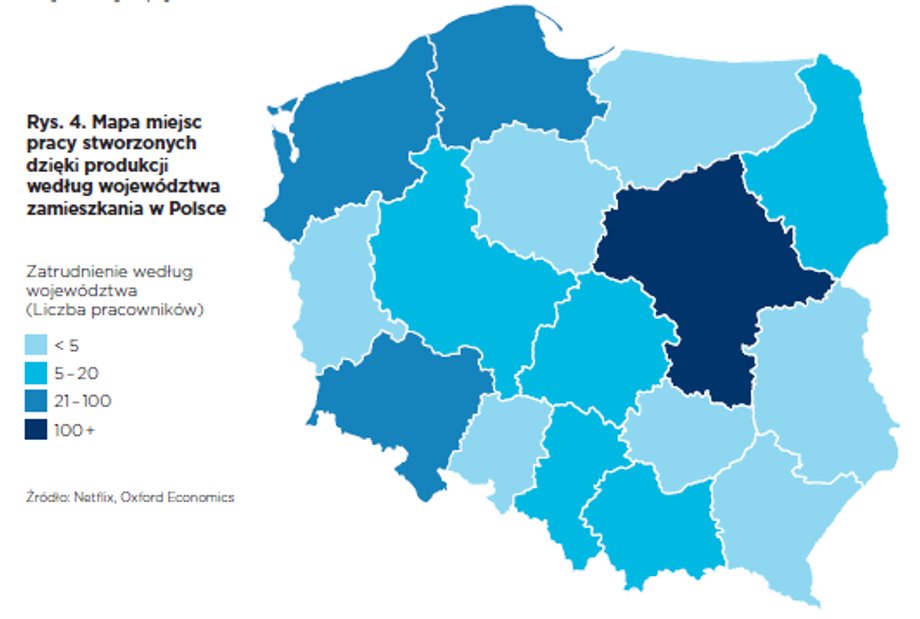
The scale of expenditure in individual voivodeships
|
Oxford Economics / Oxford Economics
In the Masovian Voivodeship, PLN 15.7 million was spent on services provided by local enterprises. 270 jobs were also created there, representing 62%. all directly created positions. Significant expenditure was also incurred in the Lesser Poland Voivodeship, where PLN 7.9 million was spent, and in the Lower Silesia and West Pomeranian Voivodeships, where the amounts were PLN 2.9 million and PLN 2.8 million, respectively.
Local government officials confirm that the impact is visible. — It is not only prestige and promotion, but also an impulse for the local community and economy. Each shooting day means orders for service providers, hoteliers, restaurateurs and a chance to engage local specialists and craftsmen. – points out Piotr Krzystek, mayor of Szczecin, quoted in the release.
— The presence of film sets affects the atmosphere of the city – it attracts observers, tourists and the media, and at the same time emphasizes its film potential. In many cases, productions become an element of local identity. The arrival of film crews means immediate financial injections for local businesses – hotels, restaurants, service companies and local creators who often get jobs on film sets. This is a great impulse for the local economy and a broad promotion of the city, local business and culture – says Aleksandra Kosiorek, Mayor of Gdynia.
— “Heweliusz” reminds us that Polish cinema is a space where important stories about ourselves and the world are born (…). And as such, it also has an impact on our economy, says Marta Cienkowska, Minister of Culture and National Heritage.