Daniel Dăianu: With wars around, we flex our muscles in the corridors and in the budget disputes. It's not ok!

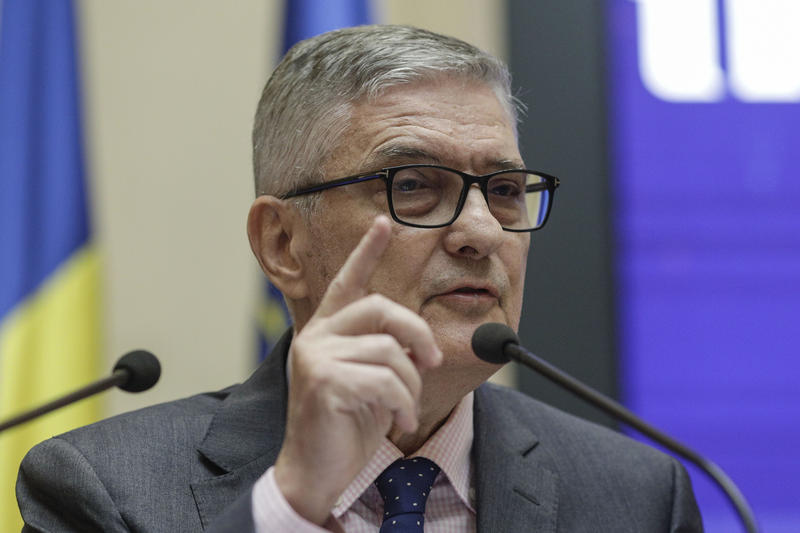
The President of the Fiscal Council, Daniel Daianu, claims that it is not right to block the budget debate for one billion lei, given that people are suffering and we have the impact of the war in the Middle East.
“Look at this dispute regarding the budget. You blocked Romania's budget for a billion lei. For a billion lei! I don't want to offend them, but when you have wars, when people suffer, when you have the impact of this war in the Middle East, we flex our muscles in the corridors and in the disputes regarding the adoption of the budget. It's not right”, said Daniel Dăianu, at the debate on his work “Crises and the authoritarian temptation”.
He also noted that the deadlock was incomprehensible because the dispute involved a small amount.
“Unfortunately, we live in the times. Even democratic governments, with enlightened people, cannot deliver basic public goods. And out of desperation, people can throw themselves into the arms of sovereignists, populists. This coalition should not be dissolved very easily. I was referring to a blockage that is incomprehensible. If it was a blockage of 10 billion, 15 billion lei, that is 0.7-0.8% of GDP, I would have understood. But not when it's about a billion lei. And that's incomprehensible,” Dăianu said.
He recalled that numerous meetings with foreign investors had taken place in recent days. “We, from the Fiscal Council, and colleagues from the BNR have these meetings. And there are two essential questions: Will the fiscal-budgetary consolidation continue? And two, will you remain stuck? That is, will you have political stability?” said the head of the Fiscal Council.
Academician and former finance minister, Dăianua touched upon problems that humanity faces in his speech, warning that the global disorder is not an accident of history, but the logical consequence of decades of illusions.
The diagnosis he proposes is that we live in a time of profound disorder, and its roots run deeper than any election cycle. The conflict between liberalism and illiberalism, which President Biden invokes as a mere narrative framework, is real. But finding it does not mean understanding it.
“Biden said the world is moved by the great confrontation between liberalism and illiberalism. That's true. That was a finding. But we have to think about the roots.”
THE ASCENSION OF CHAOS
Daianu cited a series of works—Robert Kaplan, Barbara F. Walter, Albert Hirschman, Paul Kennedy—to illustrate a reality that the European political class continues to underestimate. The return of protectionism, the rise of autocracies, the fragmentation of the multilateral order: all these are not isolated phenomena, but the symptoms of an international system that has exhausted its operating premises.
China is central to his analysis. Unlike Japan in the 1980s, which frightened America without fundamentally shaking it, China represents an entirely different scale of challenge.
“China is not the Japan of 40 years ago. That Japan Inc. China is 10 times Japan. It is overwhelming. It is invasive in what it produces. And that is why it scared the Americans.”
And DeepSeek's entry into the artificial intelligence market—a technological breakthrough achieved with tiny resources over American rivals—confirmed an older fear: that the West's technological supremacy is neither guaranteed nor irreversible.
When people do not understand what is happening and leaders do not explain in time, the ground becomes fertile for demagogues
One of the analytical threads that Dăianu consistently follows is the connection between the social fracture produced by globalization and the rise of populism. Globalization has produced visible winners and invisible losers. When the latter became sufficiently numerous, the phenomenon was seen at the polls.
“This globalization has led to great social fractures. Both in Britain and in the United States. These losers have seen themselves at the polls, unfortunately. Citizens have seen that governments, especially in times of crisis, cannot deliver.”
Dăianu does not accuse the establishment as a whole, but admits that it also has legitimate roles, that it has also made mistakes, and that responsibility for the failure to deliver public goods. But, states the head of the Fiscal Council, when people do not understand what is happening to them and why, and leaders do not explain in time, the ground becomes fertile for demagogues.
Democracy: a mechanism, not a promise
Daianu rejects both naive idealism and relativistic cynicism. The essence of democracy, he says, is not voting. It is the separation of powers—what Galbraith called “the countervailing power.”
“A strong leader does not equal a “loose cannon” (an unpredictable person – n.ed). A man who cannot be controlled, that he does anything. In a democracy, you have checks and balances. You have counterbalancing forces. That's how democracy works.”
This perspective puts him at odds with a certain theory — peddled by Indian university professors, among others — that citizens are interested in economic outcomes, not institutional mechanisms. Daianu accepts that the argument has an apparent coherence. But it rejects it, because it omits the very preventive function of democracy: to stop deviations before they become irreversible.
Rculture war and the danger of discreet fascism
Dăianu explicitly distances himself from the woke currents that he considers responsible, through their aggressiveness, for a fully predictable conservative reaction. But he distances himself even more firmly from the wing of conservatism that is sliding towards ethno-nationalism.
“I'm breaking with them because they're current in the world of conservatives who actually have fascist leanings. They talk about superior races versus inferior races. It's very bad. Because such tendencies led to World War II.”
Immigration, another sensitive topic, receives an unusually direct treatment from Dăianu. He supports immigration as a democratic principle. But uncontrolled immigration, he argues, has exactly the opposite effect: it closes doors and fuels backlash. Brexit, he says, was also rooted in this matter.
Europe is squeezed between America and China, weak for lack of real integration,
Dăianu's European diagnosis is grim. Europe is, in his view, crushed between America and China, weak for lack of real integration, vulnerable to internal sovereignist movements. Without a defense community anchored in deeper integration, Europe will remain dependent on Washington — a Washington that, under any administration, has less and less patience for allies who do not invest.
“If Europe does not have deeper integration, does not create a defense community that relies on deeper integration, it will not have a defense force”