A high-ranking Russian security general and his son stand to gain from blocking popular apps like Telegram and WhatsApp. The conclusion appears in an investigation by Russian journalist Andrei Zakharov, who claims that the family is linked to a company that supplies equipment used to filter Internet traffic and monitor users.
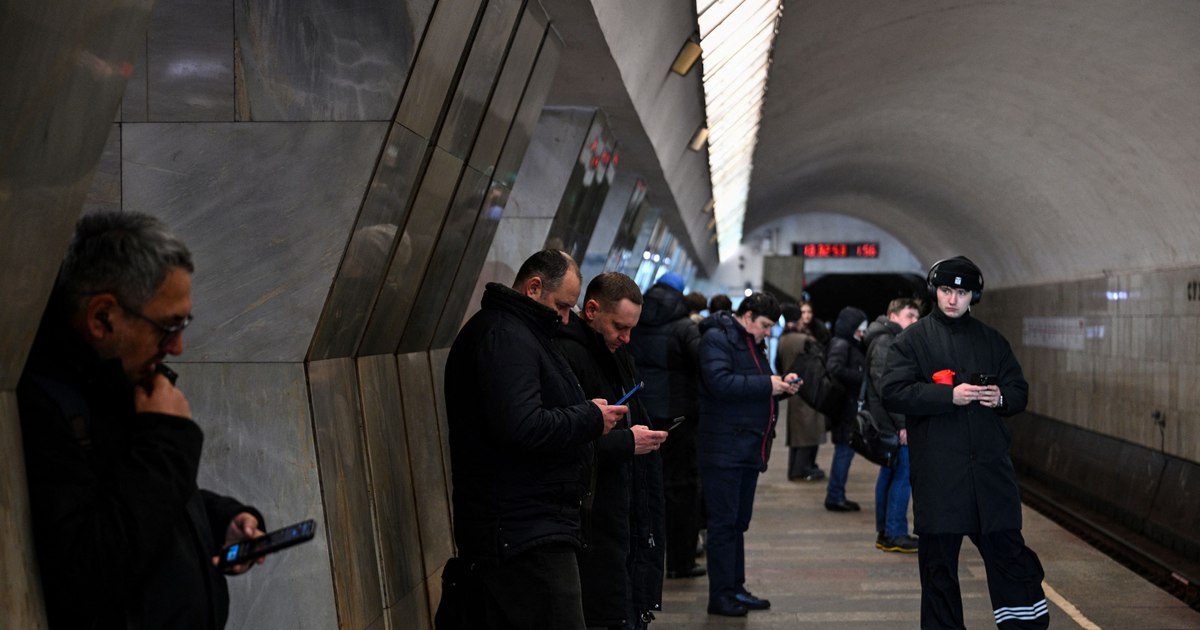
Russians using their phones while waiting for the subway PHOTO AFP
According to the investigation, the son of an important official of the Russian security services works in the management of the technological holding company IKS Holding – involved in the delivery of online traffic control systems – and he could also hold a stake in the company, writes Meduza.io.
The system by which the state controls online traffic
The structures of the holding provide equipment for the complexes called TSPU – “technical means of countering threats”. According to Russian law, these systems must be installed in the networks of all telecommunications operators.
Through them, the regulatory authority Roskomnadzor can control Internet traffic in Russia. Telecom operators do not have direct access to these systems or the ability to intervene on them, which is why many describe them as a “black box”.
The software component of the systems is provided by structures of the Rostelecom company, while the hardware part is produced by the Yadro company, which is part of IKS Holding.
The son of an FSB general in the management of the company
According to the documents analyzed by Zakharov, the position of deputy director within the holding is held by 29-year-old Boris Korolev. He is the son of the first deputy director of the FSB, General Sergei Korolev.
The journalist claims that Boris Korolev joined the management of the company in September 2023, when he was only 27 years old. At that time, the holding company's revenues exceeded 163 billion rubles, and in 2024 it would exceed 260 billion rubles.
The shadow of an influential billionaire
The holding company was founded by tech entrepreneur Anton Cerepennikov, also known as a former professional esports player. Officially, the company belonged to him for a long time, but for years there were speculations on the market that the real beneficiary was the billionaire Alisher Usmanov.
In July 2023, Cerepennikov died at the age of 40. His death fueled numerous theories, but Zakharov claims that the most likely cause would have been an overdose of xenon. The entrepreneur was passionate about the so-called xenonotherapy – procedures in which the patient inhales a mixture of oxygen and xenon.
After his death, the shares of the holding company were redistributed among the companies in the group. Some of them ended up at the Garda company, in which Boris Korolev would have owned about 20%.
However, the holding's financial data is largely classified, although the company is considered one of the largest IT firms in Russia, making it difficult to verify the current ownership structure.
Properties worth hundreds of millions
The investigation suggests that Boris Korolev's stake may actually be an asset of his father's. Zakharov states that General Sergei Korolev would have transferred several valuable assets to his son's name in the past.
For example, in 2014, when Boris Korolev was 18 years old, an apartment in the center of Saint Petersburg was registered in his name. A year later, he allegedly became the owner of a house in a residential complex near Moscow.
An apartment of approximately 200 square meters in the Russian capital would also have been registered in the name of a niece of the general. The total value of these properties is estimated by journalists at about 300 million rubles.
The family also owns a fleet of Porsche and Mercedes-Benz cars, valued at around 30 million rubles.
Zakharov claims that, at the time of the purchase of these goods, there were no legal sources of income to justify such expenses.
Profit from blocking the internet
Exactly how much the Korolev family would earn from these systems is difficult to estimate, as Russian authorities do not release all data related to the program.
However, according to available information, the Russian state would have allocated at least 80 billion rubles for the installation of TSPU systems – the infrastructure that allows the control and filtering of Internet traffic in Russia.