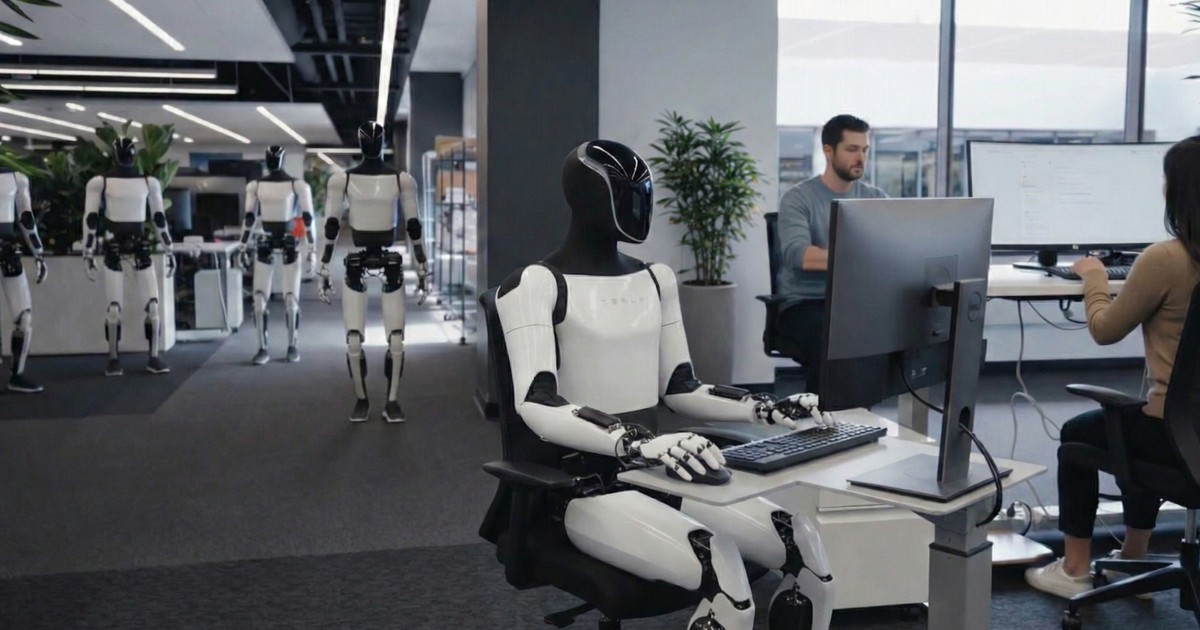
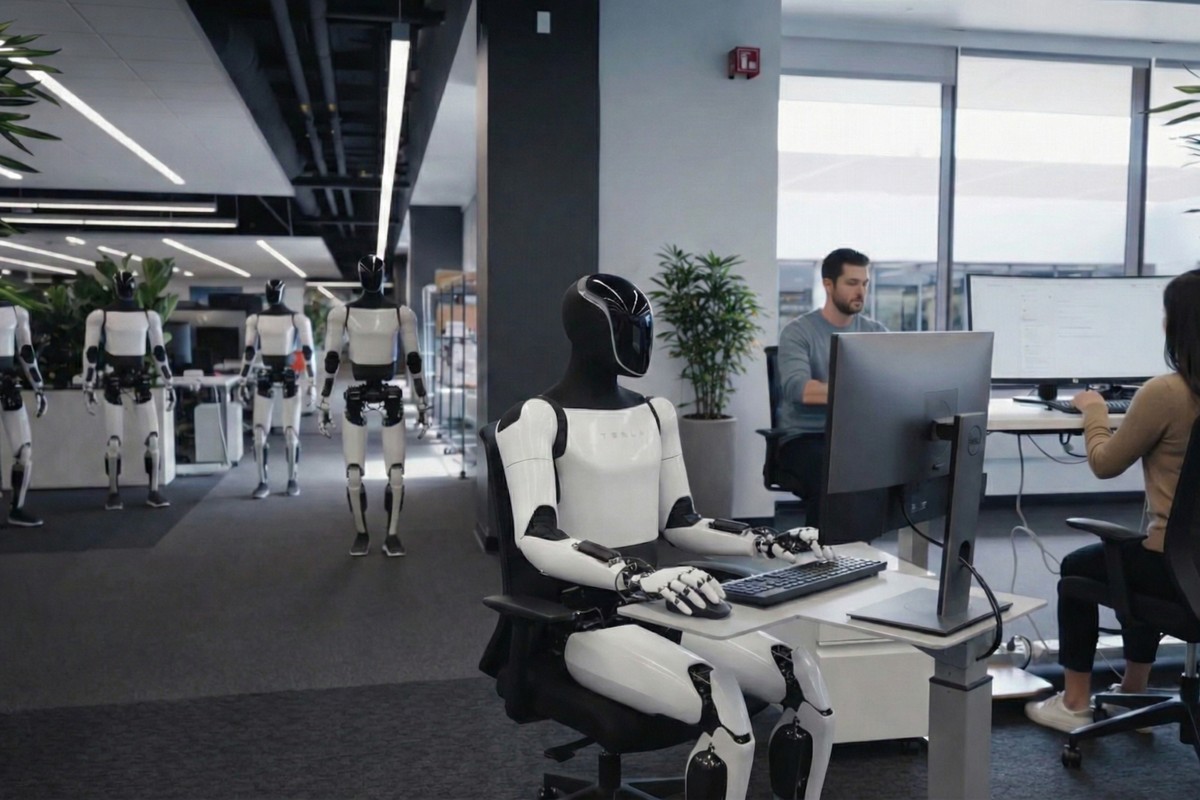
In the coming times, we will see a dynamic acceleration in the development of the so-called AI agents, i.e. bots, which are delegated to perform specialized tasks and are able, based on a simple command, to independently go through the next steps of even the most complex processes.
Until now, this type of work, consisting of a number of unique activities and interdependent stages, required human participation. Even if not constantly, achieving full automation at least for most tasks was simply impossible. The development of artificial intelligence has led to a change in this paradigm, and more and more companies are starting to take it into account in their short and long-term strategies.
An extensive report on this matter, prepared by Citi Group specialists, leaves no major doubts – it is only a matter of time before human workers are pushed out by AI.
In a situation where, in addition to agents, we also include humanoid robots capable of performing more manual work, the labor market will undergo drastic changes in the coming years and months, not so much in the decades but in the coming years and months.
Rob Garlick, who heads the team preparing the report and is no longer associated with Citi, in an interview with CNBC commented in an interesting way on the upcoming earthquake and clearly indicated the reason why it is inevitable: – We base our leadership systems in economic and business categories on glorification of profitability.
This leads us in an obvious direction – in companies, everything is focused on reducing costs while increasing revenues. Garlick added: “When we combine profitability with technological progress, we are on the verge of the greatest transformation in history. It comes down to the fact that artificial intelligence will be able to do more and more, better and cheaper, until it will finally be able to replace humans.
See also: Bezos and other billionaires are rearranging the world. Computers only for selected people
A soulless worker and soulless mathematics
This is a sentiment shared by most market analysts, but the raw numbers are much more interesting in this case. Citi's report states that by 2035, the number of robots equipped with AI and capable of performing a variety of jobs – from warehouses to cleaning to driving – is expected to exceed 1.3 billion units globally. By 2050, there will be 4 billion robots… and it should be remembered that we are only talking about physical machines. The emergence of digital agents further disrupts the entire dynamic, and of course to the detriment of people.
Even in simple economic terms, replacing physical workers with people turns out to be very profitable. Assuming that an average, beginner warehouse employee in Poland earns the lowest national salary, i.e. PLN 4,806 gross, and is able to handle one eight-hour shift, the monthly cost for the employer who wants the warehouse to operate 24 hours a day is around PLN 20,000. Humanoid robots designed to replace such an employee, for example Tesla Optimus, are expected to cost approximately PLN 80,000 in mass production. This would realistically mean a return on investment in about four months from “hiring” the robot.
Citi specialists, conducting similar calculations, but in terms of the American market operating at slightly different rates, indicated that, depending on the machine model, profitability for the company could be achieved even after four weeks, and in an extremely “unfavorable scenario” – after five months.
Referring to this issue in a recent conversation, Garlick said: – You can already buy humanoids today, with a payback period of less than 10 weeks compared to full-time employees. People can't compete with that.
The big tech dance continues
The mentioned AI agents, i.e. digital “employees”, are even more profitable for companies in this respect. Although their integration with company systems involves significant risks, it is impossible to predict clearly at this stage long-term consequences for the quality of services provided in this way and products created, other entities are more and more willing to invest in it. OpenAI, Anthropic and Google are well aware of these trends and are strongly developing projects regarding agents – both those intended for enterprises and those used by an average user, e.g. while browsing the Internet.
Just a dozen or so days ago, Sam Altman and company hired Peter Steinberger, the creator of the extremely popular AI agent – OpenClaw, and placed him at the top of the unit that is to develop further specialized bots capable of taking over entire processes. A new generation of agents is only a matter of time, but the game is worth the candle – currently this market is valued at between USD 5 and 8 billion, but by 2030, it is expected to reach a valuation 10 times higherand the high growth dynamics is expected to be maintained also in the coming years.
The cost of an AI agent, depending on its complexity, can vary greatly – there are solutions that cost $1,000 and those that cost over $100,000 to implement the entire system. However, regardless of which extreme we are talking about, the final cost in terms of employing a person or even a team needed to take care of the entire process – works to the agent's advantage.
A work colleague who doesn't exist
Some companies are already placing great emphasis on AI agents and see them as the foundation for their future employment structure. McKinsey & Company, a leading American strategic consulting company, through Bob Sternfels, chairman of the supervisory board, openly admitted that it already employs 20,000 AI agents… with 40,000 people employed. IN In the next 18 months, i.e. by mid-2028, the proportions are expected to become equal. The next quarters will most likely mean a gradually growing advantage of artificial intelligence and a change in the “balance of power”. As Sternfels pointed out in the interview: – Just over a year ago – there were only 3,000 agents. Initially, I assumed that it would take us until 2030 to reach the ratio of “one agent” to “one person”… but now I believe that we will get there within 18 months.
Although the trend visible here seems clear, in a message sent to the Business Insider Polska editorial office after the publication of the material, representatives of the company's Polish branch claim: – McKinsey & Company does not replace employees with AI agents nor does it plan to equalize the number of employees with the number of solutions based on artificial intelligence.
In recent months, the following companies have decided to significantly reduce human employment and delegate tasks and processes to AI: IBM, Klarna or HP. Although in many cases such changes were carried out without appropriate preparation and turned out not to bring the expected results, the market trend seems obvious here. Mainly because of what's going on here simple, mathematical relationshipssimilar to those we discussed in the previous paragraphs regarding the return on investment in a humanoid robot.
Enchanted by artificial intelligence
Although currently an ever-growing bubble, it will most likely burst eventually and many companies with ambitious plans related to AI will be forced to revise their strategies (according to Gartner research – up to 50% of enterprises will face this by 2027), the changes will continue.
Rob Garlic, in the above-mentioned interview with CNBC, also clearly indicated that the state in which – not in individual companies, but globally – work will be performed by more robots and agents than people, is not too distant: – In the next few decades, we will reach a point where the number of working robots will exceed the working population. And when you include agents – especially the smaller ones – we are in for real earthquakes.
The conclusions from the new report published by The Citrini Research, which shocked both Wall Street and the Polish Stock Exchange, are in a similar tone. The dark scenario of the future of the labor market and failing companies and sectors being entirely replaced by AI, outlined there, aroused so much concern that the stock prices of many software development companies immediately dropped. Although these are only predictions, the trajectory of changes and the recent drastic drop in IBM's share price due to announcements from Anthropic show that they are not completely detached from reality. If this is realized, the authors of the report predict that we may face a situation similar to the crash in 2008.