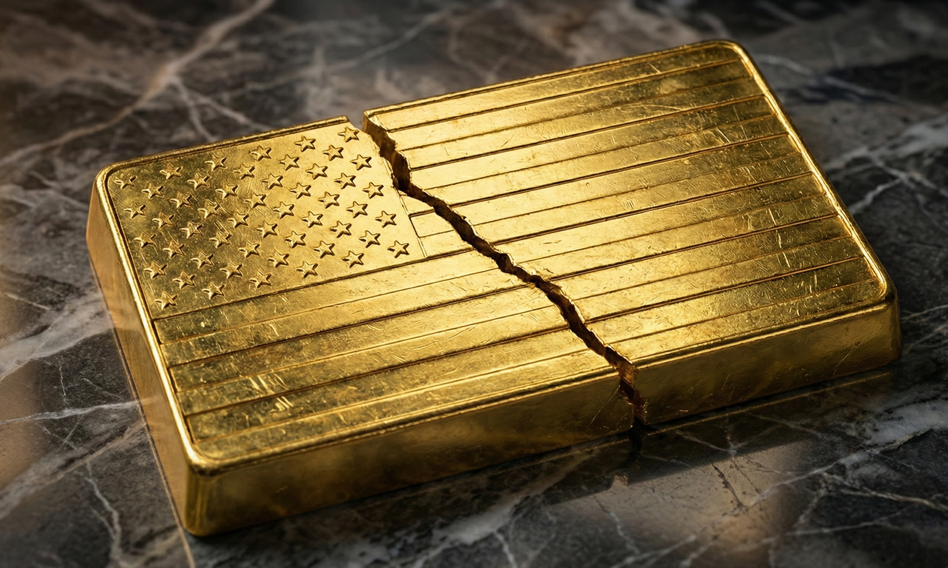
Gold is losing because of the war in the Middle East. The gold price breaks the psychological barrier of USD 5,000 down


publication
2026-03-16 10:58
update
2026-03-16 11:14
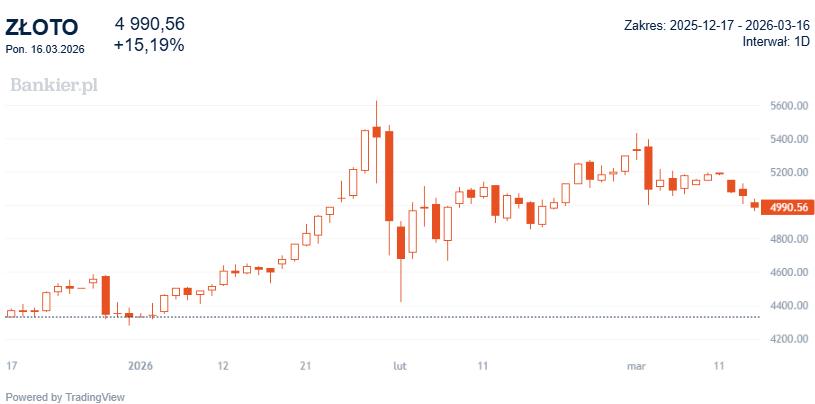
For the first time in over three weeks, the price of gold fell below USD 5,000 per ounce, continuing the downward trend caused by the escalation of the conflict in the Middle East. Although this metal is traditionally considered a “safe haven”, the current geopolitical situation has paradoxically strengthened the dollar, pushing gold and silver to multi-week lows.
The last sessions on the precious metals market were marked by a sell-off. In the first session of March, when financial markets were reacting to the first strike of the United States and Israel against Iran, the price of gold rose to USD 5,433 per ounce.classically serving as a safe haven for capital in times of geopolitical uncertainty. On the same day, gold was already $100 cheaper. The declines continued in the following days of the conflict in the Middle East.
Gold below $5,000
As a result, gold experienced two weeks of declines in a row for the first time since November last year and for the second time in over half a year. In the first week of March, the gold price lost 2.1% and in the second week – 2.6%. The third week of March also started with declines. Even more significant because for the first time in almost a month gold is priced below $5,000 per ounce. Since the peak in January, the correction is already over 11%, although the rate of return since the beginning of the year is still 15%.
Has the safe haven function ceased to fulfill its role if, despite the exchange of fire in the Middle East, gold stopped growing and even began to decline? It is impossible to hide the correlation of the current declines with the war between the USA, Israel and Iranwhich is already in its third week. The attacks on Iran caused a sharp increase in the prices of energy resources, mainly oil, but also gas and coal.
Advertisement
Rates and the dollar are hurting gold prices
Gold is not benefiting from the geopolitical crisis as one might expect because the market is afraid of central banks' reaction to the growing inflation risk resulting from higher energy prices. “Finally, as oil and gas prices rise significantly this week, so does the risk of inflation. This could force central banks to take countermeasures,” wrote Barbara Lambrecht, a commodities analyst at Commerzbank Research.
To understand the current declines, you need to look at the market fundamentals for what they are inverse correlation of gold with the dollar and US treasury bond yields, which means that when the dollar becomes more expensive, the price of gold falls. This relationship was clearly visible while the dollar was losing value, supporting the increase in the price of the precious metal. Gold earns no interest or dividendsTherefore, when US bond yields rise, investors prefer to invest their capital in “safe” Treasury debt rather than in precious metals.
Lower interest rates of the American Federal Reserve, which mainly determine what happens on the dollar and bonds, would be beneficial for the metal,
Meanwhile, fears are growing that there will be no further cuts and that it may even be necessary to increase the cost of money. Standard & Poor's warns that the war may cause long-term supply shocks. In such an environment, the Fed will probably keep interest rates in the range of 3.50-3.75%, which is a negative scenario for gold.
Precious metals under pressure
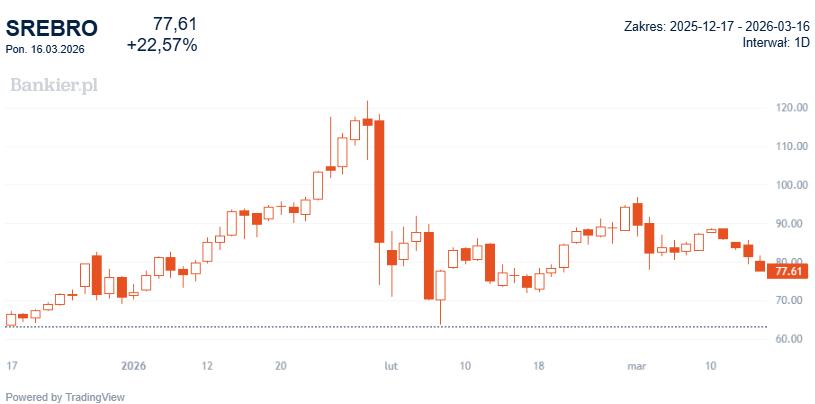
Situation on the silver market is even more difficult. The price of this metal dropped below $80 per ounce. Silver, being also a metal with extensive industrial usereacts more nervously to signals of economic slowdown. The latest data from the US paint a disturbing picture. GDP for the fourth quarter of 2025 was revised down to just 0.7%.
Gold and other precious metals are currently found in the classical period “strong dollar” trap. Although the fundamentals for growth, such as market uncertainty and war, should support gold prices, their pro-inflation consequences keep prices under pressure. Investors are anxiously awaiting the decisions of the most important central bankswhich abounds in the third week of March around the world. We face decisions from the Fed, the ECB and the central banks of England, Japan and China.
The publication contains affiliate links.