

“Paper bitcoin” on the Polish stock exchange or just bitcoin? In today's notes, Janusz Krypto discusses the cryptocurrency ETP instruments available on the WSE. How do they differ from “physical” bitcoins, how much does it all cost and how much can you lose on it? Why are IKE and IKZE the strongest weapons in the fight against the tax office? We invite you to the report: physicist or fund.
I was sitting at my desk, looking through the list of ETFs available at my brokerage on my computer. I was moving the cursor over subsequent pages and suddenly, somewhere under Vanguard FTSE Emerging Markets UCITS, the ticker VIRBTCP caught my eye. I wiped my glasses – Virtune Bitcoin Prime ETN and on the WSE. And then I came across the Beta Bitcoin ETF. – Well, you're in luck – I thought – bitcoin, which was recently associated with IT specialists' basements, has found its place in paper form on the Warsaw trading floor, next to KGHM and Orlen.
Paweł, my nephew, said they were products for boomers. Well, I am one of them, so I decided to find out what it is. Immediately – perhaps for the future or for your benefit, I checked whether, purely theoretically, it is more profitable to have bitcoin “in hand” in your own wallet, or maybe the whole “paper bitcoin” in a brokerage account is a better deal. I'm talking about costs, profits and risks, not ideologies or being your own bank.
I looked through a pile of reports, counted the costs and asked a friendly expert for his opinion. Please check out my audit:
Bitcoin ETF and ETP, or what are you actually buying?
The “fun” with bitcoin on the Warsaw Stock Exchange began in September 2025, when the Beta ETF Bitcoin officially registered on the WSE. Quite recently, in February 2026, it was joined by a newcomer from Sweden, Virtune, with four ETP products based on bitcoin, ethereum, solan and XRP.
However, don't be fooled by similar labels. These are two completely different structures. To clearly show you the difference between the Beta ETF product and the Virtune bitcoin product, I made a small table:
|
WHAT? |
Bitcoin ETF Beta (ETFBTCPL) |
Virtune Bitcoin Prime ETN (ETNVIRBTCP) |
|
Date of debut on the WSE |
September 16, 2025 |
February 25, 2026 |
|
Replication method |
synthetic (CME futures) |
physical (spot) |
|
Currency hedging |
yes (PLN/USD hedging) |
none (exposure to USD) |
|
Management fee |
0.70% |
0.25% |
|
Total Cost Ratio (TER) |
1.16% |
approx. 0.25% |
|
Fluidity (Animator) |
mBank Brokerage House / Agio |
Raiffeisen Bank International AG |
|
Legal form |
Closed-End Investment Fund (FIZ) |
Exchange Traded Note |
So we see that although both brands supposedly deliver the same thing, they have completely different engines.
- Bitcoin ETF Beta (ETFBTCPL) is a closed-end investment fund that uses synthetic replication. More specifically, it is based on the Bitcoin futures contract listed on the Chicago Mercantile Exchange (CME). He doesn't own a single real bitcoin. Instead, it uses a bitcoin futures contract listed on the Chicago Mercantile Exchange (CME). The advantage is the “hedging” fund, which protects us against dollar exchange rate fluctuations.
- Virtune Bitcoin Prime ETN (VIRBTCP) this is the so-called note using physical replication. The issuer declares that for every PLN 100 you spend, it buys real Bitcoins and locks them in a vault. However, there is no protection against currency risk here. If the Polish zloty strengthens, your profit may decrease even if bitcoin increases.
As you will see in a moment, the form of both packages of exposure to bitcoin is very important for the costs and potential profits or losses of the investor.
Why is the rate of return on BTC ETFs different than that of bitcoin?
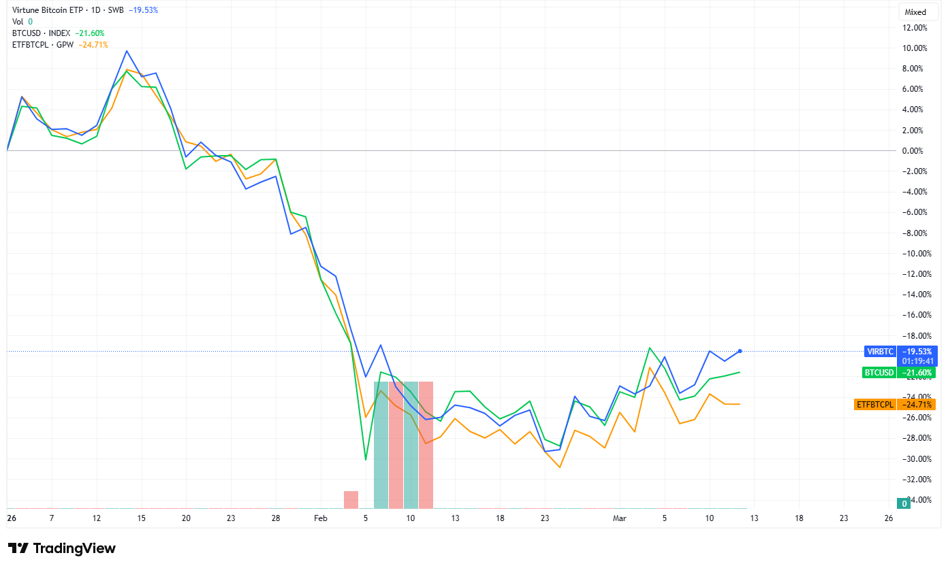
From the beginning of 2026 to March 12, physical bitcoin lost approximately 21.6%. At the same time, the Beta ETF Bitcoin on the WSE dropped by almost 24.7%.
Why this difference? This may include, among others: contango effect – a hidden saboteur of profits in contract-based funds. Contracts expire and the fund has to buy new, usually more expensive ones. This “rollover” costs money, and investors feel the cost. “Physical” bitcoin does not have this problem – 1 BTC is always 1 BTC.
Of course, this stick has two ends and the opposite may also happen – when the “rolled” contract is cheaper, we can talk about “backwardation” – and then the impact on the ETF's results is positive.
You may ask how much has Virtune Bitcoin Prime ETN lost since January 1? In this case, I had to use data from the Stuttgart Stock Exchange, because, as you know, this product appeared on the WSE only at the end of February. Since the beginning of the year, VIRBTC has lost approximately 19.5%. So it performed better than bitcoin.
If you look at the chart below, you will see that over the last 3 months there have been many situations when both the ETP from Virtune and the ETF from BETA have lost less than the king of cryptocurrencies himself. Let us agree, however, that in all three cases the trend was definitely downward.
What is more profitable? Cost of buying bitcoin vs. cost of a bitcoin ETF
Let's assume that we have PLN 10,000, we want to spend it on bitcoin exposure and we don't care what it will be.
When purchasing “physical” bitcoin, you pay:
- commission on the cryptocurrency exchange (for those from the most trusted category it is approximately 0.1%),
- if you want to withdraw bitcoin from an exchange (at the largest ones such as Binance and Kraken, it costs approximately USD 1 regardless of the amount withdrawn)
- if he wants to buy a hardware wallet and keep the withdrawn bitcoins there (I've seen such toys on the Internet starting from PLN 200)
When purchasing BTC for PLN 10,000, we have a PLN 10 fee on the exchange + possibly PLN 3.7 for withdrawal + possibly PLN 200 for our wallet = PLN 213.7 (assuming that you are your own ship and sailor). That's all.
When purchasing ETP for bitcoin on the WSE, you pay:
- management fee – TER, i.e. the total expense ratio in the case of Beta ETF is approximately 1.16%. annually. Virtune is cheaper: 0.25 percent.
- transaction fee. Although many offices (BOŚ, mBank, Santander) charge 0% interest forever or on promotion. commission on transactions on ETP instruments on IKE and IKZE accounts, at the same time they usually exclude cryptocurrency products. There is also XTB, where no commission is paid if your monthly turnover is less than EUR 100,000. Without such promotions, the minimum fee will be 0.29%. on the transaction value.
- currency conversion? Let's forget – we are talking about instruments listed on the WSE.
When purchasing for PLN 10,000, in the case of ETFBTCPL (a product from BETA ETF), we will pay annually up to PLN 116, and when purchasing VIRBTCP (a product from Virtune) PLN 25. If the commission was not avoided (let's take the 0.29%), we will add PLN 29.
Availability of IKE/IKZE – the greatest benefit of Bitcoin ETFs?
This is the only moment when Janusz the auditor allows the thought of buying “paper”. No Belka tax. If you buy physical Bitcoin and, God forbid, sell it at a profit, the tax office will take 19% of this profit. Always.
However, if you buy an ETF within IKE (limit PLN 28,260 in 2026), after the age of 60, you pocket the entire profit. In the case of IKZE (limit PLN 11,304), you deduct the payment from your PIT. If you are in the second tax bracket, the state will give you a refund of over PLN 3,300. This is free money that you can immediately invest in subsequent units.
Artur Wiśniewski from the StockBroker.pl blog compared a bitcoin wallet without a management fee but paying Belka tax with an IKE wallet that collects 2% of the annual fee but does not pay 19% at the end. tax. Artur examined the last dozen or so years, sorting them into 5-year cycles, and the result leaves no doubt – IKE wins in every scenario. By using it, you save your wallet by an average of 18%. thicker, and in record periods even by 21%. than when you have to pay capital gains tax. Mathematics doesn't lie – tribute to the state hurts more than the fund's commission.
From an expert's perspective
I wouldn't be myself if I didn't confront these paper revelations with the opinion of someone who knows this topic perfectly. I dialed prof. Aleksander Mercik and I asked him whether, from the point of view of portfolio strategy, ETF is a full-fledged substitute for bitcoin for someone who only wants to profit from the price increase or balance their portfolio. What does he think I gain and what do I lose?
Speaking of freedom, the last point in my audit is accessibility. Bitcoin trades 24 hours a day, 7 days a week. The WSE is open from 9:00 a.m. to 5:00 p.m. If nukes start exploding over Tehran on Saturday evening and bitcoin falls by 30%. You, as an ETF holder, can only look at the closed terminal and wait until Monday. A physical holder can sell his coins in 5 seconds, at any time of the day or night – whether this is good or bad probably depends on the situation.
Final verdict
After going through a lot of data and reports and asking Prof. for directions. Mercik, I close the minutes with the following conclusions:
- A Bitcoin ETF or ETP makes the most sense for retirement savers. In this case, choose Virtune if you count on low costs and a more faithful representation of the BTC (TER) exchange rate, or Beta ETF if you are afraid that the strengthening of the zloty will eat into your profit.
- Bitcoins for your own account will work well for those independent people who like to keep their finger on the pulse. You buy BTC (in the next episodes I will tell you how to do it) and you don't care about the exchange opening hours, the condition of the issuer and management fees.
- a regular brokerage account is convenient due to PIT-8C, but remember – you then pay fees for the fund and tax for the state.
- Bitcoin is a highly volatile asset. If you don't know how to deal with it (like me at this point), don't invest in this market.
Your Janusz,
In the photo titled: a crowd of traders bidding on contracts for agricultural goods – USA in the 1930s.


