publication
2026-03-11 13:30
February's CPI inflation was well in line with economists' expectations, while core inflation remained at the lowest level in 5 years. But that doesn't matter anymore. We know that the March reading will be much higher than the February reading.
In February 2026, CPI inflation in the USA was 2.4% – reported the government Bureau of Labor Statistics (BLS). This result is consistent with economists' expectations and the same as in January, when the annual rate of consumer inflation in America was the lowest since May. Also, the forecast model of the Clevleand Fed assumed a February CPI increase of 2.41% y/y (and 0.25% m/m).
However, in December consumer inflation in the US was 2.7%, after it decreased sensationally in November to 2.7% against the expected 3.0%. However, these are all still readings outside the Federal Reserve's 2 percent target. This state of affairs has been in force for exactly 5 years. The last time we saw a reading below 2% was in February 2021.
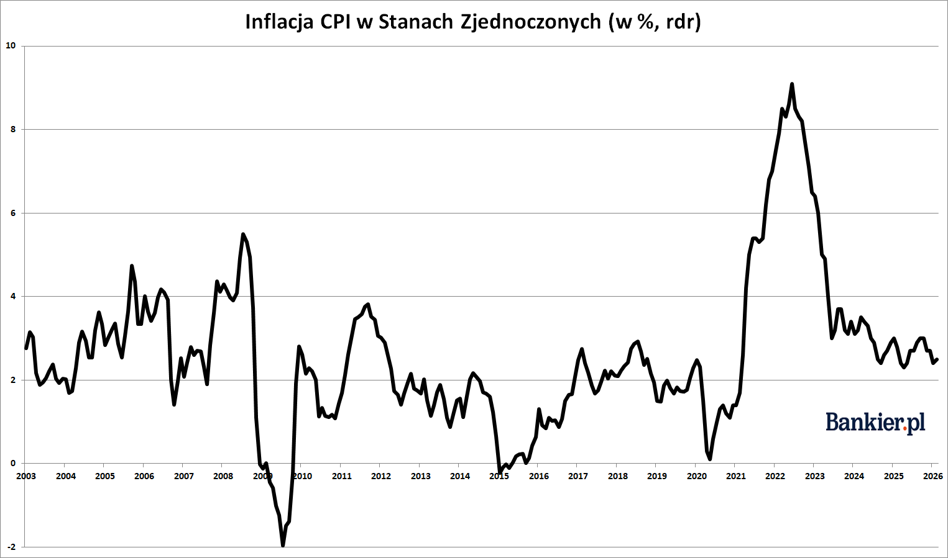
We have known since February 28 that the March CPI inflation in the United States will be significantly higher than the February one. This is, of course, the result of a sharp increase in fuel prices caused by the Israeli-American attack on Iran and the blocking of the Strait of Hormuz by that country. The Cleveland Fed model estimates March CPI inflation in the United States at 0.22% m/m and 2.61% y/y.
Advertisement
Inflation pressure in the US is still too strong
Compared to January, the CPI basket increased by 0.3% after an increase of 0.2% recorded a month earlier. The market consensus assumed an increase of 0.3% m/m. As a result, the 6-month moving average of monthly CPI dynamics remained virtually unchanged at 0.22%. If this momentum is maintained for the next 12 months, we would receive CPI inflation of 2.63% next year. That's still above the Federal Reserve's 2 percent target.
However, core inflation – i.e. CPI excluding food, fuel and energy – remained unchanged at 2.5% – the lowest level in almost 5 years. This result also turned out to be consistent with the market consensus. And higher than the Fed's inflation target.
Despite CPI inflation approaching 3%, a month ago the Federal Reserve not only reduced interest rates for the third time in a row, but also resumed the “money printing” program, announcing the purchase of Treasury bills for USD 40 billion per month. In total, in September, October and December, the FOMC cut rates by 75 basis points, despite CPI inflation rising and exceeding the 2 percent target.
The publication contains affiliate links.