The skies above Tehran are covered in thick smoke and black rain after Israeli attacks on oil storage facilities


After the Israeli attacks on Tehran's oil facilities, black oil rained down on the city of 10 million people, contaminating the drains to the point where they caught fire.
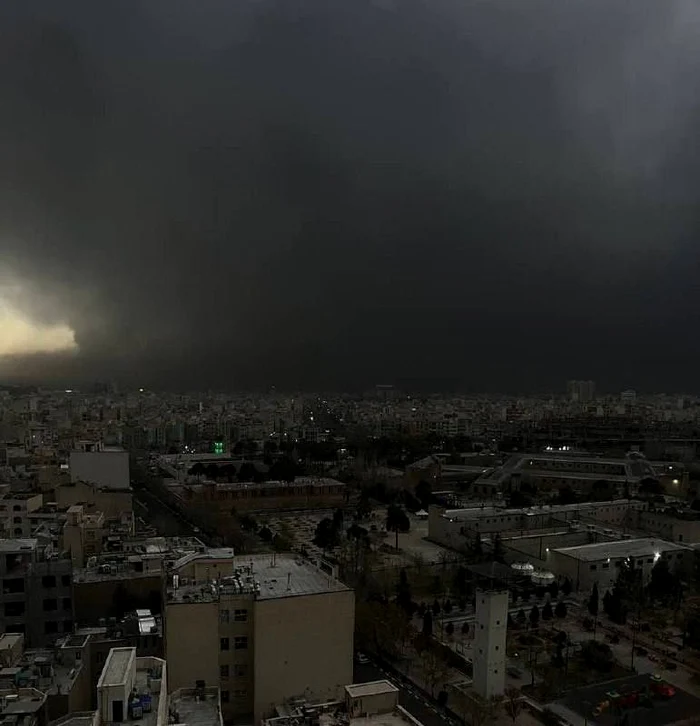
Tehran is drowning in smoke/FOTO:X
Over Iran's capital, Tehran, the sky turned into a thick blanket of smoke after Israeli airstrikes on oil depots. The nearly ten million inhabitants of the metropolis awoke under suffocating black clouds, and the rain that fell over the city was, according to witnesses, dark and laden with oil particles.
Reports by CNN journalists described thick columns of smoke rising from the area of the Sharan oil depot, located northeast of the capital, one of Iran's largest fuel storage centers. Even hours after the nighttime bombings, several tanks were still burning and the smell of burning oil wafted over the surrounding neighborhoods.
The rainwater that fell over the city turned black, saturated with oil residues – a phenomenon that meteorologists consider potentially dangerous to people's health. Aid officials from Iran's Red Crescent urged people to stay indoors even after the rain stopped, warning that the air could become dangerous to breathe.
Similar accounts were reported by Reuters, citing residents of the city: thick, suffocating smoke hung over Tehran after attacks on oil infrastructure.
Politically, the reactions were not long in coming. Iranian Foreign Ministry spokesman Esmail Baghaei described the operation as “a new dangerous phase” of the confrontation and a possible “war crime”. According to him, the strikes on the fuel depots would have released into the atmosphere toxic substances that threaten the civilian population and the environment.
On the other hand, the Israeli army claims that the targeted targets had a military role. Israel Defense Forces spokesman Lt. Col. Nadav Shoshani told reporters that the warehouses were used to produce and store fuel for ballistic missiles, which is why they were “legitimate military targets.”
Shortly after the attack, Israeli Prime Minister Benjamin Netanyahu announced that operations would continue. In a video message, he said his government has “an organized plan with many surprises” to weaken the regime in Tehran and bring about political change in Iran.
The airstrikes were launched on the night of March 7 against several oil targets in the Iranian capital and the neighboring city of Karaj. Explosions and fires lit up the night sky, and oil spilled into the city's sewage network reportedly even caused fires in some urban arteries, a sign that the industrial disaster had spread beyond the perimeter of the refineries and reached residential areas.
The next morning, the inhabitants of the capital woke up under a dome of black smoke – the image of a city that, overnight, went from the routine of a crowded metropolis to the harsh reality of an invisible front, where war is felt in the air that people breathe.