Who wins against smog? This is what it looks like in 16 cities [RANKING]

We would like to remind you of one of the most frequently read materials on Business Insider in 2025. The text was originally published in August.
In recent years, there has been a lot of talk in Poland about the need to improve air quality. Anti-smog programs, replacing heat sources with more ecological ones, investments in public transport and restrictions on industrial emissions were supposed to make the inhabitants of Polish cities breathe cleaner air.
At Business Insider, we checked what hard data says about the effects of these changes and air quality in Poland and translated it into charts and tables to indicate the winners and losers in the fight for the health of our lungs.
Read also in BUSINESS INSIDER
We took a closer look at the numbers collected by the Chief Inspectorate of Environmental Protection (GIEP). On this basis, we calculated the average values of PM10 suspended dust for each of the 16 provincial cities from all measuring stations located there. We performed such calculations for the first half of November 2025 (November 1-17) and the corresponding periods from 2015-2024. Similar calculations apply collectively to the entire country based on data from all over a hundred measuring stations in Poland (including not only provincial cities).
We took PM10 as a reference point for assessing air quality – it is harmful due to the content of carcinogenic heavy metals. It has a negative effect on the respiratory system. It is responsible for coughing attacks, wheezing, deterioration of the condition of people with asthma and acute, violent bronchitis.
See also: Is the state budget facing a disaster because of the Clean Air program? “We have a big problem”
Smog is becoming less and less troublesome. Air quality in Poland is improving
The standard average daily concentration according to the World Health Organization is 50 micrograms per cubic meter. During the period under study, averaging the results from all days, values close to this limit level appeared in individual cities until 2018. Later, it was clearly better.
It should be emphasized that data for the first half of November in particular years depend largely on the weather. In warmer periods, less intensive home heating resulted in lower pollution rates, and in colder periods – the opposite. But over 11 years there is a clear tendency to improve air quality.
The average for the entire country in the first half of November shows a decrease in the PM10 index from 47.44 micrograms per cubic meter. in 2015 to 25.20 in 2025. This almost halved in a decade.
Smog in cities. Where is the worst and best air quality?
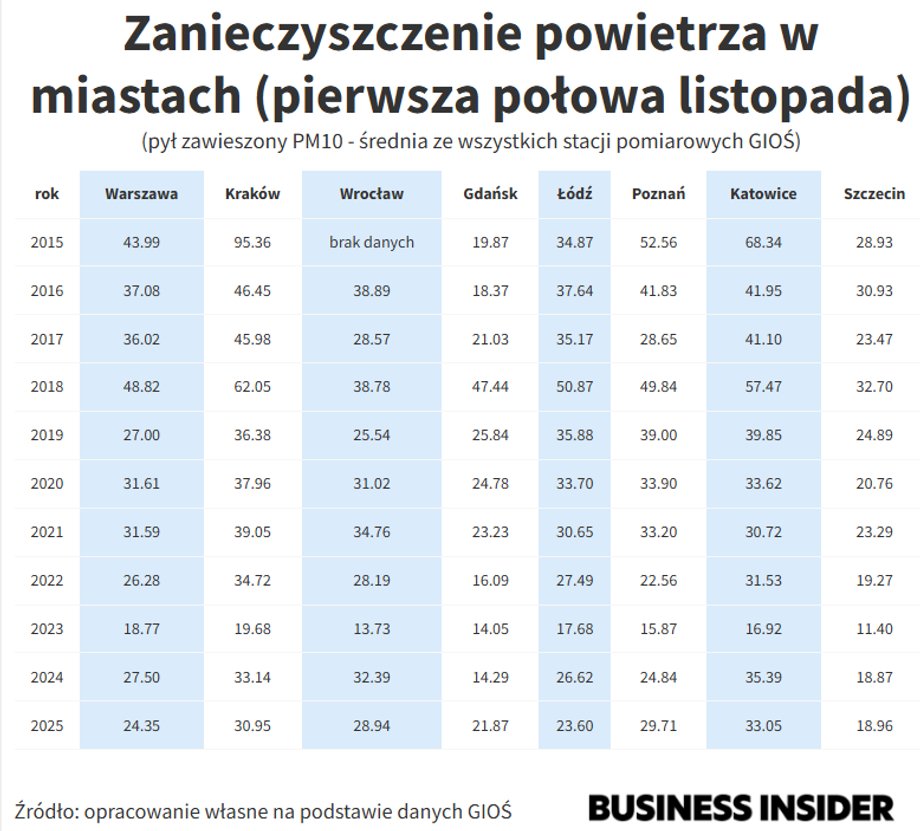
The highest concentrations of PM10 suspended dust in mid-November were in 2015–2018, when average daily values nationwide reached almost 50 micrograms per cubic meter. The situation was the worst in Kraków and Katowice. Bydgoszcz also sometimes surprised us negatively.
The capital of Małopolska deserves special attention, having recorded once in the last decade almost 100% exceeding the norm for PM10 suspended dust in the period studied by us. This happened in the first half of November 2015. At the same time, in Katowice, the levels reached almost 70 micrograms per cubic meter.
See also: Changes in the law are coming. The fight against smog will be more effective
What does it look like after 10 years? The highest PM10 values in recent weeks were also in Katowice (33.05), but these are much lower levels. Only Kraków had three ahead (30.95). Poznań took third place in terms of the worst air (29.71). These cities, located in areas with high population density and industrial history, still struggle with smog.
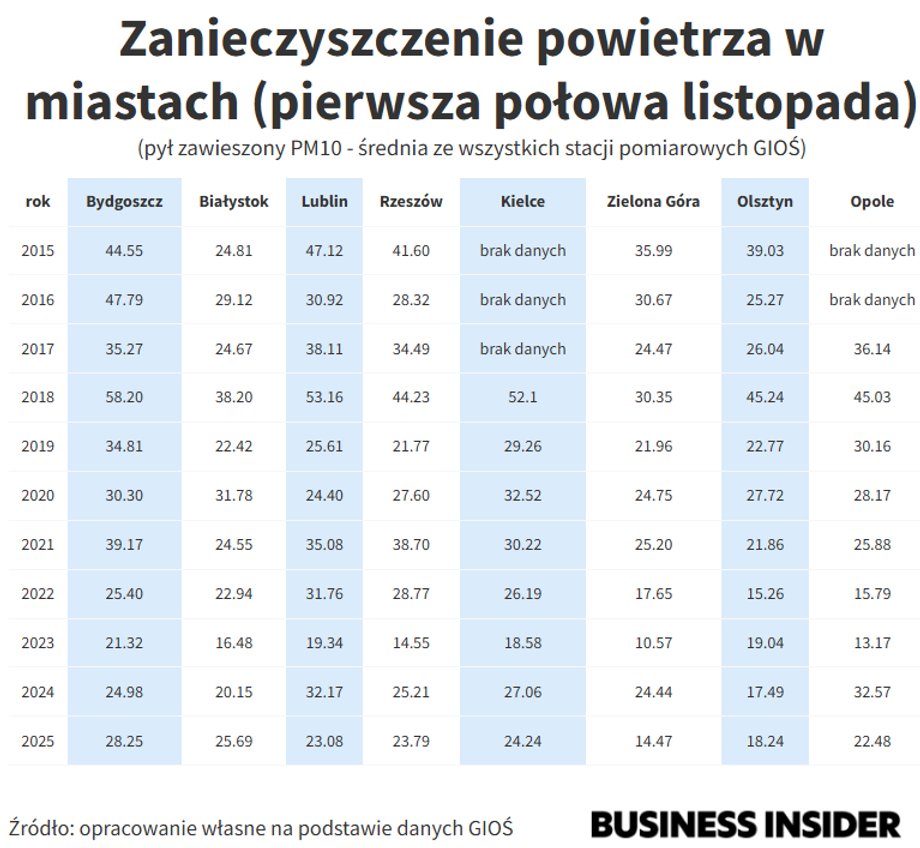
The World Health Organization recommends that the average annual concentration of PM10 should not exceed 20 micrograms per cubic meter. Recently, several provincial cities have met this condition. Zielona Góra (14.47), Olsztyn (18.24) and Szczecin (18.96) stood out with the lowest pollution value and the best air quality in the first half of November in 2025..
These locations regularly record lower dust concentrations, which may be the result of more favorable topography, lower car traffic, and a lower share of coal in local heating.
For example, Warsaw (24.35) was below the average for the country (25.20). Kielce has a similar result to the capital. On the “green” side (below the national average) there are also: Gdańsk, Opole, Lublin, Łódź and Rzeszów.
In terms of air pollution, in November also (apart from the previously mentioned worst three) were also: Wrocław, Bydgoszcz and Białystok.
Air quality in cities. Where is the biggest improvement?
Comparing the years 2015 and 2025, the greatest improvement can be seen in cities that had the biggest problems with air pollution a decade ago. Kraków is the leader in this statisticswhere the concentration of PM10 suspended dust dropped from 95.36 to 30.95 micrograms per cubic m, i.e. almost threefold. We observe a similar tendency in Katowice. They also recorded a high decline Lublin and Poznańalthough in these cities the fluctuations were greater in subsequent years.
Relatively the smallest progress in statistics can be seen in Szczecin and Łódź. Over a decade, the average PM10 content decreased by approximately 10 micrograms per cubic meter.
There are also two cities where GIOŚ data in the first half of November this year show worse air quality than in 2015. These are Białystok and Gdańsk.
Click on the table to open in a new window
|
Damian Słomski / Business Insider Polska
Click on the table to open in a new window
|
Damian Słomski / Business Insider Polska
Is smog still poisonous? CIEP assesses the air quality in Poland
A few months ago, the Chief Inspectorate of Environmental Protection (GIEP) presented an official report comprehensively summarizing the air quality assessment for 2024. For most types of pollutants, the results of the annual assessment are similar to those obtained for the previous year. At the same time, in the case of almost all pollutants, there can be a significant improvement compared to the assessment results obtained for 2022 and also for previous years.
“The assessment carried out for 2024 based on the criteria established to protect human health, in the case of sulfur dioxide, carbon monoxide, benzene and lead, cadmium and nickel contained in PM 10 suspended dust in all zones in the country, showed compliance with air quality standards“- we read in the CIEP report.
It also shows that the number of zones with exceedances of the average annual permissible level for nitrogen dioxide decreased from four in 2023 to two in 2024. The concentrations of this pollutant are lower, and the exceedances were local and occurred only in areas with intensive impact of road transport in the centers of large cities.
In turn, the number of zones in which benzo(a)pyrene was exceeded in PM 10 was the same as in 2023 (21 out of 46 zones). However, these results are much better than those obtained in previous years.
“However, air pollution with benzo(a)pyrene in suspended dust PM 10 is still a serious problem in Poland and requires further corrective actions“- emphasizes the Chief Inspectorate of Environmental Protection.
Author: Damian Słomski, journalist of Business Insider Polska