Europe is trying to get out of America's shadow – and is colliding with reality. Internal disputes brutally bring her down to earth


During Thursday's summit in Brussels, leaders are expected to sign an agreement on European support for Ukraine, defense spending and measures to increase Europe's competitiveness vis-à-vis the United States and China.
But while Europe is determined to take matters into its own hands after decades of relying on its friends across the Atlantic, it is not that simple.
The US president's criticism has convinced EU leaders that making progress on a stalled trade deal with Latin America – Mercosur – would be the best way to show their geopolitical clout in a region increasingly sought by China and the United States, but France and others remain adamant.
— The response to US allegations about the “collapse” of Europe, the response to the US national security strategy, the US trade agreement, the response to the actions of China, Russia and the growing transactionalism between the superpowers is Mercosur, a senior EU official told POLITICO.
Making a deal would require EU leaders to face up to deep-seated resistance in France — and growing doubts in Italy — where the entire political class has been hostile to the deal for years, fearing it could expose influential farmers to a flood of cheaper products from Latin America.
For supporters of the deal, closer ties with the Mercosur bloc, which includes Argentina, Brazil, Paraguay and Uruguay, is a key test of whether Paris really wants Europe to become independent after years of being the loudest advocate of European sovereignty.
'The agreement is starting to fall apart'
A group of governments led by Germany and Spain say it is time for France to back up its claims of sovereignty, warning that Paris's blockade of the Mercosur deal undermines Europe's push for independence.
These countries see Mercosur as an excellent opportunity for their companies to expand into new, similarly oriented markets – away from China and the United States.
“We are convinced that if an agreement cannot be reached this week, it will probably fail,” said a German government official. — We see that the agreement is already starting to fall apart.
His supporters warn that after years in which Paris has championed Europe's pursuit of “strategic autonomy”, it appears unable or unwilling to reconcile that ambition with its long-standing opposition to an agreement with Latin America.
For France, however, there is no contradiction here.
— For Paris, this position fits perfectly into its vision of “strategic autonomy”: the EU should do everything in its power to protect its producers and maintain its standards, notes Georgina Wright, a senior researcher specializing in relations between France, the EU and the United States at the German Marshall Fund think tank.
In France and Poland, the deal is so toxic across the political spectrum that the European Commission's assurances have been met with indifference. This is despite efforts by Brussels to provide additional funding for farmers and impose tariffs if cheap Brazilian beef would harm the country's farmers.
Paris fears the deal will fuel public anger towards the political establishment, in a situation where the far right is leading in opinion polls before the 2027 presidential elections.
— However, most member states consider this position harmful at a time when the EU is trying to diversify its trade relations to respond to pressure from the United States and China. France is perceived as intransigent, refusing to make concessions even though it is in the minority, adds Wright.
Flagship projects are in question
But it's not just about trade. Growing concerns about the unpredictability of the United States and the scale of Russia's aggression are prompting European countries to take responsibility for their own security.
The European Commission is putting pressure on member states to join the so-called flagship defense projects and pooled resources in key areas such as drones and counter-drone systems.
However, EU powers such as France and Germany reacted skeptically to these proposals since they were announced in the summer. Paris and Berlin fear the moves will undermine their domestic priorities and give Brussels too much power over defense policy.
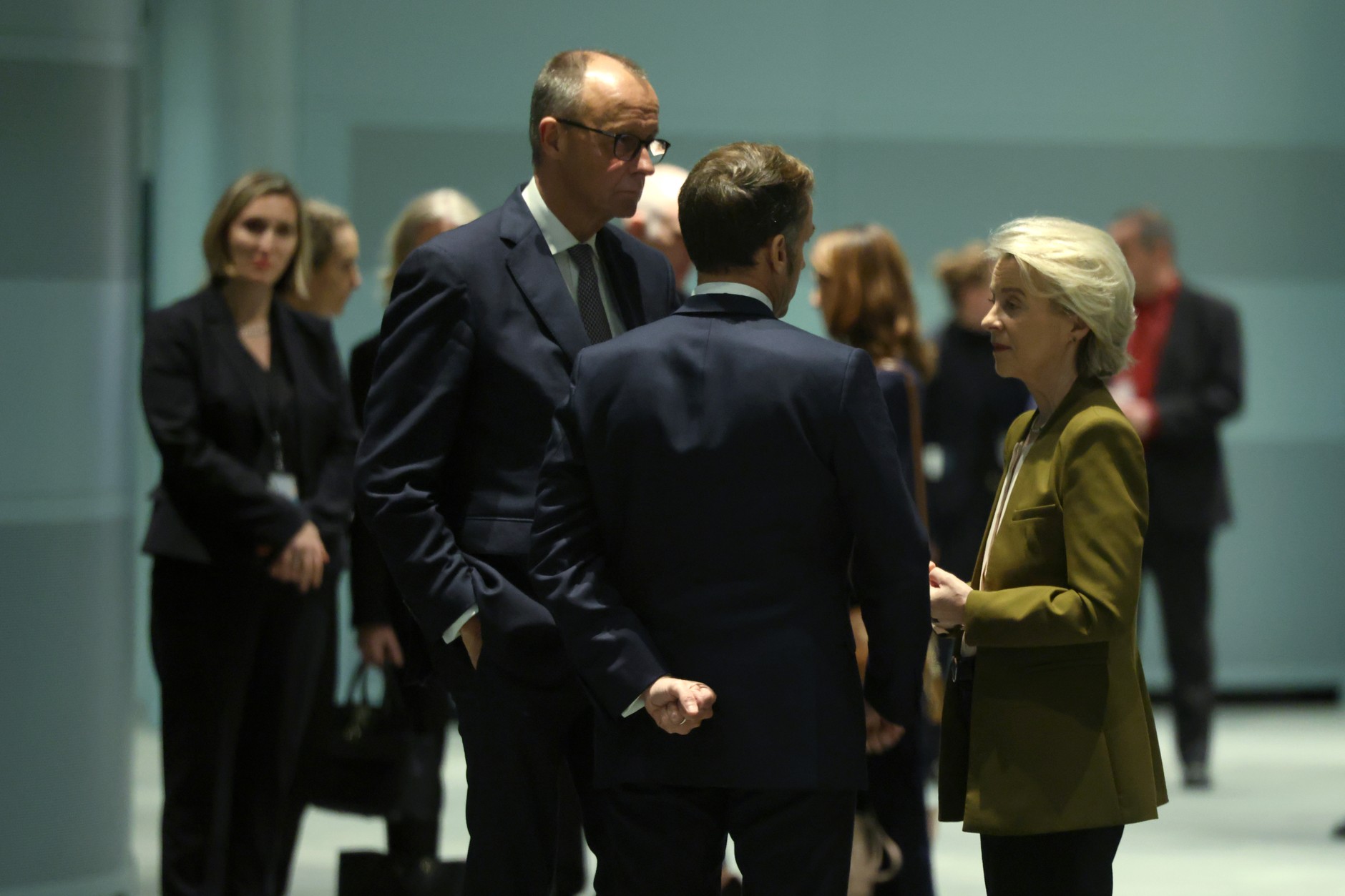
German Chancellor Friedrich Merz, French President Emmanuel Macron and European Commission President Ursula von der Leyen in Berlin, December 15, 2025.Sean Gallup/Getty Images
Flagship projects are not included in the latest draft of the summit's conclusions, obtained by POLITICO. However, while Paris said they were not on Thursday's agenda, the Nordic countries they still hope to save these plans.
Two EU officials said the bloc's executive was working to reassure skeptical countries that Brussels was not overstepping its powers and that they would continue to have clear control over their assets and spending.
Difficulties in approving greater cooperation, even as Russian fighter jets and drones violate EU airspace, have many concerned that action against hostile states and competitors that may act under the executive order is not quick enough.
“We have no other choice”
The EU's difficulties in acting on its own are most visible in the dispute over the use of frozen Russian assets to guarantee a loan of 210 billion euros (PLN 884 billion) intended to keep Ukraine's finances afloat.
Whether Trump fuels or hinders Europe's push for strategic autonomy, The time to make decisions on key issues is approaching.
“We can have discussions in the evenings, on weekends, all night long,” a second official said of preparations for Thursday's summit. “But when it's this important, we really have no choice but to get down to work and get it done.