China is testing giant floating wind turbines after already becoming a wind power superpower


Wind power is gaining momentum again — literally this time. In China, a multi-institutional research and development project has created a series of large-scale floating wind turbine prototypes. The helium-filled balloons, which transmit electricity to the ground via an anchor cable, can float at altitudes of thousands of meters and are proposed as a mobile, low-environmental-impact alternative to conventional wind turbines.
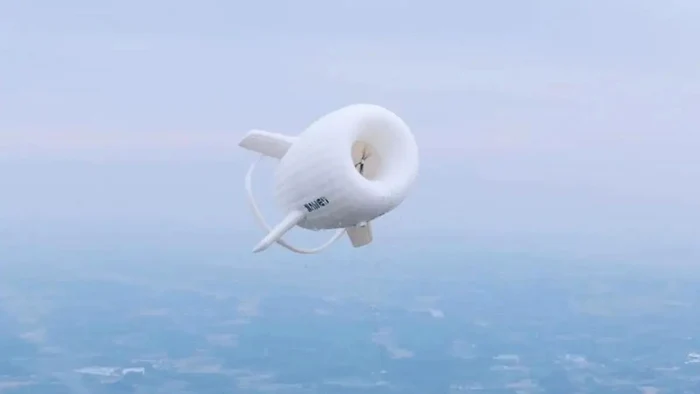
Floating wind turbine, tested in China/FOTO:X
The initiative is coordinated by Tsinghua University in Beijing, in collaboration with the emerging company Beijing SAWES Energy Technology Co., Ltd.. The system, called Stratospheric Airborne Wind Energy Systems (SAWES), presented the first prototype in October 2024, and since then the models have grown in both size and altitude.
The latest model, the SAWES Type S2000, is described by the developers as the first airborne wind power generation system in the megawatt category.
Tests at 2,000 meters altitude
The S2000 prototype was tested in January in the city of Yibin in Sichuan province. The balloon hovered at an altitude of about 2,000 meters and was successfully connected to the power grid — a first for the company.
During the test, the system produced 385 kilowatt-hours of electricity, enough to power an average home in the United States for about 13 days.
The S2000 is 60 meters long and approximately 40 meters high and wide. It is equipped with 12 turbines, with a total capacity of 3 megawatts, according to the developers.
By comparison, the world's most powerful conventional wind turbine, built by the Chinese company Dongfang Electric Corporation, reaches a height of about 340 meters and has a capacity of 26 megawatts.
Environmental advantages
According to Jianxiao Wang, an associate professor of data research at Peking University and a member of the project team, the SAWES system has several environmental advantages over conventional turbines.
“We use up to 90 percent less material than traditional wind turbines,” he explained. “No massive concrete foundations or steel towers are required, and the soil ecosystem is not disturbed.”
Air turbines would also have much less visual and sound impact.
“At ground level they are virtually silent and create much less visual obstruction on the horizon,” added Wang.
The professor also claims that birds could avoid overhead turbines more easily than traditional wind farms. In the United States, studies estimate that wind turbines kill between 140,000 and 679,000 birds each year—far fewer than power lines or domestic cats.
Possible uses
A pilot project is already being considered on an island in southern China's Guangdong Province, where land space is limited and environmentally protected, making it difficult to install traditional turbines.
By the end of 2025, the company has filed 51 patent applications related to SAWES technology.
The engineering team made advances in materials and electrical systems, using advanced composite fabrics to keep the aerostat light and reduce helium loss.
The system uses atmospheric models and artificial intelligence to automatically ascend or descend in search of optimal air currents. Research suggests that this approach could significantly increase energy production over turbines installed at a fixed height.
Wang Lei, a spokesman for SAWES, says that in the short term, the system could be used to power isolated areas, for independent power grids, or to provide power in emergency situations, including disaster areas.
In the long term, the company hopes the technology will help power industrial infrastructure and ultimately deliver clean energy directly into power grids.
The potential of high-altitude wind energy
According to the International Energy Agency, global wind power production needs to more than quadruple by 2030 to support the goal of net zero emissions.
Global installed capacity is expected to reach about 2,000 gigawatts by 2030. China is already the world leader in the sector, adding about two-thirds of new wind capacity installed globally in 2023.
Wind is an abundant resource, but its distribution is uneven. The speed and density of wind power varies with location, time of day, and geographic conditions.
According to Professor Wang, air turbines could harness stronger and more stable winds at high altitudes, which would enable power generation in more land-based locations than conventional turbines.
Questions from the specialists
But Mark C. Kelly, an associate professor in the Department of Wind and Energy Systems at the Technical University of Denmark, says these claims are difficult to evaluate without independent studies.
He pointed out that existing research shows that aerial wind power systems can exploit stronger currents at higher altitudes than traditional turbines, but the behavior of wind above 100 meters altitude is complex.
Kelly added that he has yet to see peer-reviewed studies or independent data on the performance of the SAWES prototype at altitudes above 1,000 meters.
Regulatory challenges
Commercial implementation of the technology would require compliance with each country's aeronautical and energy regulations.
In the United States, for example, hot air balloons are regulated similarly to civil aircraft and are subject to airspace restrictions. Special permits are required for flights at altitudes above 500 feet, and activity is restricted near airports or in low visibility conditions.
The SAWES team is currently developing a new generation of aerostats that will include additional communications and monitoring systems, called AeroMatrix.
According to Professor Wang, these platforms could have multiple functions — from power generation to wireless communication services, charging drones or even acting as local compute nodes for GPU processing.
The project is carried out in collaboration with the Chinese Academy of Sciences, as part of a major national research program, whose funding details have not been made public.
The company says it is already working on the next generation of prototypes, which will be tested later this year at higher altitudes and for longer periods of stable operation.