He became a real estate agent in Romania, a country he came to with a child in his arms and another by the hand. “I pay all the taxes” / The story of Cristina Shatrovska, the refugee who had learned Romanian at school in Ukraine


Cristina Shatrovska, 36, arrived in Romania on June 27, 2022, with a five-and-a-half-year-old child and a one-and-a-half-month-old baby in her arms. Two months after her arrival, she started working as a translator at the refugee center at Romexpo, with her little girl in her carrier. Four years later, she is a real estate agent, filed for Romanian citizenship and says that Romania has become her home.
Cristina Shatrovska arrived in Romania on June 27, 2022. She was scared and says that she did not hope that life would be good to her again.
Today, four years after the start of the war, she says her life looks “much more settled” than in the first months. “I came with Matei, who was five and a half years old, and Eleonora, who was a month and a half old. In August, two months after I arrived, I started working at Romexpo, at the refugee center.”
She knew Romanian and that helped her
He asked if there was a need for Romanian speakers. He was told yes. The problem was that she had the baby in the carrier. “They asked me: what are you doing with the baby? I said: it's with me. If you need it, let's try it.”
She worked for a year as a translator, with both children by her side. Eleonora was in the pram or carrier, behind the desks. “It was quite difficult. I'm not saying it was easy. But we managed. We were with them both the whole time.”
In May 2023, he joined Save the Children, also as a translator and carer for children. He worked there for about a year and a few months, until December 2024, when the contract ended. “After that it was a pretty rough road. I lost my job at the beginning of the year. I looked for work on my own.”
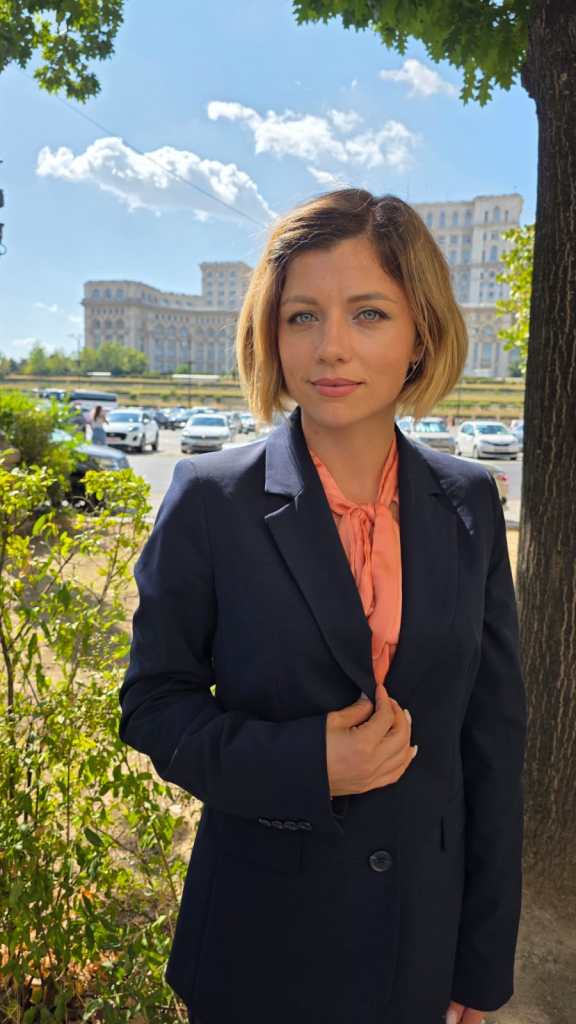
She worked as a babysitter through an online platform. In parallel, he started working as a real estate agent. She is currently employed with a contract in a real estate agency founded by a Ukrainian woman in Romania.
Her story was reported for the first time in December 2022 by Republica, in an article signed by Diana Marcu and Raluca Ion, who described her as “the strength of a mother with a baby in her arms and a child in her hand”. Then he was at the beginning of his life in Romania. Today, Cristina talks about what has changed in these years, about the children who grew up here and about her plans to stay permanently.
“I am officially employed, with a contract. I pay all taxes to the Romanian state. I am proud that I can do my job well. I work with Romanians, with Poles, with anyone who needs it,” says Cristina.
Over time, her life in Romania began to gain stability. He made friends, he has colleagues and close people. “I have godparents here too. I've settled down. It's not like the beginning when I was scared and didn't know what to do.”
The children go to school
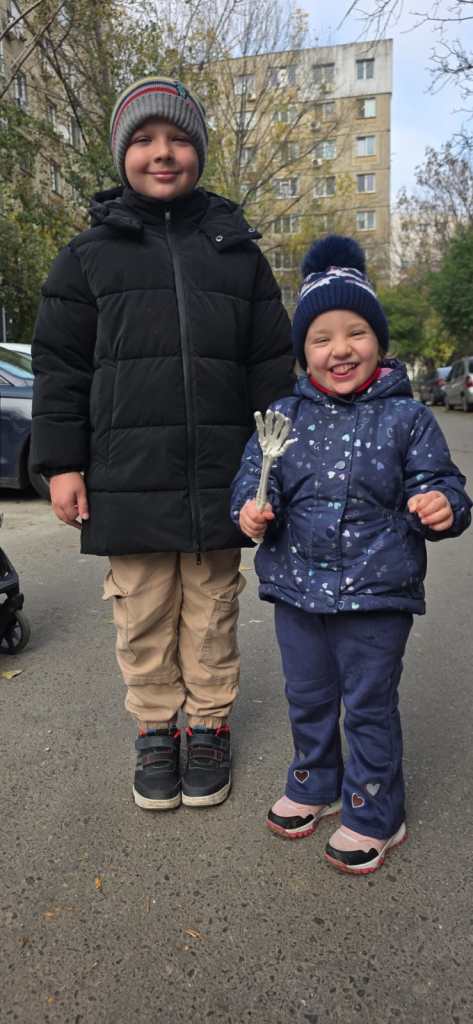
Eleonora, Cristina's daughter, is now three and a half years old and goes to kindergarten. “He is the child who grew up in Romania. He learned the Romanian language from nursery school and kindergarten,” the woman says. The boy, Matei, is in the second grade. When he arrived in Romania, he didn't know a single word of Romanian. “He didn't understand what the kids wanted from him. He had no friends. It was breaking my heart. I had to go everywhere with him and translate for them.”
Today, says Cristina, the situation is also different for the little one: “He knows how to read, write, knows the multiplication table. He no longer has communication problems.”
She says that the language remains a challenge for her too, although she learned Romanian at school in Ukraine. “Sometimes I want to say something, express my thoughts, and I can't. The Romanian language is quite complicated. For someone who has never learned it, it's hard.”
“I feel safe, I feel at home”
Asked if Romania has become home, she answers without hesitation: “Yes. I feel at home. I feel safe. Romania is my home now.” Moreover, he submitted the file for Romanian citizenship and already passed the language exam. “There is a difficult road ahead until the Romanian certificate. But I want to become a Romanian citizen with the right documents.”
She says that her future is in Romania. “I don't feel like I want to leave. I don't feel uncomfortable. I feel good here.”
Cristina says that one of the great uncertainties for Ukrainians under temporary protection in Romania is what will happen after the expiration of the current legal framework.
“What will happen after the residence permit ends in 2027? We know absolutely nothing and we are terrified of what will happen after,” she says.
He says he would like a clear procedure at the state level to allow those who want to stay to do so legally. “We have nowhere to go. We don't want to leave. This is our home, that's what we want to convey.”
“There were more good times than bad”
He met all kinds of people. It had good times and bad times. More good ones.
Asked how she sees the solidarity of Romanians after four years of war and if she feels that something has changed compared to the first months, Cristina says that her experience was, for the most part, positive. “There were different times,” she explains. “But there were more good times than bad.”
She says she mostly met people who supported her. “I met welcoming people who helped me and continue to help me. I don't mean the money, the financial side. I mean the human side. It's very important to have some people who can guide you and help you with advice, with anything. To speak a good word.”
Cristina says, however, that there were also episodes in which she felt rejected. “They told me to go home, that I shouldn't be here. It was racist stuff, towards me and the kids.”
However, she says that such situations were fewer than those in which she was supported and that the experience in Romania helped her become stronger. “It taught me to be able to solve any situation, no matter how difficult it is.”
“I am grateful that I learned many things in Romania”
Cristina says that she has built a stable life in Romania and that she is grateful for the support she received. “I am grateful that I learned many things in Romania,” she says. She says that here she learned to be stronger and to handle difficult situations. “I wouldn't want anyone to end up in the situation of putting their life in a suitcase and going, with their children and documents, wherever their eyes take them.”
Speaking about the war in Ukraine and how it is perceived outside the country, Cristina says that the reality there remains present and concrete for those who left. “The fight going on right now is absolutely real. Drones are all over the country, absolutely even in my village. People don't want to give anything up, because that's where their home is.”
Cristina says that support for Ukrainians remains necessary, including for those who have decided to stay in Romania. It states that it is not just about financial aid. “There are many things that need to be helped, at the state level, at the law level, at the document level.”
She explains that integration takes time and effort, especially for those who do not know the language. “It's not very easy to learn a language from scratch. And we don't have anywhere to go either. We don't want to leave. This is our home. Children, first of all, have to live a normal life.”