A wave of violence erupted in several Mexican states over the weekend after the killing of Jalisco New Generation Cartel (CJNG) leader Nemesio Oseguera Cervantes, known as “El Mencho,” prompting US authorities to issue security alerts and US elected officials to warn of possible retaliation. On Monday, Mexican authorities provided more details about the operation.
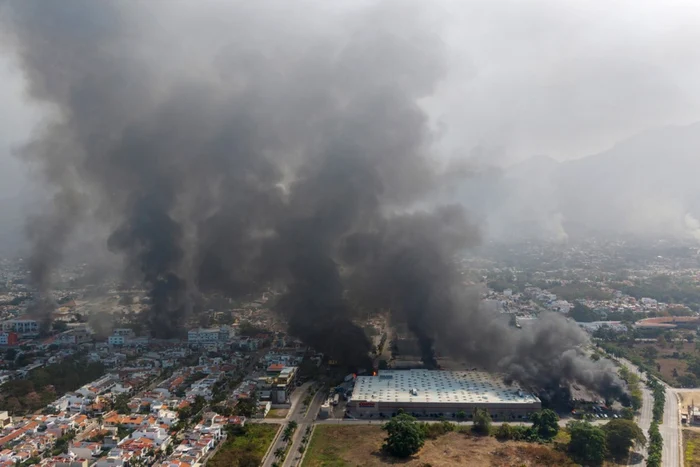
PHOTO EPA-EFE
Mexican authorities have confirmed that DNA tests have identified Oseguera Cervantes following a military operation in the town of Tapalpa, Jalisco state, about 270 kilometers southeast of the city of Puerto Vallarta. Mexican Defense Minister Ricardo Trevilla said the information that led to the raid came from someone close to him.
El Mencho ran one of Mexico's most powerful criminal organizations, which US authorities accuse of smuggling methamphetamine and fentanyl into the United States. His death sparked violent clashes between cartel members and security forces in at least 20 Mexican states.
Video footage shared on social media shows plumes of smoke near popular tourist destinations, while gunfire can be heard in the background.
The US State Department issued an order advising US citizens in several regions to stay sheltered, citing “ongoing security operations, roadblocks and criminal activity”. The warning targeted major tourist destinations such as Puerto Vallarta, Cancun, Playa del Carmen and Tulum.
Road blockages due to burning vehicles were reported in several areas. In Guadalajara, more than 1,000 visitors to the city's zoo were stranded overnight after major roads were closed. Twenty-one buses with families and children remained parked in the zoo, under the protection of the police and armed forces, until an escort was arranged.
“It was horrible,” tourist Ángeles Martínez told The New York Times. “We were visiting the animals when our phones were suddenly filled with alerts about what was happening outside.”
A match in Mexico's premier women's soccer league between Club Necaxa and Querétaro Femenil was suspended on Sunday after gunfire was heard near the stadium, with the players rushing to the dressing room.
Political reactions in the US
Ohio Republican Senator Bernie Moreno wrote on Platform X that he had received “disturbing reports” that cartel members were hunting US citizens in Puerto Vallarta. He warned that if any American was hurt in Mexico, “violent and decisive retaliation by the US” would follow. Moreno also called for the suspension of trade negotiations under the US-Mexico-Canada Agreement (USMCA) until the situation stabilizes.
President Donald Trump posted a message on Truth Social urging Mexican authorities to “step up efforts” against cartels and drug trafficking.
Stranded tourists
American and Canadian tourists have reported flight cancellations and difficulty leaving affected areas. Some took to social media to ask airlines to add flights from Puerto Vallarta.
The Louisiana-based nonprofit United Cajun Navy said it has been contacted by people seeking help for relatives “stranded” in Mexico. However, the organization specified that, although it specializes in disaster response, “extractions from hostile areas abroad are not normally part of our operational capabilities.”
Mexican President Claudia Sheinbaum said she expected flights to resume Monday or Tuesday, including those to and from Puerto Vallarta.
Security forces remain deployed in several states as violence continues. Attention has also turned to Rosalinda González Valencia, the ex-wife of Oseguera Cervantes and a prominent figure within the CJNG, whose whereabouts are currently unknown.
Residents of the affected towns reported the presence of armed individuals on motorcycles and exchanges of fire. Images shared online show armed clashes between cartel members and Mexican security forces near urban centers and tourist areas.
Authorities have not provided further details on the ongoing operations, but officials warn that heightened security measures will remain in place.
The tip that led authorities to El Mencho
Mexican authorities said a tip led to the operation that killed Nemesio “El Mencho” Oseguera Cervantes, the notorious leader and co-founder of the Jalisco New Generation (CJNG) cartel, in a violent confrontation in western Mexico on Sunday.
The mission, described by officials as the culmination of a complex investigation, came after months of intelligence work targeting Oseguera's inner circle. According to Mexican Defense Secretary General Ricardo Trevilla Trejo, investigators identified a key person with access to the cartel leader's hideout on February 20. The person in question was the girlfriend of one of Oseguera's most trusted associates.
That lead led authorities to a complex of isolated cabins on the outskirts of Tapalpa, a mountainous area in the state of Jalisco, where the cartel operated.
On Saturday, February 21, the woman left the property, but reports indicated that Oseguera remained on the premises with members of his security team. Confirmation of his presence allowed the Mexican Air Force and the National Guard's Immediate Reaction Force to plan a swift and coordinated operation before he disappeared again
President Claudia Sheinbaum confirmed that the United States provided intelligence support ahead of the mission, but emphasized that no US ground forces participated. “There was no involvement of American forces,” Sheinbaum said. “There was just an exchange of information.” The White House also said US support was limited to providing information.
operation
The military operation was based mainly on ground forces, supported by an airmobile unit and air support. The helicopters were strategically positioned but did not enter Jalisco state airspace to avoid raising suspicions before troops established control on the ground.
After establishing a security perimeter around the lodge complex, Mexican forces moved in to arrest Oseguera. An intense firefight broke out as cartel militants tried to repel the troops.
Eight members of the CJNG were killed on the spot during the initial confrontation, and two Mexican soldiers were wounded, General Trevilla said. As security forces closed in, Oseguera and several lieutenants fled into a nearby wooded area, sparking a chase through dense vegetation.
“El Mencho left, leaving behind a group with a large amount of weapons,” Trevilla told reporters. “It was a very violent attack carried out by the organized crime group. The military forces repelled the attack.”
Special Forces units eventually located Oseguera in the woods. Officials confirmed he was killed during the confrontation.
Violence in Jalisco
The operation triggered a wave of violence in the state of Jalisco. Omar García Harfuch, Mexico's Secretary of Security and Civil Protection, reported six coordinated attacks against authorities on Sunday.
“Twenty-five members of the National Guard, one prison guard and one from the State Prosecutor's Office died,” García Harfuch said. A civilian woman was also killed. In addition, 30 suspects died in the clashes.
Authorities described the attacks as “cowardly” and retaliation by cartel members after military intervention against their leader.
In response to the unrest, the government deployed about 2,500 troops to Jalisco and neighboring states to restore order. On Monday, Trevilla said that “normality has been restored” after the reinforcement of security forces.
President Sheinbaum tried to reassure the population, assuring that “peace, security and normalcy are maintained” and that the government's immediate priority is “to guarantee peace and security for the entire population.”
US reaction
The killing of Oseguera, one of the most powerful and violent drug traffickers in Mexico, provoked immediate reactions from the United States.
US President Donald Trump asked Mexico to step up efforts against cartels, posting on the Truth Social platform: “Mexico must step up their effort on Cartels and Drugs!” Trump also praised former acting DEA administrator Derek Maltz, who described the situation as a “wake-up call to the world about the treachery of the Mexican cartels” in a TV interview.
General Trevilla acknowledged the role of US intelligence agencies in disrupting Oseguera's information networks before the operation.
“We also benefited from US intelligence institutions and agencies, and this allowed us to dismantle El Mencho's information networks and proceed with the arrest operation,” he said. “The intelligence process is very complex. It takes a lot of time. You have to gather a lot of clues and information from different sources.”
However, Mexican officials insisted that the operation was carried out exclusively by the Secretariat of National Defense.
“The entire operation is the responsibility of the Secretary of National Defense,” Sheinbaum reiterated.
A turning point?
Oseguera's death marks a major blow to the Jalisco New Generation cartel, one of the most powerful and violent criminal organizations in Mexico, known for aggressive territorial expansion and armed operations.
It is unclear whether his killing will significantly weaken the cartel or trigger further instability. Historically, the removal of cartel leaders has often led to internal power struggles and a resurgence of violence.