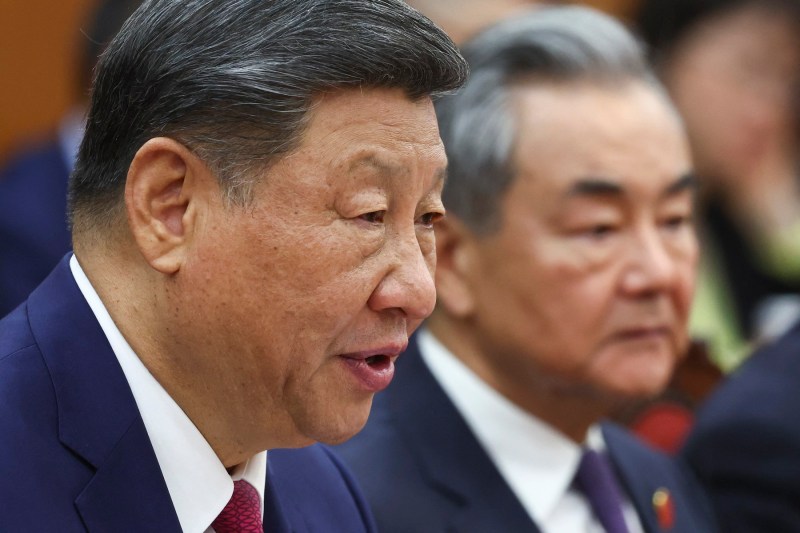
Chinese President Xi Jinping with his Foreign Minister Wang Yi, PHOTO: Athit Perawongmetha / AFP / Profimedia Images
China has banned the export of dual-use items to 20 Japanese entities it says supply Japan's military, Beijing's Commerce Ministry said on Tuesday, in the latest escalation of a dispute with Tokyo.
China is using its influence over supply chains to step up pressure on the government in Tokyo even as Prime Minister Sanae Takaichi, who angered Beijing with comments he made in November about Taiwan, secured a strong mandate following a landslide election victory this month.
The measures announced by China now target divisions of large Japanese industrial conglomerates, such as the shipbuilding and aircraft engine divisions of Mitsubishi Heavy Industries, the Ministry of Commerce in Beijing said.
In practice, the rules cut off Japanese companies' access to the seven rare earths and related materials currently on China's dual-use control list, along with a wide range of other critical minerals subject to regulation. The new rules ban exports of rare earths such as dysprosium, yttrium or samarium, which play small roles by volume but are vital in the production of cars, planes, weapons and consumer electronics.
The measure taken by China will hit Japan's big companies
Reuters notes that it is not clear how long it could take before potential shortages become a problem for the Japanese economy. Japanese companies are known to hold stocks of rare earths, and until at least December 2025 – the most recent month for which export data is available – China regularly sent large shipments to Japan.
China has an export control list of about 1,100 dual-use products and technologies, and manufacturers must obtain a license to ship them overseas, regardless of who the end user is.
“The measures announced today are completely unacceptable and deeply regrettable,” Kei Sato, Japan's deputy cabinet secretary, told a news conference.
He said the Tokyo government had asked for the restrictions to be lifted.
The restrictions were aimed at curbing Japan's “remilitarization” and its nuclear ambitions, China's Commerce Ministry said, adding that overseas organizations and individuals were also prohibited from transferring dual-use products of Chinese origin to the listed entities.
Companies can apply for permission to sell to listed entities in “special circumstances” that require export, the ministry said.
“It can be said to be a form of counterbalancing the Japan-US relationship and Japan's additional defense efforts,” Ryo Sahashi, a professor at the University of Tokyo, told Reuters.
Japan is working on a new defense strategy
Japanese Prime Minister Takaichi has pledged to revise Japan's three core security documents to craft a new defense strategy and speed up the review of military export rules to expand overseas sales and strengthen defense companies.
She accelerated the military build-up launched in 2023, which will double Japan's defense spending to 2 percent of GDP by the end of March. In absolute terms, the island nation has gradually become one of the world's biggest military spenders, despite its pacifist constitution.
Japan has the fifth largest economy in the world, with a GDP estimated by the IMF for 2026 at $4.46 trillion.
China's Ministry of Commerce also added 20 other Japanese entities — including Subaru Corp, Itochu Aviation and Mitsubishi Materials — to a monitoring list, saying it could not verify the end users or final destinations of their dual-use products.