In August 2025, President Karol Nawrocki received a petition authored by an auditor and financier – his details were not made public. In the petition, the auditor points out that for years he has been observing the problem of “disproportionate involvement of time and resources in settling and collecting receivables of the order of 1-2 groszy, especially in large, multi-million projects.
“This is a source of costs that are inappropriate to the value of the disputes and burden both the public administration and entrepreneurs“, we read in the document.
Therefore, he calls for the abolition of 1 and 2 groszy coins, the introduction of the principle of mathematical rounding of final payment amounts to the full five groszy, and the creation of a state Social Rounding Fund to be supplied with the remainder resulting from rounding.
Assumptions of the petition to withdraw penny coins
The scheme would be as follows: if the amount had to be rounded up, e.g. from PLN 3.99 to PLN 4, the surplus would be paid by the consumer, if it had to be rounded down, e.g. PLN 3.32 to PLN 3.30, then it would be charged to the entrepreneur. Entrepreneurs would allocate the surplus obtained from consumers to the Social Rounding Up Fund and from there to public purposes..
The fund could also be supplied voluntarily with any amounts and used to finance public benefit projects. However, parties could not use the money to cover, for example, campaign costs. The Fund would be supervised by the Minister of Finance.
The Chancellery of the President informs that it has sent the proposal to the National Bank of Poland for evaluation. It was also submitted to the Ministry of Finance. The president personally found the idea “sensible”, but emphasized that the decision was not up to him.
Read also: Inflation finally anchored. What does this mean for us?
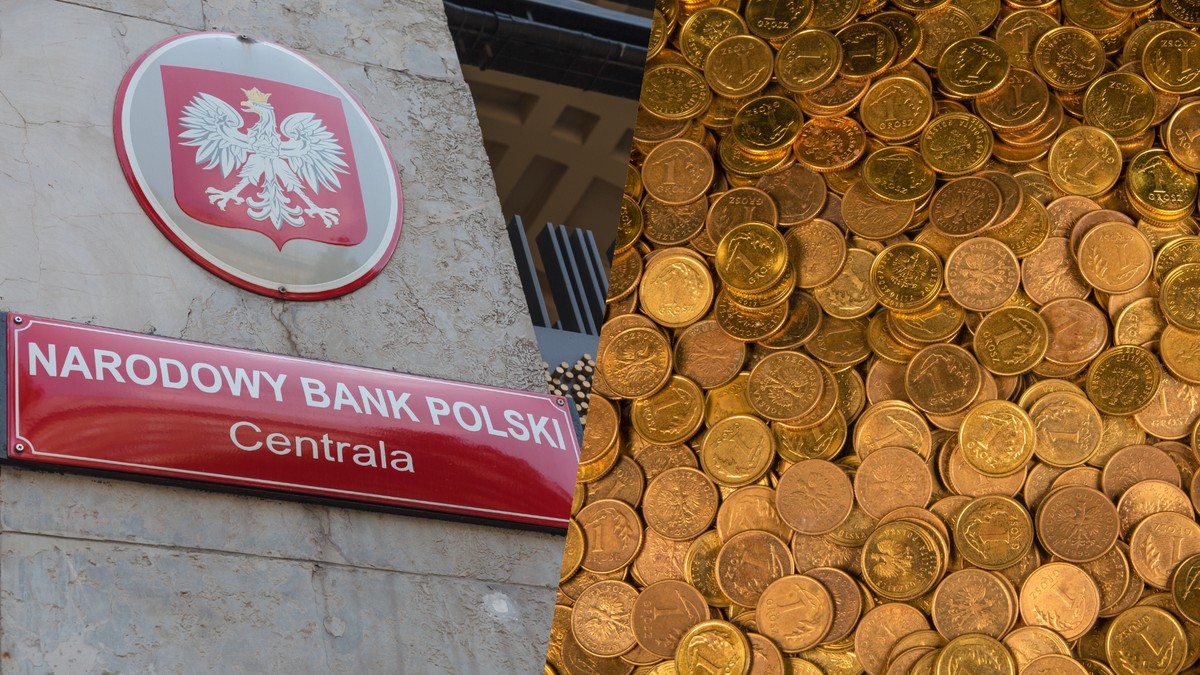
Costs of production of one- and two-cent coins in Poland
— Expenditures on the production of one- and two-cent coins are higher than the denominations of these coins, Nawrocki noted in an interview for Radio ZET. In his opinion, this is not only an economic problem, but also a practical one, because entrepreneurs have long been reporting difficulties with using penny coins.
According to some data, minting a one-gross coin costs five groszy, and a two-gross coin costs six groszy. It is therefore unprofitable. Efforts to liquidate one-grosz coins were undertaken by the National Bank of Poland itself in 2013. At the time, Marek Belka was at the helm of the bank, and he still believes that one-cent coins should disappear.
Previous attempts by the National Bank of Poland ended in failure
In 2013, the National Bank of Poland presented a ready-made draft act. The central bank did not plan to completely eliminate one- and two-cent coins from cash circulation, but to significantly reduce the demand for them and, as a result, to slowly disappear.
The NBP assumed then that product prices would not change, the bill would simply be rounded to five groszy, or ultimately by two groszy up or down. Bills ending in one and two groszys and six and seven groszys would be rounded down, while those ending in three and four groszys and eight and nine groszys would be rounded up.
It was estimated that the NBP could save approximately 40 percent thanks to the introduction of this act. funds spent on the issuance of these coinst. The idea could not be implemented.
By the time the article was published, it was not possible to obtain information whether the NBP was considering such a change. The Ministry of Finance, in response to questions from Business Insider Polska, said that “only the National Bank of Poland has the exclusive right to issue currency of the Republic of Poland.”
— NBP has not recently asked the Ministry of Finance to withdraw low-denomination coins from circulation. Any changes of this nature must result from the real needs of Polish citizens and Polish enterprises – note representatives of the press office of the Ministry of Finance.
Read also: Only a small part of NBP gold is found in Poland. See where most of the bullion is
The impact of penny liquidation on retail
For now, there is no such demand from business. Renata Juszkiewicz, president of the Trade and Distribution Organization (POHiD), notes that the issue of the possible liquidation of one- and two-cent coins should be analyzed primarily from the perspective of the stability of economic turnover, costs for entrepreneurs and consumer convenience..
— Retail trade involves a very large number of transactions with low unit value, so any change in the structure of monetary denominations must be well prepared, preceded by an impact analysis and properly communicated to the market, he notes.
Read also: This is the rate at which wages will grow in Poland in 2026. This will have good and bad consequences
He points out that from the point of view of trading companies, the withdrawal of the smallest denominations would mean the need to introduce uniform rules for rounding cash payments.
— The key here would be a statutory, clear regulation of the rounding mechanism, so that it is neutral for both consumers and sellers and does not cause any disputes at the checkout. In practice, changes would require changes to cash register systems, accounting procedures, customer information materials and employee training. This generates organizational and operational costs, especially in the first transition period – says Renata Juszkiewicz.
On the other hand, he notes that the smallest coins are today rarely used in everyday circulation and often do not come back into circulation. Some European countries have decided to introduce rounding rules for cash payments, without withdrawing prices ending in 1 or 2 groszy in non-cash transactions..
According to the president of POHiD, if a similar solution were to be considered in Poland, it would be necessary to ensure that prices could still be determined freely, and only the final bill amount in the case of cash payments would be rounded.
Entrepreneurs are afraid of the reaction to price increases
It is also very important for trade that the change is not perceived socially as a “hidden price increase”. — In conditions of high price sensitivity of consumers, any reform of this type requires a broad information campaign conducted by public institutions, in particular the National Bank of Poland, in order to explain the mechanism and dispel fears, says Renata Juszkiewicz.
POHiD is therefore neither “for” nor “against” the abolition of pennies, but emphasizes that any decision should be preceded by a thorough analysis of regulatory effects, consultations with the market and the introduction of clear and simple rounding rules that will be financially neutral and will not constitute an additional burden for entrepreneurs or consumers.
We learn from people close to the National Bank of Poland that the central bank is not taking any actions aimed at eliminating groszy. So everything indicates that they will stay with us for a while