
One of Nvidia's philosophies that you can sometimes hear in Jensen Huang's statements is working at the “speed of light”. The speed of technological development is to be limited only by the laws of physics, not by internal politics or finances, because if a company develops technologically as fast as possible, it cannot be outdone – just as it cannot be outdone by light.
In practice, this manifests itself in the fact that the latest generations of Nvidia's AI accelerators, on which the company has made a fortune, regularly make the earlier generations, which the world admired several months earlier, look like equipment belonging to a technological open-air museum. However, such constant searching and crossing technological boundaries not only makes the offer of products better than the competition, but also part of a broader strategy that allows Nvidia to largely control the supply chain key components.
Read also: Four American giants with a data center budget equal to Sweden's GDP
Searching for bottlenecks and striving to control them
Nvidia in fact, it produces nothing itself. He designs his own hardware, then manages the supply chain and ensures that the millions of components that make up a modern rack system for the most advanced AI models are assembled by someone else into a working whole. For some of these components, it is relatively easy to find an alternative supplier or subcontractor. For others, no, because of that constitute a market bottleneck, setting a limit on the number of accelerators that can be produced globally. And just as whoever controls the Suez Canal or the Panama Canal has a lot of control over global maritime trade, whoever controls the bottlenecks in the supply chain of accelerator components deals the cards across their entire market. What good is a revolutionary project if you can't implement it on the necessary scale? One of such bottlenecks is access to the HBM memory used by accelerators and Nvidia is doing a lot to keep them in hand.
A quiet spec change that says a lot about the source of Nvidia's success
At this year's edition of CES held in Las Vegas, Jensen Huang devoted a lot of attention to the next generation of Nvidia's AI accelerators, codenamed Rubin. This is not the first time he talked about them, because he discussed elements of their specifications, among others, in March last year, during the GTC conference. However, if you compare the slides from these two presentations, you can see that one of the points has changed significantly over the course of a few months and its change shows very well the modus operandi of the current king of Wall Street:
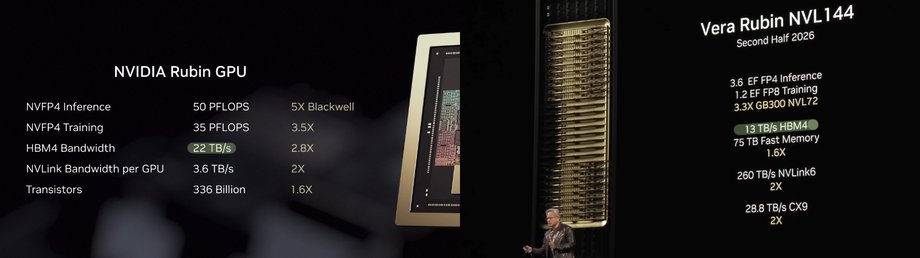
At Nvidia's recent presentation, it turned out that the company's latest accelerators will have much faster memory, the specification of which exceeds parameters that seemed possible at all.
|
Onet
There was 13 TB/s of bandwidth, are 22 TB/s. To achieve this throughput, it is necessary to use chips with performance significantly exceeding that assumed by the currently approved official specification for this type of memory. Where did Nvidia get it? We know from a report by TrendForce analysts, but also from various market reports, that Nvidia representatives went to three existing HBM memory manufacturers – SK Hynix, Samsung and Micron – and said that they were not satisfied with memory with the previously negotiated speed, nor were they satisfied with memory with the maximum speed described in its official specification. They said they wanted something even faster. Memory manufacturers thought this was crazy, but they adapted to Nvidia's requirements anyway — although this required them to redesign their semiconductors, get them re-approved by Nvidia, and delay the start of production by several months.
These companies knew that if they managed to meet the demands of their most important customer, they would face another quarter of record profits. And if they do not achieve this, but one of the competitors does, they will be pushed to the sidelines, just as Samsung was for many months, whose earlier generation memory could not pass subsequent Nvidia tests for many months.
The benefits of forcing your suppliers into fierce competition are quite obvious. But what does this have to do with supply chain control? The demands of Jensen Huang and company are so high that only a limited portion of memory made by Samsung, SK Hynix and Micron will be able to meet them. So in practice, Nvidia makes it happen will have exclusive access to the fastest memory on the market for a long timeand memory speed has a large impact on the final performance of accelerators in AI computing. Of course, by setting such requirements, Nvidia risks that they will turn out to be too high, which could result in insufficient memory for its needs. Apparently she manages to balance on this thin line.
Access to HBM memory is not the only element of the supply chain controlled by Nvidia
HBM memory is not the only bottleneck that Nvidia is trying to keep in its grip. It will certainly try to control, among other things, access to technology used for direct integration with optical fiber communication chips (so-called silicon photonics), because it is communication between chips and systems that is becoming more and more important in leading AI solutions, and Nvidia is currently very strong in this field. In technological and strategic terms, it is therefore prepared to resist competitive attacks for a very long time. The most dangerous sword of Damocles hanging over the company is the question whether we are dealing with an AI bubble, and if so, when and how loudly it will burst.
See also: What's going on with DeepSeek? One decision by the authorities brought down Chinese AI, but Beijing has just changed its mind