The research covered key points on the routes currently used by Russian “shadow fleet” ships, as well as places where they may appear in the future. One of the analyzes concerns the area north of Łeba, where the shipping route used by tankers runs.
According to analyzes prepared for Greenpeace by the Helmholtz Hereon center, a spill from a tanker carrying 48,000 tons of oil could lead to contamination of beaches from Kołobrzeg to Jastrzębia Góra. In practice this would mean:
- long-term closure of the most touristic sections of the coast,
- financial losses amounting to hundreds of millions of zlotys,
- permanent destruction of bird and marine mammal habitats,
- restoration of the marine ecosystem lasting decades.
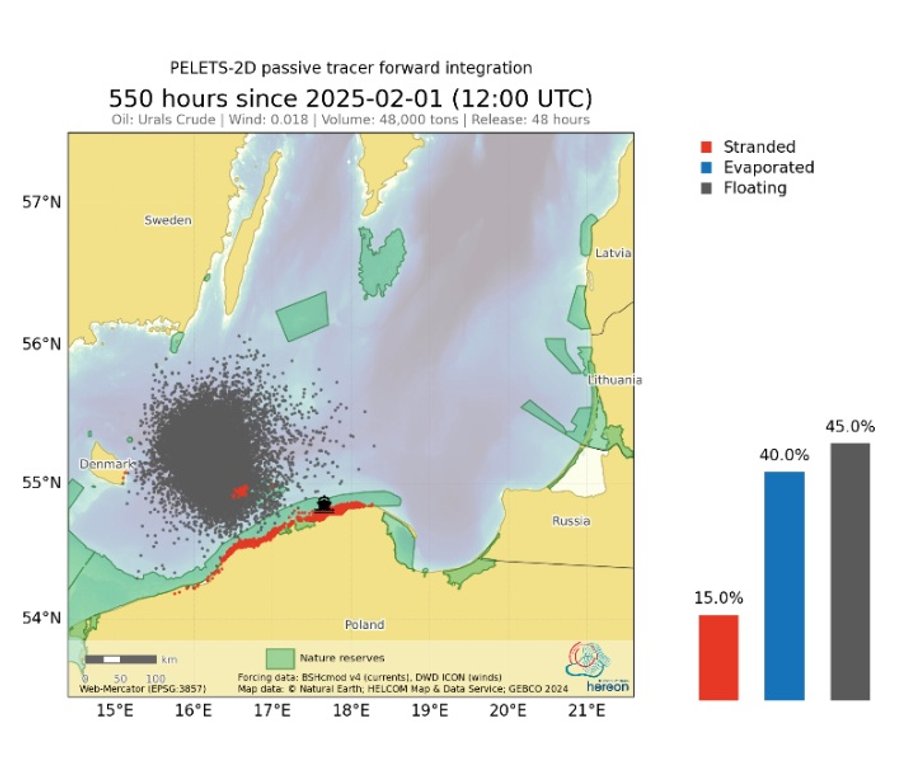
simulation of an oil spill near the Polish coast
|
Greenpeace
Traffic on the Baltic Sea is growing. Risk too
—The Russian shadow fleet is often a near-wreck that would normally be sold for scrap. They sail around the Baltic Sea under fictitious flags, with dubious insurance, and commanded by crews recruited in unclear ways. They transport huge amounts of sanctioned Russian oil through sensitive marine environments. This practice allows Putin to bomb Ukrainian cities, destroy energy infrastructure and keep people in the cold and darkness – comments Anna Ogniewska, Greenpeace campaign coordinator.
He adds that ships are already deviating from their designated routes, carrying out espionage and sabotage activities. The risk of similar incidents may increase if Europe decides to take stronger action against these operations.
Read also: Huge penalty for the tanker owner. He tried to bypass sanctions
Europe is not prepared for a disaster
It passes through the Baltic Sea and the Danish Straits every day approximately five tankers belonging to the shadow fleet. Although there has been no leakage so far, these vessels have already been involved in incidents in the Baltic Sea and in the Danish Straits.
Taking into account the technical condition of the units and the scale of traffic, this is a real threat. As Greenpeace emphasizes, Today, no Baltic Sea country has the technical capacity to cope with a large oil spill.
— Since the beginning of the war, we have been calling on European governments to stop these practices. We were the first to compile a list of tankers illegally transporting Russian oil through the Baltic Sea. Some of them are already subject to sanctions, but this is still not enough – adds Anna Ogniewska.
The analyzes prepared by the leading German research center, Helmholtz Hereon, concerned a tanker carrying 48,000. tons of oil, taking into account data on sea currents and winter winds provided by the German Federal Office for Maritime Navigation and Hydrography. The results clearly show that an oil spill from a Russian tanker in the Baltic Sea could be a disaster with long-term consequences for the region.