
On Wednesday, the sixth meeting of the CCR takes place, on the topic of magistrates' service pensions. The presence of judge Gheorghe Stan, again uncertain

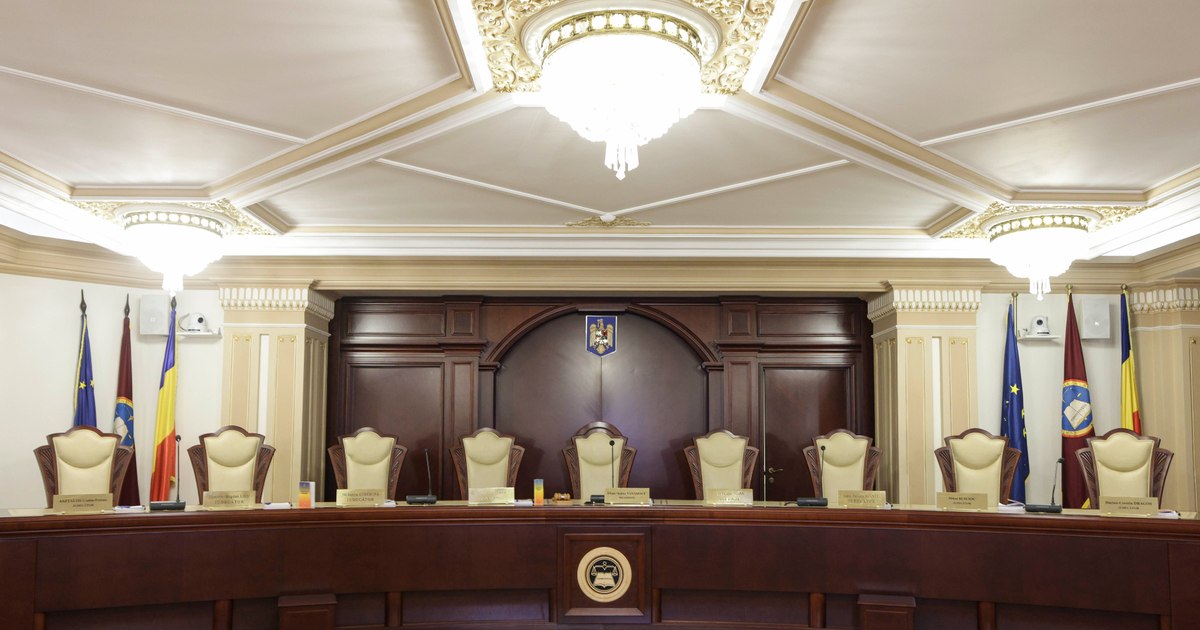
The judges of the Constitutional Court are meeting, on Wednesday, in the sixth meeting on the subject of the service pensions of the magistrates, after they have already postponed five times to pronounce a decision following the referral made by the High Court of Cassation and Justice (ICCJ).

Constitutional Court PHOTO: Inquam Photos/George Ganea
Wednesday's meeting of the CCR is scheduled for 11:00 a.m., and the file regarding the objection of unconstitutionality of the Law for the amendment and completion of some normative acts in the field of service pensions, formulated by the High Court of Cassation and Justice, is “pending”, according to the information on the website of the Constitutional Court.
On February 11, the CCR postponed for the fifth time taking a decision in this file, considering the request to interrupt the deliberations to study the documents submitted the previous day by the author of the referral. In these documents, the ICCJ requests the CCR to refer the European Court of Justice, considering that, among other things, the service pensions law would treat magistrates “discriminatoryly” in relation to other beneficiaries of such pensions, would “reduces the financial security of judges below the appropriate level” and would perpetuate a state of “legislative instability”, writes News.
Although the presence of Gheorghe Stan at that meeting was uncertain because he would have entered paternity leave for at least ten days, the judge came to the meeting, so that all nine judges of the Constitutional Court were present at the deliberations. And at the meeting on Wednesday, February 18, Stan's presence is under question, given that he would not have completed his leave.
At Wednesday's meeting, the CCR judges should also discuss the ICCJ's request for referral to the Court of Justice of the European Union. According to the ICCJ, the law would violate European Union law, as it would not respect the principles of proportionality, equality, legal security and the protection of legitimate expectations.
According to the law, in order to deliberate, all nine constitutional judges who participated in the debates should be present at the meeting.
And at the deadline of January 16, the CCR postponed the ruling in the file also as a result of the interruption of the deliberations for studying the accounting expertise submitted also the previous day and also by the High Court of Cassation and Justice.
Last Wednesday, the Bucharest Court of Appeal rejected, as unfounded, the requests to suspend the documents by which Dacian Dragoş and Mihai Busuioc were appointed to the CCR. At the same time, the court admitted the referral request to the Constitutional Court, made by the lawyers of the Presidency, the constitutional judges being requested to clarify certain issues related to the seniority required to be a judge at the CCR, this being, moreover, the motivation for which the lawyer Silvia Uscov challenged the two appointments in court. A day before, another court of the CAB rejected as unfounded another request to suspend the decree signed by Nicuşor Dan regarding the appointment of Dacian Dragoş as a judge of the CCR, submitted by the same lawyer.
At the deadline of December 29, 2025, when Simina Tănăsescu announced that she canceled her leave to be present, the meeting quorum could not be met, as four judges – Cristian Deliorga, Gheorghe Stan, Bogdan Licu and Mihai Busuioc were absent, after having left the meeting during a break the previous day.
Later, the four explained that one of them requested the postponement of the ruling and three others rallied to the request, the reason being “the request for a point of view through which the Government publicly clarifies that the law does not change aspects of the service pension, but effectively abrogates this right of the magistrates”. In fact, they requested a study on the impact of the disputed law.
Almost two weeks ago, Prime Minister Ilie Bolojan sent the president of the CCR a letter regarding the magistrates' pension law in which he informed that the members of the European Commission consider Milestone 215 unfulfilled, resulting in Romania's loss of 231 million euros.
Later, the president of the ICCJ, Lia Savonea, stated that “the explicit warning regarding the loss of European funds in the event of an unconstitutionality solution, as well as the implicit request that the constitutional court take into account financial consequences external to the act of constitutional justice, represents an interference incompatible with the principle of separation of powers in the state”.
Ilie Bolojan specified that it is not “of a pressure”as he did not tell the judges “to give one sentence or another”but it seemed to him “common sense to know these things”under the conditions that, when they will “lose the money or any other money”, “those responsible will be searched”.
On December 2, 2025, the Government led by Ilie Bolojan assumed responsibility in Parliament for the draft law on the reform of the service pensions of magistrates, but later the High Court notified the CCR regarding the unconstitutionality of the law.
The law gradually increases the retirement age for magistrates up to 65, similar to the public pension system, and gradually introduces the condition of 35 years of total length of service.
The project also establishes a pension amount of 55% of the calculation base represented by the average of gross monthly employment allowances and increases for which social insurance contributions made in the last 60 months of activity before the retirement date were withheld, with the limitation of the net amount of the service pension to 70% of the net income had in the last month of activity, before the retirement date.
In addition, the provisions regarding the granting of the 1% bonus and the update of the service pension are amended, in the sense of restricting these possibilities only to people with retirement decisions or who meet the conditions for retirement before the entry into force of the law, respectively without taking into account the length of service completed after the entry into force of the law, for the granting of the 1% bonus.
The contested law at the CCR modifies the way in which the service pension is established and the conditions under which magistrates can retire. The magistrates of the supreme court argued that the law creates “obvious discrimination” between the categories of service pensions, being clearly unfavorable to magistrates, although they are the only ones among these categories with a constitutionally guaranteed status. They also said that the law “de facto cancels service pensions”, creating for magistrates who do not meet the conditions for retirement on the date of entry into force of the law, the reduction to the cancellation of the character of the service pension, and for future generations it will become even inferior to that of the public pension system.


