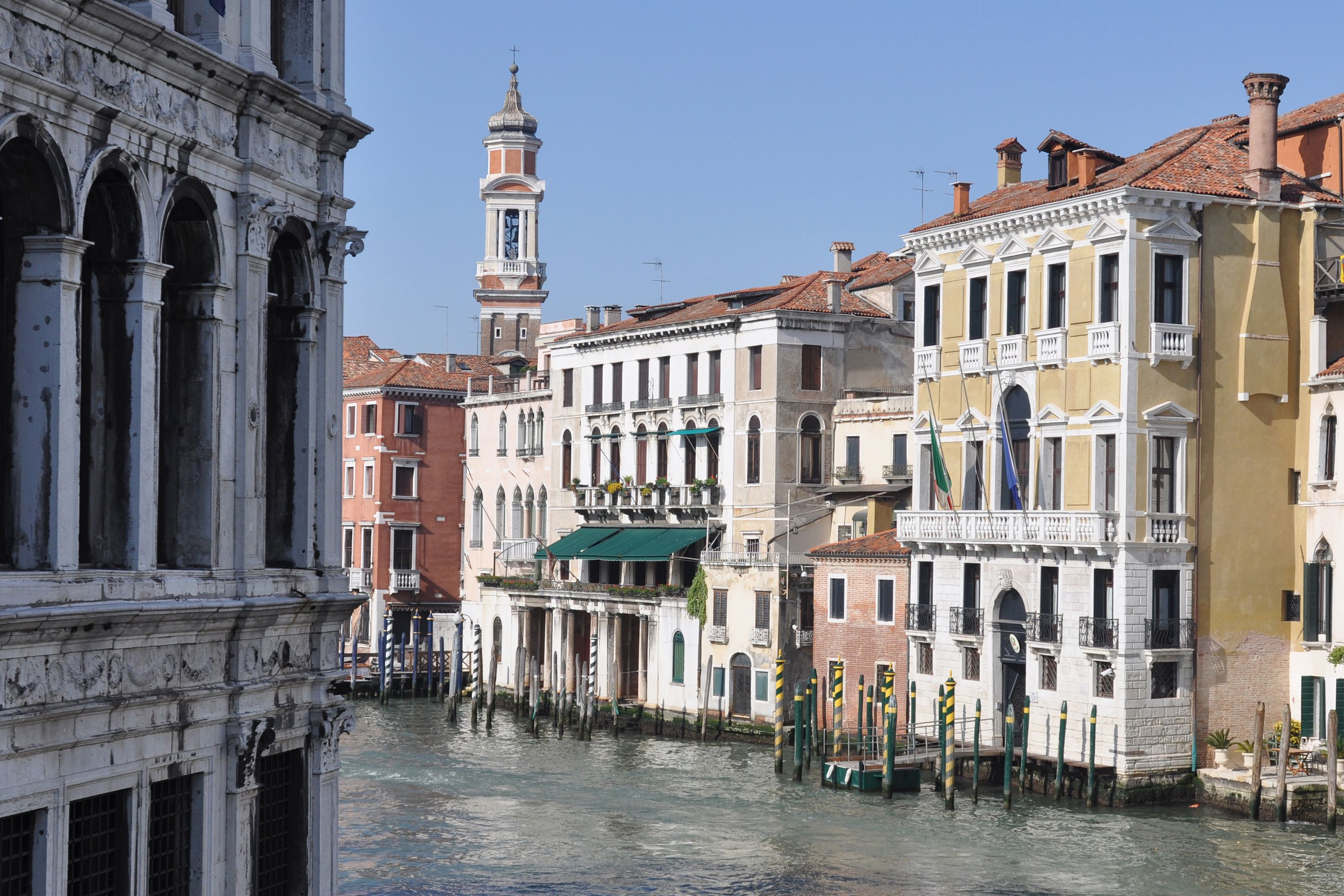
Venice is slowly sinking, while rising sea levels and increasingly intense storms amplify the risk of severe flooding. Climate change is accelerating the city's degradation, putting pressure on coastal infrastructure and unique cultural heritage. Historical data and climate studies indicate an increase of over half a meter in the water level, compared to the 18th century, according to an InfoClima.ro analysis.
Venice is finding it increasingly difficult to cope with the “waves” of tourists
Venice is one of the most visited cities in Europe, with around five million tourists a year. Tourism is one of the main sources of income, but it comes at a cost.
The city's infrastructure is old, and the total area (sea and land) of 410 km2 is relatively small. As a result, year after year, Venice has to deal with “waves” of tourists in a city that has already reached a significant population density (630 inhabitants/km2).
Venice has had much to gain from its geographical position throughout its 15-century history, but the disadvantages are also increasingly apparent.
Research has shown that, from the mid-18th century to the present, the level would have risen by 61 cm, taking into account that the waters of the Venetian canals currently have an average depth of approximately 1 -1.5m (Grand Canal/Main Grand Canal 5m).
Tides, storms, floods
“Aqua alta” is a natural phenomenon specific to the Venice area, characterized by seasonal floods. This has always happened, and the locals are used to it. However, as we see the increasingly accentuated effect of climate change, this phenomenon can contribute to the occurrence of even more violent floods against the background of increasingly pronounced storms, where the volume of precipitation in a short period of time can lead to strong floods, the analysis of InfoClima.ro also shows.
Such floods occurred in November 1927, December 1933, March 1964, February 1974, November 1996, November 2001, October and November 2012.
In 2019, Venice suffered the second most catastrophic flood in its recent history, with water levels reaching 1.87m. The costs were enormous, and the authorities could only offer €5,000 in compensation to individual households and €20,000 to businesses. The mayor of Venice at the time, Luigi Brugnaro, declared a state of disaster, saying “these are the effects of climate change”.
Mass tourism “suffocates” Venice
Many European cities are facing increasing difficulties in managing the number of tourists that cross their threshold. Barcelona, Florence, Edinburgh, Bruges are some examples where local authorities have had to take measures such as the introduction of hotel and tourism taxes in general.
One of the big problems Venice has faced over the years has been dealing with super cruise ships, the congestion and pollution they cause. The response of the local communities was a campaign entitled “no grande navi” (“no big vessels/no big vessels”), which became a reality for several years. In the summer of 2021, however, cruise ships are back.
Among the main arguments against these cruise ships are: the danger derived from the transit of the ships, the risks for public health, but also the pollution (noise, leaks).
An alternative found by the local authorities was the creation and development of another port designed to receive the largest vessels, along with those transporting goods. Diversion to the nearby ports of Ravenna and Trieste was another proposed solution, and for smaller cruise ships, the port of Marghera (industrial area) was found as an alternative closer to Venice. Specifically, the measure reduces the level of pollution in Venice's lagoon area, but also the risks of associated material damage.
What will happen to Venice by the end of the century
The data shows that the level of the Adriatic Sea could rise by about 17 cm by 2050, and some pessimistic scenarios indicate the possibility that in 2100 this increase will continue up to 120 cm, a catastrophic situation for the region. Reducing maritime traffic is seen as an immediate “mitigation” and adaptation measure, one that could have economic consequences in the short to medium term.
On the other hand, the implementation of mechanical barriers to protect Venice and the lagoon area could have long-term effects on natural habitats, flora and fauna. What is certain is that Venice, a city that would not have existed and could not live without water, is constantly threatened by this original source of its wealth and uniqueness.
Photo source: Dreamstime.com