The rivalry between Elon Musk and Jeff Bezos is entering a new stage. After years of talking about colonizing Mars, Musk announced that he is temporarily shifting his focus to the Moon, where he wants to build a “self-sustaining” city. The decision puts him in direct competition with Bezos, who has consistently argued that a lunar base would be the logical next step for space exploration.
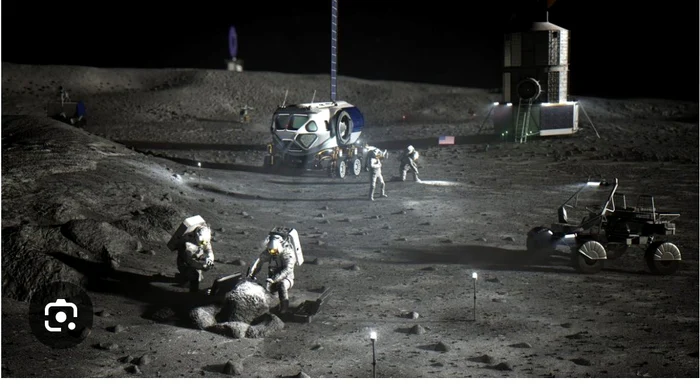
Monthly base project/PHOTO:X
The announcement marks a shift in strategy for SpaceX, founded in 2002 with the stated goal of reducing launch costs by developing reusable rockets and turning humanity into a “multiplanetary species.” Until recently, the central focus was Mars.
Meanwhile, Bezos' company, Blue Origin, has been banking on the idea of building industrial infrastructure on the Moon for years. Its slower pace has often been mocked by Musk, but Bezos has defended a gradual approach, comparing his company to a turtle: slow but steady progress, The Wall Street Journal and BBC write.
From Mars to the Moon
A little over a year ago, Musk was saying that “the Moon is a distraction,” insisting that the road must lead directly to Mars. But the context has changed. SpaceX is preparing for a possible public listing, and investors are looking for a clearer outlook in the short and medium term.
In parallel, political priorities in Washington have shifted to the return of astronauts to the Moon by 2028. The US Artemis program, coordinated by NASA, aims to establish a sustainable human presence at the lunar south pole.
Musk recently admitted that developing a colony on Mars could take more than two decades, in part because of “launch windows” — favorable periods of alignment between Earth and Mars that occur roughly every 26 months. Instead, he claims, a self-sufficient lunar base could become a reality in less than ten years.
However, the challenges are considerable. SpaceX has yet to fully place its large Starship rocket into orbit, and space refueling technology — essential for long-duration missions — is still under development. In addition, the company experienced delays in projects related to the lunar lander commissioned by NASA.
Different paces, similar ambitions
In 2023, SpaceX achieved 165 launches, consolidating its dominant position in the commercial market. Blue Origin, founded in 2000, has made far fewer orbital flights. However, Bezos' company is planning a cargo mission to the moon in the near future and has reduced its investment in suborbital tourism to focus on lunar projects.
Amid SpaceX's change in direction, Bezos posted an image of a turtle on the X Network — a gesture interpreted as an allusion to competition with Musk.
Musk responded by saying that it doesn't matter who gets to the moon first, but who can transport “millions of tons of equipment and people” to build a functioning city. “In that sense, maybe we are the turtle for now,” he added.
The new “space race” is no longer dominated by states, as it was during the Cold War, when the United States and the Soviet Union competed for scientific supremacy. This time, the competition is held by billionaires, in a different geopolitical and economic context.
What does life on the moon entail?
In the following years, the Artemis II mission will send a human crew beyond the Moon aboard the Orion capsule. Among the astronauts is Victor Glover, who points out that space exploration is “harder than it looks”.
“The space is really challenging,” says NASA astronaut Victor Glover. “It's harder than it sounds, and we don't say that often enough.”
Glover is set to fly the Artemis II mission – the first manned Orion capsule to fly beyond the Moon, further than humans have ever gone. For ten days, he and his colleagues will live in a small pressurized compartment, completely dependent on the limited resources on board, the BBC reports.
“We have a tank of water, and as we drink it, it runs out. We have food, and as we consume it, it disappears – no one comes to supply us,” he says.
Even the most mundane activities become complicated. “There's no privacy. You can go into the hygiene compartment and close the door, but as soon as you turn the system on, you wake everyone up – it's the loudest thing after the engine.”
They are apparently minor details, but which require a special psychological preparation.
The Artemis program is the first step towards a sustainable return of mankind to the Moon. Future US-led missions aim to build a base near the lunar South Pole. Astronauts will live months away from Earth in an airless environment with extreme temperatures, radiation and nights that last for two weeks.
Selecting the right ones for such a mission is a complex task.
“We're not looking for superhumans in one field,” explains Sergi Vaquer Araujo, coordinator of the space medicine team at the European Space Agency. “We're looking for good people in all areas – and that's extremely difficult.”
In the 1950s, when NASA was selecting its first astronauts, candidates were test pilots in exceptional physical condition who underwent exhaustive medical tests. Today, standards remain high, but the focus has shifted.
Chronic illnesses that could affect performance during the mission are disqualifying. Lung conditions such as asthma, heart problems or color blindness can eliminate even otherwise outstanding candidates. “We don't have the medical equipment from Earth in space,” says Vaquer Araujo. “Risk reduction is key.”
However, fitness is only the beginning.
The psychology of isolation
If the first astronauts were often described as “alphas” – competitive and willing to take risks – today the ability to work in a team is crucial. In the recent ESA selection process, candidates were assessed in group exercises, where team success mattered more than individual performance. “To succeed, you sometimes had to lose for the benefit of the team,” says Vaquer Araujo.
An insight into life on a lunar base can be obtained in Antarctica. British surgeon Nina Purvis spent a winter at the Franco-Italian station Concordia, nicknamed “White Mars” because of the isolation and extreme conditions. For nine months, she and 12 other colleagues lived completely cut off from the rest of the world, in temperatures that can drop below -80°C.
“You have to be a pleasant person to work with, first and foremost” says Purvis. “Managing the pressure, the stress and the uncertainty and still getting the job done.”
Studies conducted there show that monotony can become as great a danger as the cold. To combat boredom and isolation, the team organized sessions of mindfulness, yoga, Lego building and painting – activities with “low logistical cost and high psychological benefits”.
Space agencies, including the European Space Agency, place increasing importance on the selection of candidates able to work in a team and manage long-term stress. Experiments conducted in Antarctica or in simulated habitats show that monotony and isolation can become challenges as great as technical risks.
Building a moon base also involves major engineering hurdles: shielding from solar radiation, transporting materials, and maintaining energy autonomy. However, both Musk and Bezos argue that the Moon can become an industrial and technological hub, including for the development of artificial intelligence infrastructures in space.
The race is on. It remains to be seen who will succeed in turning the ambitions into reality—and how ready humanity is to live, permanently, beyond Earth.