An outstanding general reveals Russia's weak point. He also mentions Poland

Carolina Druten, Die Welt: In your article for The Telegraph, you wrote that the Baltic countries must be prepared to fight for up to two weeks without additional reinforcements. This is quite a long time, especially considering the fact that speed works to the advantage of the aggressor.
However, soldiers do not sit in vehicles and wait for the start signal like in car races. A big problem is the availability of German railways and DB-Cargo [niemieckiego przewoźnika kolejowego świadczącego usługi w zakresie przewozów towarów] in conditions of peace.
That is why the issue of military mobility is so important. If, despite the crisis, we are not yet formally at war, all rail transport in Germany, Poland and other countries operates normally. It is simply not possible to clear all the tracks overnight to transfer an armored brigade from one country to another within 24 hours.
In Germany, a state of emergency would be needed to prioritize military transport and speed up the movement of troops. It is not easy to introduce it – the Bundestag must approve it by a two-thirds majority.
I am convinced that in such a situation, German and Polish railways would react quickly. However, if you start from scratch and are completely surprised, it takes a few days. Hence these two weeks. I find this unlikely. However, it was quite a shock for Lithuanians when I told a conference a few years ago that in the event of an attack, it might take some time before additional American or German combat troops would arrive to help. Therefore, they must be mentally and materially prepared to continue fighting. NATO is not a big protective wall that everyone can hide behind. Lithuania and the troops stationed there are part of this wall. And this is why the concept of total defense is so important.
Does this mean that the NATO forces already stationed in the Baltic countries are insufficient? For example, a German brigade is deployed in Lithuania, which will eventually number 5,000 soldiers.
It's not just about land forces, but about all the air power that the allies can contribute, i.e. the German, Polish and other air forces. Finland, Sweden and Norway have or will soon have F-35s, Gripen and other fighters. This is a huge force, it would dominate any Russian air force.
When it comes to long-range weapons, missiles for HIMARS systems or other launchers, there are definitely not enough of them. In every exercise I participated in, the ammunition ran out after two days. This is a structural problem: no one wants to stockpile large stocks of ammunition that will hopefully never be needed because it is very expensive.

German Defense Minister Boris Pistorius with soldiers of the Bundeswehr armored infantry battalion Panzergrenadierbataillon 122 during exercises before the unit's deployment to Lithuania, Weiden, Germany, February 28, 2024.Leonhard Simon / Stringer / Getty Images
In our war game, NATO had difficulty activating NATO Article 5 – this was met with American opposition. What would the reaction of Lithuanians be like without the alliance if Russia attacked the Suwałki Isthmus militarily?
Additional NATO forces would arrive through the port there to defend Lithuania…
Of course, the Russians wouldn't start by sending tanks right away. It would start with an infiltration by their special forces to decapitate political leaders. All this would take place in parallel. So the actual onset of aggression would not be black and white. But this attack would be visible. I myself participated in several war games, organized especially for Lithuania, during which we tried to encourage it to adopt a more comprehensive total defense concept, like Finland's. It's about preparing society for the effects of an attack on electricity supplies, cyberspace, roads, railways – all of these things.
You're describing a large-scale invasion. There were no air raids on Lithuania in our war game. Franz-Stefan Gady, who played the role of the Russian Chief of Staff, wanted to avoid NATO's formal activation of Article 5 and therefore tried to mask the invasion under the guise of a humanitarian action. What, militarily, can be done without Article 5? To what extent is NATO's military response automatic and does not require a political decision?
Lithuania would most likely request consultations with the alliance under Article 4 if it noticed any hostile actions or preparations by Russia for aggression. In the event of an armed attack – not necessarily using air power – it would likely turn to the alliance again and demand the application of Article 5. Whether all member states would agree to this is another matter. However, individual countries can take action on their own. In a serious case, this would happen very quickly. I can well imagine that the British Joint Expeditionary Force, for example, would react [kierowana przez Wielką Brytanię wielonarodowa koalicja 10 państw północnej Europy ]which include the Nordic and Baltic countries.
It is a kind of coalition of the willing without the participation of Germany.
Nobody would stand and say: Lithuania is unlucky. I think your war game served a useful purpose in forcing people to grapple with important questions. When should you make which decision? Under what conditions? However, I also believe that in any war game the assumptions should be revealed: how much time was there for warning? What resources were available? Personally, I am particularly interested in how Germany is perceived internationally in connection with this war game. Headlines appear in the media: “The United States just watched, Germany was weak.” As an American living in Germany, I am sensitive to this. Germany is the strongest and most important country in Europe. And it must be perceived that way. The issue of perception is very important.
In the war game, Germany was not prepared to act quickly and decisively without American leadership. For me, this was one of the most important takeaways from this game – not a question of whether Lithuania could repel a Russian attack. In our simulation, the NATO Secretary General, played by Oana Lungescu, tried to activate the alliance's regional defense plans for the Baltics and Central Europe – without invoking NATO's Article 5. But even this requires American capabilities.
If Russia attacks in any way, the game will be about regaining the initiative — not necessarily just at the point of attack. The purpose of effective deterrence is to make Russia realize that in the event of aggression it would lose Königsberg – and very quickly. He needs to know that we are ready and capable of this.
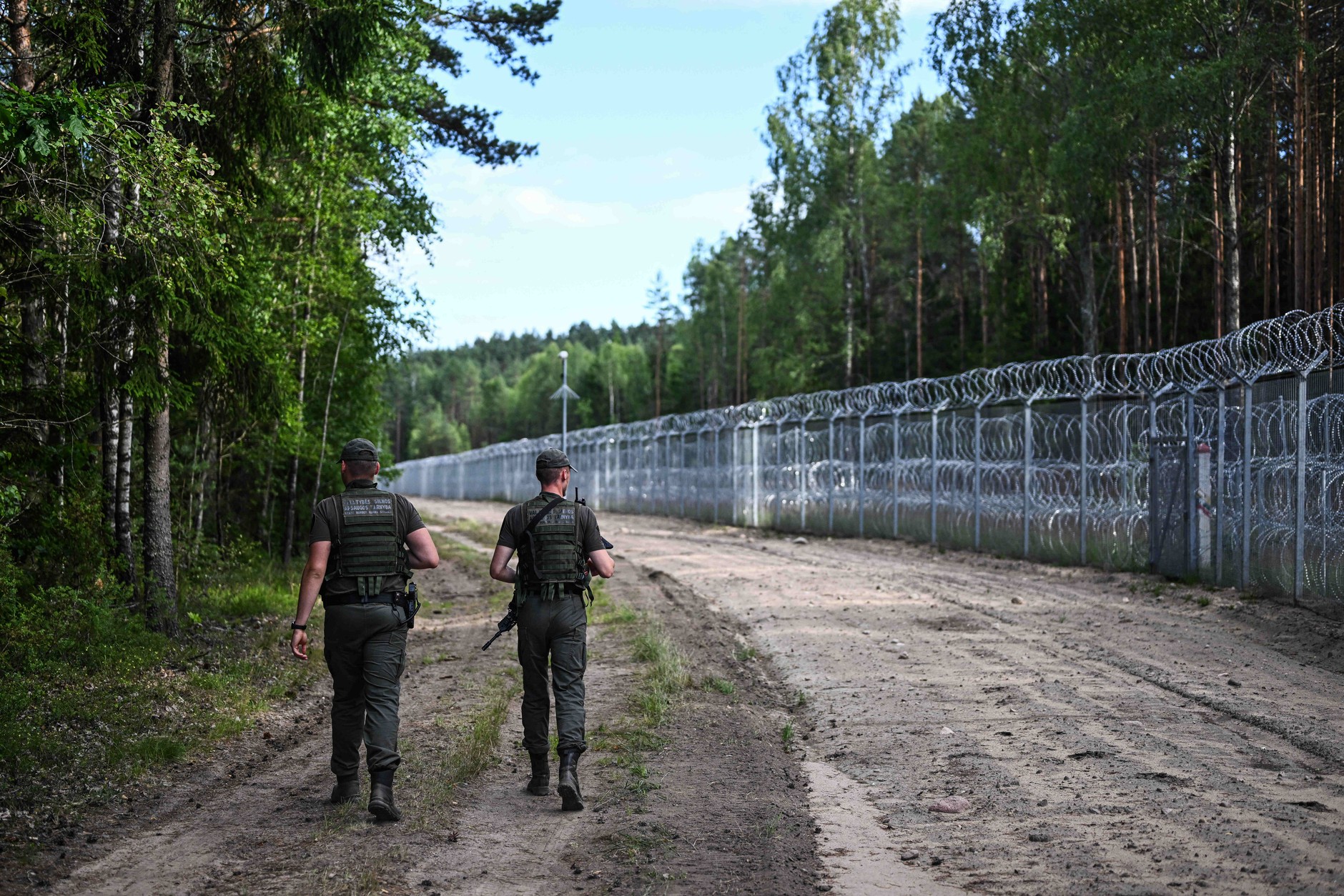
Lithuanian border guards near the metal fence on the Lithuanian-Belarusian border, Dziewieniszki, July 10, 2023.AA/ABACA / PAP
Brief explanation: Königsberg is a Russian exclave between Poland and Lithuania on the Baltic Sea. Russia keeps there, among other things, air defense systems and ballistic missiles.
I'm pretty sure Königsberg would have been neutralized within the first 24 hours. Other commanders say the same. I do not mean the entry of ground troops there, but the use of kinetic and non-kinetic means to neutralize Königsberg as a military factor of the Russian Federation.
Please explain this.
First of all, I am sure that we understand the situation in Königsberg perfectly well and know exactly what capabilities Russia has there – air and naval forces, long-range weapons, air defense systems and so on. This could start with cyber and electronic attacks aimed at disabling as many systems as possible, especially air defense and long-range weapons, to prevent the Russian air force and navy from operating from there. Then I can imagine using long-range kinetic weapons – artillery or rockets – against key facilities in Königsberg.
And would it be possible even without US support?
I don't know what specific capabilities countries in the region would have, and I shouldn't know, because it's rightfully confidential. I think that countries in the region could inflict significant damage on Russia in Königsberg even without US participation. For example, I can imagine that Poland would immediately join such attacks. There are other places to put pressure on Russia, such as the Kola Peninsula in Russia's far north, close to Norway and Finland.
The main bases of the Russian Northern Fleet are located there, including the bases of submarines equipped with strategic nuclear weapons systems.