Economists' warning to the Government: “The ceiling on the addition is a populist measure that takes us back to the 90s. The costs will also be borne by the customer”


Although presented as a saving solution for periods of high inflation, the administrative limitation of the commercial addition to food products – a measure prepared by the Ministry of Agriculture – risks generating more problems. Economics professor Christian Năsulea explained to “Adevărul” why the project announced by the relevant minister, Florin Barbu, could produce effects contrary to those promised, from the disappearance of goods from the shelf to price increases hidden in the bureaucracy.
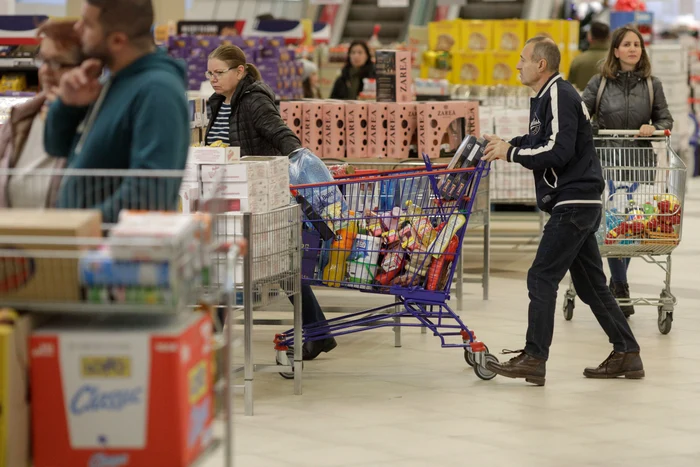
People shop in a supermarket in Bucharest. PHOTO: Inquam Photos
The Minister of Agriculture, Florin Barbu, said on Wednesday that, in the next period, he will promote in the Government and Parliament a project on the management of inflation through a mechanism for capping the commercial addition for agri-food products on the territory of Romania, when inflation exceeds 5%-6%.
Asked whether the government will come up with an extension of the food additive capping measure, given that the current measure is due to expire, the minister said that a new capping scheme is being worked on.
“Sure, it expires on March 31st. We need to talk about inflation right now. Inflation is high in Romania and on agri-food products and, of course, we must sit down, the Government of Romania, my colleagues in the Parliament, to try to create a mechanism to manage the inflation part. I will do this, I will bring all the data, of course, economic and all the data established by the National Institute of Statistics. And I think that at the moment we don't have to intervene in the market, but through a correct mechanism by which we can manage inflation very well, everything that means agro-food products on the territory of Romania, when inflation jumps by 5%-6%, should include a mechanism for capping the commercial addition”said Florin Barbu, on Wednesday, after participating in the General Assembly of the National Union of County Councils in Romania.
He pointed out that the measure would only target commercial additions, not one of price capping.
“To be very clear, the Ministry of Agriculture promoted the capping of the commercial addition and it had no impact, as happened in Energy, when the price of energy or gas was capped, and the Romanian state paid almost 32 billion to the companies that delivered this gas and this energy”said Barbu.
“The market reacts naturally, regardless of politics”
However, the measure is harshly criticized by economists. In an analysis for “Adevărul”, economics professor Christian Năsulea emphasized that Romania's recent economic history has already demonstrated the inefficiency of state intervention in price formation. Năsulea believes that politicians ignore the lessons of capitalism and propose solutions that seem attractive to the electorate, but which seriously distort the market.
Christian Năsulea emphasizes that any price forcing causes chain reactions that the legislator cannot control. When the state imposes limits, traders will look for methods of economic survival, and the end result directly affects the citizen's pocket.
“In principle, any capping measure, intervention on the price system, leads to distortions with a negative effect on the economy. We are not only talking about an impact on companies in the agricultural sector […] but also about negative effects on consumers. They can end up feeling either shortages, if the measure is implemented in an exhaustive way, or effects that go in the direction of moving the margin in the price of other products, as we have already seen happen with the previous capping scheme that we introduced in Romania”, Professor Năsulea declared.
He insisted that supply and demand mechanisms are stronger than government decrees: “We already know it doesn't work the way the politicians tell us. The market reacts naturally, and any attempt to insist on such measures, which in my view are purely populist in nature and not intended to help the consumer, will actually lead to higher overall costs.”
The hidden bill of bureaucracy
A technical aspect, but with a major financial impact, is the cost of compliance. Any new rule requires separate accounting, additional checks and dedicated staff. The economist warns that these administrative expenses do not disappear into thin air, but are found on the tax bill.
“The bottom line that bothers us the most is that when you make businesses comply with additional rules, any rule has a cost. An accountant has to keep records, someone has to calculate and verify how the add-on is determined. Those costs are passed on, in one form or another, to the end consumer. It is, again, a measure presented as having a positive impact and good intentions, but it will generate a negative impact that consumers will still want. endure”, Christian Năsulea explained.
The economics professor also dismantles the argument of protecting the Romanian producer. He reminds that the domestic business environment knows very well the methods of avoiding such controls, methods that proliferated during the transition period after the Revolution. Large chains or intermediaries may “walk” the goods through several firms to dilute the official trade mark.
“I don't see how such a measure could benefit Romanian producers, especially since there are already known workarounds. I'm referring to the practice of limiting or publishing the addition, introduced by Romanian populists in the early 90s, which was avoided by passing the products, on paper, through several companies, so that the addition seems smaller”explained the expert.
The ceiling on the commercial addition to food expires on March 31
On September 25, the Government extended by six months the capping of the commercial addition to basic foods, until March 31, 2026.
The list of foods with a capped commercial allowance includes 17 products and food categories:
- Plain white bread (300-500 g, no specialities)
- Drinking cow's milk (1 l, fat 1.5%, except UHT)
- Bulk cow telemea cheese
- Plain yogurt from cow's milk (3.5% fat, maximum 200 g)
- White wheat flour “000” (maximum 1 kg)
- M caliber chicken eggs
- Sunflower oil (maximum 2 l)
- Fresh chicken meat (whole chicken, cutlery, bone-in legs, wings, standard version)
- Fresh pork (pork meat, pork leg with/without bone, pork loin)
- Fresh bulk vegetables (tomatoes, onions, cucumbers, dried beans, carrots, Bianca bell pepper, capsicum, garlic)
- Fresh fruit in bulk (red apples, golden apples, plums, pears, table grapes)
- Fresh white potatoes in bulk
- Cast white sugar (maximum 1 kg)
- Sour cream (12% fat)