Inflation in China disappointed again. Prices are slowing down and factories are still at a low


2026-02-11 09:56
publication
2026-02-11 09:56
The January inflation reading from the Middle Kingdom brought another cold shower to investors. The dynamics of consumer prices (CPI) unexpectedly slowed down, missing economists' forecasts. Producer prices continue to fall, confirming that the Chinese economy continues to struggle with deep structural problems and weak domestic demand.
The latest data released Wednesday morning by the National Bureau of Statistics (NBS) showed China's CPI inflation was just 0.2% year-on-year in January. This result is clearly worse than the market consensus, which assumed a price increase of 0.4%. It also means a sharp deceleration compared to December, when the consumer price index amounted to 0.8%, raising (as it turns out premature) hopes for a more lasting recovery in domestic consumption.
On a monthly basis, prices increased by 0.2%, which was also below the expectations of analysts who expected a reading of 0.3%.
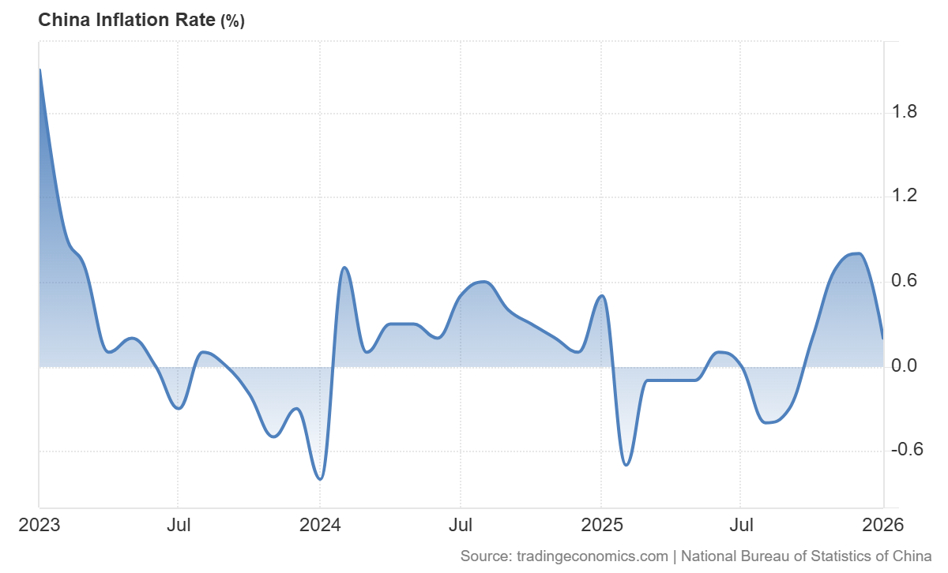
Why such a poor result? Some analysts point to a base effect related to the Lunar New Year. Last year, the holiday fell in January, driving up prices at the time, while this year the celebrations have been moved to February. This statistical disruption makes it difficult to clearly assess the condition of the Chinese consumer, although the fundamental data do not inspire optimism.
Core inflation (excluding food and energy prices) also decelerated from 1.2% in December to 0.8% in January. The main culprit for the low overall reading were food prices, which fell by 0.7% y/y. Primarily, pork and eggs became cheaper, although the prices of fresh vegetables increased.
Deflation in Chinese factories is in full swing
The situation on the production side is even worse. The so-called Producer inflation (PPI) fell by 1.4% year-on-year in January. Although this result is slightly better than forecasts (a decline of 1.5% was assumed) and is a certain improvement compared to December's -1.9%, the fact remains that Chinese industry has been stuck in deflation for over three years.
Goods leaving factory gates continue to become cheaper, which affects corporate profits. Chinese producers, struggling with excess production capacity, are forced into price wars, and weak domestic demand is unable to absorb supply. Exports remain the salvation, which, however, creates tensions between Beijing and Washington.
The Chinese authorities are trying to stimulate domestic consumption in order to base economic growth more on it. For this purpose, stimulus programs were launched, including: subsidies for household appliances and electronics, encouraging citizens to replace appliances with new ones. Beijing intends to allocate 62.5 billion yuan (PLN 32 billion) for this type of programs.
Still, consumers appear to be continuing to tighten their belts. Markets are now impatiently waiting for the March meeting of the Chinese authorities, where the communists are to present their economic goals for 2026. For now, however, January's data suggest that the fight against deflationary pressure in the world's second largest economy is far from over.
MM