Glovo's Italian branch investigated for exploiting delivery workers, who were paid below the poverty line


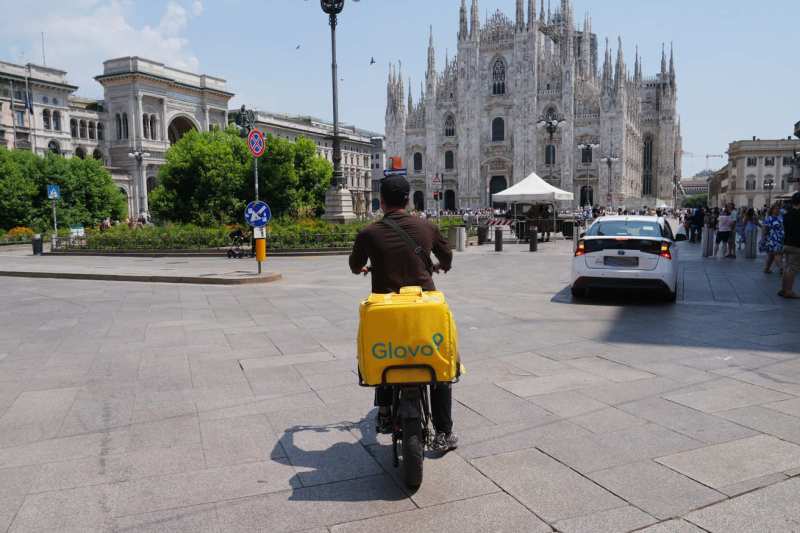
Glovo delivery man in Milan. PHOTO: Duilio Piaggesi / Zuma Press / Profimedia
The checks carried out indicate a situation of real labor exploitation, perpetuated for years at the expense of a very large number of workers, who receive wages disproportionate to the quantity and quality of work performed, said prosecutors quoted by Reuters and Corriere della Sera.
Prosecutors in Milan have placed the Italian branch of delivery platform Glovo under judicial supervision and its chief executive is under investigation for alleged exploitation of workers, according to court documents cited by Reuters.
The documents show that a specialized division of the Carabinieri issued a decree placing the Foodinho company under judicial control, the latest in a series of wider actions to combat labor exploitation in various sectors of activity over the past three years.
The 54-page court order seen by Reuters shows Foodinho's deliverymen were paid below the poverty line, an average of 2.50 euros per delivery. In some cases, the wage was 75 percent below the poverty line, according to the document, which includes testimony from 39 migrant workers.
The minimum subsistence level for workers in Italy is considered to be 1,245 euros per month.
“A real exploitation of labor”
“The checks carried out indicate a situation of real labor exploitation, perpetuated for years at the expense of a very large number of workers, who receive wages disproportionate to the quantity and quality of work performed,” the prosecutors wrote in the document.
“This illegal situation must stop as soon as possible, also because it involves a significant number of workers living on incomes below the poverty line,” officials said.
Prosecutors said the bike couriers were officially self-employed but in practice worked as employees because they were coordinated through an IT platform that set their working conditions.
Under judicial review ordered by prosecutors, a court-appointed administrator will ensure that the company grants its workers the correct legal status and will monitor compliance with work rules and conditions.
Testimony of a Glovo courier
Corriere della Sera quoted the testimony of a Pakistani courier who works for the Glovo platform in Milan.
“I am a freelance courier for Glovo. I use an electric bike that I bought myself and I get an average of €2.50 per delivery, with increases depending on distance or weekends. I do about 10-15 deliveries a day, with peaks of 20-25, covering between 50 and 60 kilometers,” said the courier.
“I stay connected to the app for about 12 hours a day, generally from 10 am to 10 pm. I'm constantly located by GPS. If I'm late, Glovo calls me to find out why I'm not moving or why I'm not delivering. If I could, I'd quit this job, but I don't have a residence permit yet and I can't find another job,” he added.
“I pay 300 euros a month for a bed in a room where I live with three other people 35 km from Milan, I spend 200 euros a month on train trips and I send 300 euros a month to my mother in Pakistan,” the courier also said, according to the testimony quoted by Corriere.
According to the Italian daily, around 40,000 bike couriers work for Glovo in Italy, 2,000 of them in the Milan area alone, most of whom are migrants.
Foodinho srl is an Italian company with an annual turnover of 255 million euros, with McDonald's, Burger King and Poke House among its main clients. It is controlled by a Spanish company owned by a German group with ties to American investment funds.