Spectacular railways built in the 80s with huge viaducts and tunnels. How they ruined themselves in just a few years


Two spectacular railway routes in Romania have been abandoned since the 90s, just a few years after construction. In their wake were impressive works of art, ruined by the passage of time.
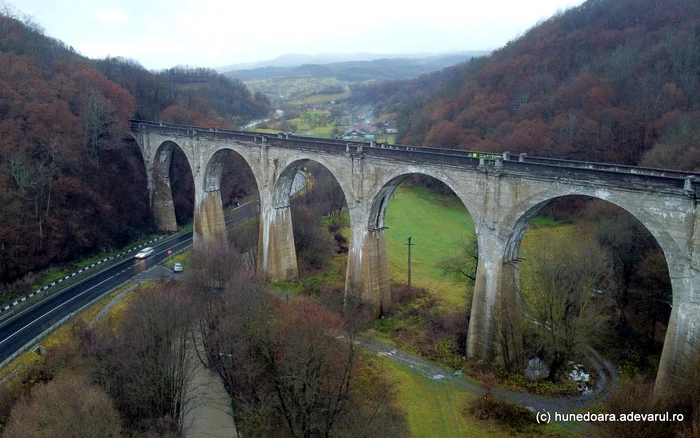
Luncoiu Viaduct. Photo: Daniel Guță. TRUTH
At the end of the 80s, after more than a decade of intense work, two of the most spectacular railways in Romania were inaugurated, but both sections only lasted a few years. The Deva – Brad and Vâlcele – Râmnicu Vâlcea railways were decommissioned in the 90s, and today some impressive works of art and the embankment remain from their routes. Some locals proposed turning them into tourist routes and even restoring them, but without success.
Deva – Brad railway, permanently buried after a landslide
The works on the Deva – Brad railway, 36 kilometers long, spanned more than half a century. The railway section was planned at the beginning of the 20th century, as part of a future Craiova – Oradea highway, which would have connected the south and the north-west of Romania. The railway, with a length of over 450 kilometers, would have crossed the Southern Carpathians and the Apuseni Mountains, transiting the cities of Craiova, Târgu Jiu, Petroșani, Deva, Brad, Vascău, Beiuș, Holod and Oradea.
In the middle of the last century, the railway from Defileul Jiului was completed, which ensures the connection between Deva and Craiova. In contrast, the Western Mountains proved more difficult to cross. On the Deva – Oradea route, a 35-kilometer section, between the towns of Vascău and Hălmagiu, was never completed, and the Deva – Brad line, inaugurated in 1987, was decommissioned a decade later.
The construction of the Deva – Brad railway, which crosses the Metaliferi Mountains, began in 1939, and by 1946 the Mintia – Stoieneasa viaduct, 14 kilometers long, and Brad – Luncoiu viaduct, 5 kilometers long, were completed until 1946, later completed with another two kilometers, up to Dealul Feții, where a mining operation was operating. Work on the most difficult section of the railway, between Stoieneasa and Dealul Feții, was resumed in 1979.
“Among the three sections (Mintia – Stoieneasa, Brad – Dealul Feții and Stoieneasa – Dealul Feții), the latter presented the highest degree of difficulty, from a geological and topographical point of view, with a difference in level of 164 meters and numerous landslides. The section, 13.9 kilometers long, includes 31 bridges and footbridges, 11 viaducts, four tunnels, 11 kilometers of slope reinforcements and embankments, 17.8 kilometers of trenches, for which 1.2 million cubic meters of rock and earth were excavated and more than 400,000 cubic meters of concrete were poured,” showed engineer Liviu Corfaru, at the inauguration of the railway, in 1987.
In April 1997, a landslide in the Stoieneasa area marked the beginning of the end for the Deva – Brad railway.
“The interruption of traffic on the Deva – Brad route occurred on April 22, at 5 am, due to heavy rains. These caused landslides on several sections of the railway. The landslides were more pronounced at km 19-20, between Stoieneasa and Ormindea, caused by the movement of the slope on the right side, in the direction of Brad. The resumption of traffic of the line is, for now, impossible, because the land in that area has not stabilized”, informed, in 1997, the representatives of the CFR Timișoara Regional.
Investments in the restoration of the railway did not continue, and most of the route was decommissioned in the following years, currently only the Deva – Chișcădaga sector, about eight kilometers long, remains functional. The circulation of passenger trains between Oradea and Vașcau has been stopped since the 90s, some sectors being permanently closed to rail traffic, and the railway project between Vașcau and Hălmagiu was no longer completed.
Two kilometers of tunnels
The Vâlcele – Râmnicu Vâlcea railway section had a fate similar to that of the Deva – Brad railway. The line, with a length of 40 kilometers, was planned in the early 1970s to connect the Argeș Valley with the Olt Valley, shortening the connection between Sibiu and Bucharest, and was presented as one of the most spectacular railways in Romania.
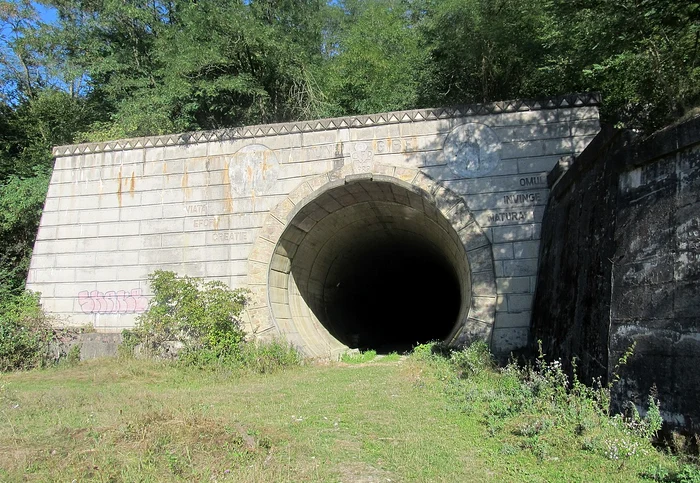
The Gibeah Tunnel. Photo Nenea Harta. Wikipedia
The works started in 1975. The route started from the town of Vâlcele, located about 15 kilometers from Curtea de Argeș, and reached near Râmnicu Vâlcea, where it was connected to the Piatra Olt – Podu Olt railway, which crosses the Olt Gorge.
The simple railway, designed on a route close in distance and relief to that of the Sibiu – Pitesti Motorway (Section 3, with the Poiana Tunnel), included two tunnels with a total length of 4.2 kilometers (Gibei and Ploștina), two large bridges over Argeș and Olt, with a total length of 450 meters, over 100 footbridges, the Topolog, Sâmnic, Sâmnicel and Linia viaducts, in total length of 2,100 meters, and six other smaller viaducts, at Hogea, Ostroveni, Racovița, Blidari, Valea Hotarului and Popești.
“The accelerator covers (via Piatra Olt) the distance between Pitesti and Râmnicu Vâlcea in four hours – a time that will be reduced to only one hour by the construction of the Vâlcele – Râmnicu Vâlcea railway. Due to the uneven relief and the fact that it must cross all the hills and valleys in the area, the Vâlcele – Râmnicu Vâlcea railway line has numerous works of art. Along the 39 kilometers there will be 12 bridges and large and very large viaducts, with a total length of 3,611 meters, located at heights of up to 50 meters from the valley floor. The infrastructures of the largest viaducts – Topolog, Sâmnic, Sâmnicel – were designed for double track, it is estimated that the doubling of the line will be imminent in the near future.“, informed Romania Liberă, in 1976.
In addition to viaducts, digging tunnels was extremely difficult. A “shield”, a mechanical mole used in previous years to dig tunnels in the Jiu Valley, was used, but the terrain posed problems for the builders.
“Here, among unstable lands, progress is arduous, slippery, dangerous. Marl is the rock that terrifies miners – and especially tunnel miners. It is crumbly, slips through the fingers, opens eyes tens of meters deep. The tunnels through which the railway will pass are dug only in marl – and the “mole” (mechanized shield) can only advance with a meter or two in 24 hours. Beyond the marl – or, more precisely, between the marl – the viaducts rise up, like shoulders of the sky supporting the future railway. Even the few portions of the outer embankment – without tunnels and viaducts – are not easy to achieve: they need special reinforcements, drains, retaining walls, bank defenders real industry. Solutions, machines, technologies are tested here – many for the first time nationally, and not only nationally”. note the press of the time.
Work on the railway was partially completed in 1989, but due to the lack of railway signaling systems, it could not be put into traffic. In 1992, landslides destroyed the embankments and structures of some bridges and viaducts still in operation. Due to the lack of funds allocated by the Romanian state, the repair and consolidation works were not completed, and the railway was decommissioned starting in 1998.
Romania's railway network, with a history of almost two centuries
Romania's railway network totals over 10,500 kilometers of railway, being one of the most extensive in Europe. The first railways on the territory of Romania were built in the middle of the 19th century, in the historical regions of Banat and Transylvania, as well as on the route Bucharest – Giurgiu.
A century later, in the first years after the Second World War, Romania's railway network had reached almost 10,000 kilometers. During the more than four decades of communism, approximately 500 kilometers of railways were built, and more than a quarter of the network was electrified and doubled.
“The basic structure of the national railway network was completed before the outbreak of World War II, when the total length of the system was 9,900 kilometers. In 1986, the network had a total length of 11,221 kilometers, comprising 10,755 kilometers of standard gauge, 421 kilometers of narrow gauge and 45 kilometers of gauge track wide. Approximately 3,060 kilometers of track had been doubled, and 3,328 kilometers of railway were electrified”, the authors of the volume “Romania, a country study”, published in 1991 by the Library of Congress of the United States of America, pointed out.
In the second part of the 20th century, along with industry and agriculture, the railway infrastructure benefited from important investments, being considered essential for the transport of goods and the mobilization of labor. More than 400,000 Romanians used the trains annually in the 1980s, some reports showed, and more than 300 million tons of goods were transported annually by rail during the same period.
Extensive investments, resumed in recent years
After 1990, rail transport entered a period of decline, accentuated by the drop in industrial production, the lack of investment in infrastructure, which had numerous deficiencies, and the loss of the attractiveness of this field. In the absence of renovations, many railway stations ended up dilapidated and unsanitary, and the trains were in a similar state.
In addition, the number of cars in Romania has gradually increased from 1.3 million in 1990 to almost 11 million at the end of 2024, according to a report by the General Direction of Driving Licenses and Registrations (DGPCI).
Extensive investments in Romania's railway infrastructure were resumed in the last decade, with financing from the Romanian state and European funds. The most important ones are on the IV pan-European Corridor, of about 1,000 kilometers, on the route Curtici – Arad – Simeria – Brașov – Bucharest – Constanța, where a large part of the route has been modernized or is in the process of being modernized, to increase the speed of the trains and the transport capacity.
Almost 600 kilometers of railway have been modernized in Romania, over 1,200 kilometers are under construction, and another 1,000 kilometers are in the preparation stage, according to 2025 estimates of the Ministry of Transport and Infrastructure.