The hidden danger of Romania's dependence on gas from Hungary. “The EU will ban Russian gas from 2027”

Romania is forced, on cold days, to import gas from Hungary, although we are the largest producers of natural gas in the EU. Energy expert Dumitru Chisăliță explains why we import gas from the neighboring country and what we risk when the Russian gas tap in Hungary closes in 2027.
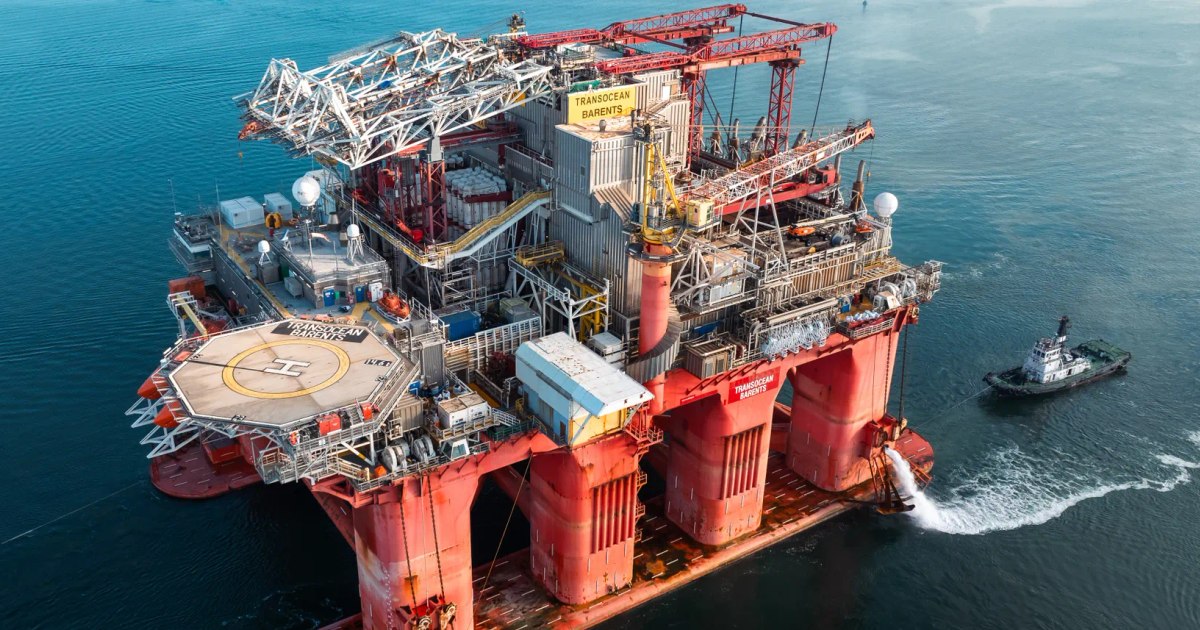
The Neptun Deep platform will produce only over 10 years. PHOTO: OMV Petrom
The Minister of Energy, Bogdan Ivan, stated at the beginning of 2026 that Romania has become the largest producer of natural gas in the European Union. However, during the recent cold days, when gas consumption in Romania increased strongly, the volume of imported gas increased significantly, and they also came from Hungary.
“We have reached the psychological threshold of 60 million cubic meters per day, consumption, which automatically leads us to the growing need to synchronize everything that means extraction from deposits and production, plus to balance the import area at certain intervals“declared Minister Ivan the other day.
An example of this is January 19. At 21.00, Romania was importing gas through all connections, including from Hungary, due to increased consumption due to the cold outside. Domestic consumption was covered as follows: domestic production delivered 23.6 million cubic meters, 26.2 million cubic meters were extracted from deposits, and from imports Romania brought 19.7 million cubic meters to peak consumption. Practically, imports represented about 30% of domestic consumption, according to Ziarul Financiar. One of the main sources of import is Hungary.
From 2027, the EU has established that the continent will no longer import Russian gas. One of the main countries targeted is Hungary, a country on which Romania depends on frosty days.
Energy expert Dumitru Chisăliță, president of the Intelligent Energy Association (AEI), explains for “Adevărul” why we need to import gas from Hungary even though we are the biggest producers in Europe and what will happen from 2027, when the EU will ban the import of Russian gas.
Chisăliță: “The national transport system was designed, when it was designed 50 years ago, to also rely on imported gas”
The truth: The Minister of Energy said the other day that Romania is the largest producer of natural gas in the European Union, but on the other hand we see that these days we import gas from Hungary. Why is this import needed?
Dumitru Chisalita: We import not only these days, but whenever the temperature drops. We call for imports from two sides, i.e. either via Bulgaria, gas coming from the area of Turkey and there in turn these gases, or gas coming from the Caspian Sea area, or gas coming from the Russian area and respectively from Hungary, either we are discussing gas coming from Hungary, which transited Romania, also coming from Turkey and were stored in Hungary, or we are discussing gas coming from the western area, Austria, Germany from that area.
Does the gas imported from Hungary come from Russia?
Unfortunately, it's impossible to tell where the gases are coming from, because the gas molecule is always mixing, and then you really have no way of knowing. According to their statements, it is not gas coming from Russia. But it's just a statement, because eventually the gasses mix in the pipe and you can't tell for sure unless you turn the valve all the way off.
The problem is that we, practically, the gas pipeline from Negru Vodă, at the moment is at its maximum because in addition to the gas that is consumed in Romania, we also have transit obligations through the national transport system to other countries. As such, we are at maximum capacity on Negru Vodă. Giurgiu, which is another point with gas coming from Russia, from Bulgaria, we are somewhere over half of the capacity.
And then there are situations in which to be able to maintain the continuity of the supply of natural gas to the consumer and at the same time to ensure the transit, gas from Hungary is needed.
At the moment we are not taking gas from Hungary, at the moment the gas is leaving Romania to Hungary, but if the cold will persist, considering that the other two import points are at maximum capacity, most likely the only option is to import gas from Hungary.
Now why is it important? Because the national transport system was designed, when it was designed 50 years ago, to also rely on imported gas. That is, at the peak of consumption, our sources and our storage gas extraction capacities are not sufficient, and then at the level of a few days when it is very cold, especially in temperatures that are below minus 15 degrees, we impose this import of natural gas from other sources.
“There is no question, at least until the moment when the natural gas from the Black Sea comes, not to depend on imports”
Do you think it is a vulnerability and should we somehow, taking into account the geopolitical situation, find solutions so that we no longer depend even on these cold days?
There is no question, at least until the moment when the natural gas from the Black Sea comes, not to depend on imports. Without import it is not possible because our consumption needs are more than what we produce and how much we manage to store in summer. So it is an element to which we are dependent until the gases from the Black Sea come.
There are several models. There are models in which you always close on the gases in the warehouses. There are models in which you are limited to imported gas. Shutting down gas between imports, of course, is the most risky, because there is a possibility that you won't find it when you need it, because when it's cold here, it's also cold in Bulgaria, Hungary, and Germany.
Do we have such a system at the moment?
Yes, but at the same time it is an option that, from a cost perspective, may in some situations be cheaper than developing storage warehouses. We have two models. Hungary chose its model to close on gas from its storage facilities. That is, it has a relatively constant import throughout the year, and when it needs to cover its consumption peaks, it calls on specific, developed storage capacities that have a high reaction capacity to cover these consumption peaks.
There are other models based on the idea that for the higher consumption peaks you go and buy gas from the market during that period because you don't have all the costs you have with a storage facility. It is a technical-economic model on which an entire system was built at one point.
Changing this concept doesn't happen overnight, it takes years to completely and totally rethink the system, and of course it comes with lower risk, so your grades in the warehouse mean lower risk, but it also means higher costs in reality.
It is the difference between what we are now as humans and what our grandparents were. Our grandparents built houses with cellars, went and bought everything they needed in the fall, and practically in the winter they only went out to the store from time to time for the absolutely…necessary. We no longer build houses with cellars, we no longer buy anything in the fall, but whenever we need something, we go and buy it at the store.
If at some point there is a shortage of something, that price is very, very high or, please, we risk not even finding it at all. But it's a model that we've built for that.
The danger that may appear from 2027: Hungary, forced to give up Russian gas
In this situation, why does the Minister of Energy state that Romania has become the largest producer of natural gas in the EU?
Because we are the biggest gas producer in Europe. So there are two distinct things: we are the largest manufacturer in terms of annual production. It's just that annual production means a big difference between daily production. Why? Because we have a consumption difference of 13 times between the summer peak and the winter peak. Either the gas field or the deposit does not know how to increase 13 times. Flexibility, for example, in Romania on gas sources is somewhere around 1%, that is natural flexibility, there is no way to increase it. That's all there is to it, that deposit. Naturally, that's all it can be. And on warehouses, in the middle of winter, the flexibility is somewhere around 14-15%. At the beginning of the withdrawal from deposits, the flexibility is greater, but somewhere in January-February this is the flexibility. Or we had increases on certain days from 40 million to 60 million cubic meters of gas, we increased by 50%. 50% do not know how to react these systems and then we turn to imports.
That does not change the fact that when we add up the production for the whole year we are the biggest producers.
Could we, if we had warehouses, live only with gas from us?
We could not live without imports.
If we take into account the exploitation of gas from the Black Sea, then the situation would somehow change. Would an investment in these deposits of ours be more efficient, more sustainable?
So once again, any investment means higher costs. So there are no investments without high costs.
In the case of gas exploitation from the Black Sea, we at the level of production will far exceed consumption. The problem is that, with this surplus of natural gas, we will be put in a position to conclude sales contracts outside of Romania, because Romania has no way of consuming such a large amount of gas.
Everyone wants some contracts that provide for the supply of gas in the winter as well. I mean, nobody wants to buy you gas in the summer. Or if you want to sell both in summer and winter, because that's your interest, in winter you can't go and say, “I'm not giving you gas anymore” because you're breaking the contract.
Then there is a variant, which is again a technical-economic variant, in which the scenario is repeated in those moments as well. It's a technical and economic variant, again along these lines. If we go back to our grandparents and go and buy in advance absolutely everything we need and put in the cellar, or stay like the modern man who when he needs to go and buy. That's exactly the difference.
What time horizon are we looking at in relation to these Black Sea exploits?
According to official data, we are talking about 10 years. Taking into account the way onshore mining has evolved, the duration will certainly be longer than 10 years.
Will the decision taken at the EU level to completely stop the import of Russian gas until 2027 affect us?
We do not have any direct contract with the Russian Federation, as other countries, Hungary and Slovakia do, so there should be no direct influence. I do not exclude the fact that such a situation could lead to a lack of supply at certain times of the year. The lack of supply causes the high price increase on a frosty situation, on a situation with high demand. And then, yes, indirectly we can also be affected.