Article by Andrei Niculescu – Published on Sunday, 01 February 2026, 13:06 / Updated on Sunday, 01 February 2026 13:06
There is a new element in today's football. I don't know exactly when it came out, who had the idea to throw it in our face, and what it's good for, but we run into it frequently. It's about “expected goals”.
I'm not a big follower of corporate language, of “meetings”, “tasks”, “dead lines” or “calls”, but this thing sounds better in English than in Romanian, goals expected. Starting from here, it is very possible that from now on in Barcelona's matches, a new column will appear in the statistics area: unscored goals. It's kind of nonsense, I know. The goals are the ones that appear on the scoreboard, the others are misses. But if there are expected goals, why not unmarked goals?
In fine. Returning to Barcelona, who did not see Saturday night's match with Elche they could think that everything was within normal limits and that it was a result, speaking of the idea above, “expected”. Even if you take a look at the statistics and stop only at the shots on goal, you are not overly surprised: 3-8. You think that Inaki Pena was in Elche's goal, who was at Barcelona and showed that he has quality, and you even think that he had something to prove to Hansi Flick.
Later, however, if you continue your research and reach the goal area, some lights should light up there. 30 times the Catalans shot on Saturday night, new record this season (last season, the record was also Barcelona's, 40 shots in a match with Mallorca, finished 1-0!!). Following the same line, the last 3 games of the Catalans in La Liga produced, in this chapter, 62 shots. For 6 goals. On average, one goal per 10 shots.
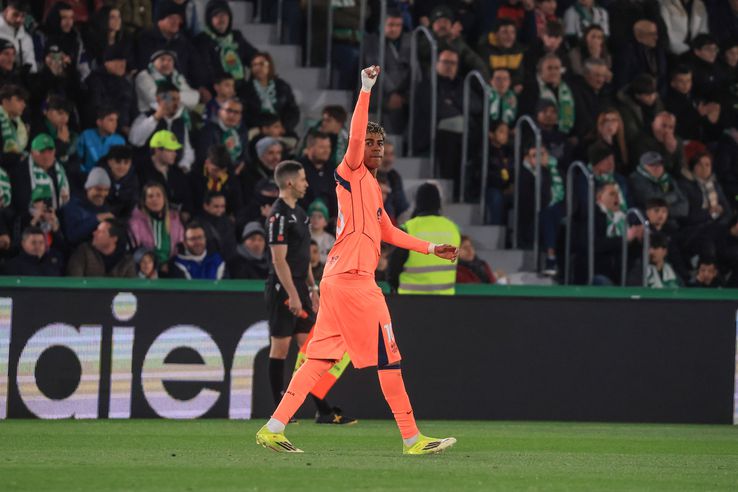
If it's a lot or a little, good or bad, it's a matter of taste. Barcelona today seem extremely keen to give their fans games that straddle the fine line between spectacle and heart attack. It's a different team, that's for sure, but this thing works in a positive way when things end well. They didn't finish well with Real Sociedad and the failure that keeps the title fight alive appeared in a match that the Catalans should have controlled since the break and still in scandalous fashion.
Flick's boys seem to be having fun on the field, and there is nothing illogical here since their football is proposed by an increasingly better Lamine Yamal, but still a child at his 18 years. Not long ago, Lewandowski gave an interview in Poland and told how, although when he came he was asked to implement in the locker room the seriousness that has always characterized him, he was infected by the exuberance of his younger colleagues. In principle this is not bad, because football is made, in principle, for people's entertainment, but it cannot be said that it is too good when the fun is replaced by disappointments, see the situation in San Sebastian.
This is the job of Hansi Flick, who perfectly captures this role of father-grandfather. Which, in fact, it is in real life. In a locker room like Barcelona's, it's not that simple, especially since there are a lot of young people. The German coach had requested an approach to the game in such a way that there would be no need for a new “comeback”.
It's happened 14 times this season, in 33 games! And his players started like a rocket, they scored quickly and, apparently, they thought that from here on it was simple, so, “viva la fiesta!”. It ended with Cava (we are in Spain after all) but it might as well have ended with Xanax as Elche didn't give up even when it was 3-1. In parentheses, let it be said, Elche is an example of a nice team, a team that plays football and does not deviate from this line.
The question now is: Can Barcelona, with this style, make claims beyond La Liga? In Europe, that is, where opponents are both valuable and cynical, see Arsenal or Bayern. It was known about the Catalans that they have big problems in defense with this philosophy of Hansi Flick, more recently it seems that the problem is actually converting the industrial amount of opportunities they create into goals.
Can this Russian roulette work in the Champions League, the example of the “double” with Inter being still fresh? Can this teenage spirit be a winner? Obviously we have no way of knowing the answer today, but keep the questions in mind for the end of May.
But one thing is certain. Flick's Barcelona matches are never boring.