3I/ATLAS is an object from outside the solar system, representing the third confirmed case of an interstellar visitor in the history of astronomical observations. The name “3I” means “third interstellar”, emphasizing the rarity of this phenomenon. The object's diameter is about 20 km, which makes it much larger than its predecessor, such as 'Oumuamua, which was about 400 m long and ten times smaller in diameter.
The trajectory of the object draws special attention. It moves almost in the plane of the Earth's orbit, with a deviation of only 5 degrees. According to the calculations of prof. Avi Loeb from Harvard University, the probability of such a coincidence is extremely low, comparable to winning the lottery. Additionally, the object will approach Venus, Mars and Jupiter, which reduces the chance of randomness to just 0.00005 percent.
Read also: Surprising results of observations of comet 3I/Atlas. The unusual symmetry puzzles astronomers
These parameters suggest a precisely planned path, leading some to hypothesize a deliberate course towards potential signs of life. While such interpretations remain speculative, they provide a basis for further discussion.
Prof.'s hypothesis Avi Loeb and new reports
Prof. Avi Loeb, a renowned astrophysicist and former director of the astronomical institutes at Harvard, has been dealing with the topic of extraterrestrial intelligence for years. His approach is based on thought experiments that challenge conventional explanations.
In January 2026, based on analysis of Hubble images, Loeb and his colleague Toni Scarmato identified symmetrical streaks – three mini-jets spaced 120 degrees apart and a fourth, stronger jet directed towards the Sun. This system rotates every 7.1 hours, resembling a trajectory control mechanism. After the discovery of symmetrically spaced “tails” in the 3I/ATLAS facility, Dr. Frank Laukien, Loeb's colleague, joined the discussion and put forward his theory: it was not a natural gas ejection, but… correction engines to change the spacecraft's flight trajectory.
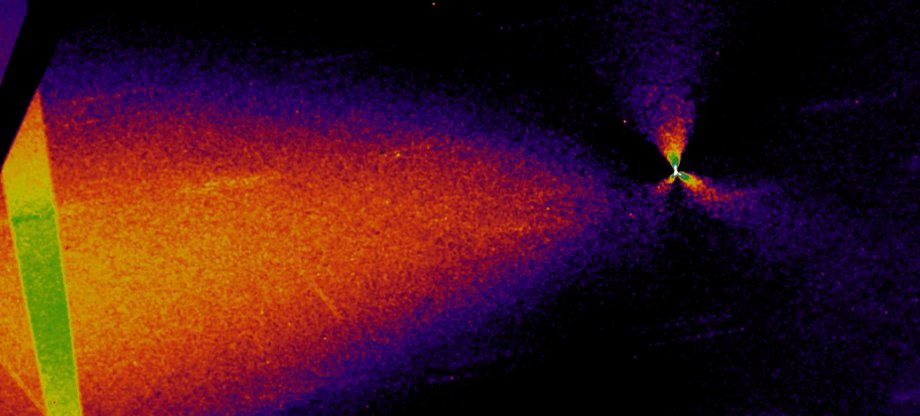
Symmetrical ejections from 3I/ATLAS
The latest reports also indicate further changes in the facility's activity. SPHEREx observations from December 2025, analyzed in early January, revealed a dramatic increase in activity after perihelion, with strong gas emissions. Emissions of carbon monoxide and water increased twentyfold, indicating complete sublimation of the ice.
Earlier observations in November 2025 by the Europa Ultraviolet Spectrograph instrument on Europa Clipper revealed ultraviolet activity when the object was invisible from Earth. ESA also contributed to the research, using spacecraft such as Mars Express, ExoMars Trace Gas Orbiter and Juice to observe from different perspectives.
Still, Loeb treats these observations as hypothesis, not fact. However, he himself suggests that 3I/ATLAS could be the mothership of an alien civilization, capable of sending reconnaissance probes.
Read also: Mysterious radio waves from Antarctica. Scientists still don't know their source
Reports of this type come mainly from researchers who publish analyzes based on data with elements of speculation. The media hypes up these stories with catchy titles, e.g. “Comet too symmetrical? Streaks like engines!”, forgetting that all of nature is full of symmetry and order. The goal is to generate internet traffic, discussion and interest, which translates into popularity and research funding. This mechanism combines facts with hypotheses, promoting astronomy, although it ultimately explains natural processes.
The voice of skeptics
NASA and most astronomers are wary of 3I/ATLAS, classifying it as a rare but natural comet. Light emission results from the release of gases and dust that reflect sunlight. Symmetric jets may be the result of natural phenomena, with no evidence of technological intervention.
Skeptics point to the lack of complete data, including spectral measurements and confirmation of the lack of a tail. They emphasize that media hype around similar objects is not new and often ends with confirmation of their natural origin.
The phenomenon of the popularity of conspiracy theories
Topics such as UFOs, flat Earth and alien visits are extremely popular on social media and video platforms. The reason is the mechanism in which sensation generates popularity, which generates income.
An example is David Icke, a former sports presenter who became a prominent propagator of conspiracy theories. The author of more than 20 books about reptilians, secret elites and global conspiracies, Icke attracts followers from a variety of backgrounds, from New Age to the far right. His narratives create a coherent “hidden truth”, which is an effective marketing strategy: book sales, subscriptions and lecture tickets.
It is therefore not surprising that more and more such people and content appear on the Internet. This is simply a very effective marketing strategy – the sensation attracts attention, which translates into subscriptions, sales of books and lecture tickets. You can turn it into a very lucrative business, which has one more advantage – if you are caught lying, you will say that it is another attempt to block and cover up the only true revealed truth, described in yellow subtitles on YouTube videos.
Read also: Not having your own satellites is a risk. This will be one of the key sectors in 2026.
In addition, there are programs like “Ancient Aliens” that flood YouTube and network servers. Millions of people watch, comment, and NASA? On the one hand, he ignores these theories, and on the other, he has to deal with them somehow, because such a wave of interest cannot be completely ignored.
New reports about 3I/ATLAS, such as symmetrical streaks, fit perfectly into this pattern, increasing views and audience engagement.
Psychological basis of belief in conspiracy theories
Psychologists and sociologists explain why people adopt such narratives. First of all, conspiracy theories are like a ready-made recipe for order in chaos. In a world full of uncertainty, stress and pandemics, it is easier for us to believe that someone – a mysterious group, the Illuminati or aliens – is controlling everything from behind the scenes. This gives the illusion of control and meaning.
Research conducted in Poland, the USA and Great Britain shows that the tendency to believe in conspiracy theories is associated not only with the level of education, but above all with emotional instability and problems with emotion regulation. In other words, if you have difficulty controlling stress, frustration or anxiety, you are more likely to find the explanation in a conspiracy theory.

Conspiracy theories flood the traditional media and social media
|
Syda Productions / Shutterstock
Thanks to them, you can put the responsibility for your failures on the “bad guys” who are allegedly plotting without our knowledge. It's a psychological shield that helps you get through difficult times.
Moreover, in the age of social media, algorithms feed us with content that excites us emotionally, creating information bubbles. This means that the more often you catch yourself clicking on a sensational title, the more similar content you will see.
Read also: Aurora borealis in Poland. It is beautiful, but deadly to technology
There are also personality traits that predispose to accepting such narratives – suspicion, the need for uniqueness, and sometimes simply a tendency to paranoia. But be careful – this doesn't mean that all conspiracy believers are crazy. They are often people looking for meaning, security or belonging who need help.
So the next time you hear news about aliens coming, stop, take two deep breaths and ask – where are the facts? Instead of succumbing to conspiracy narratives, it is better to focus on rational analysis and action to address real problems.