Donald Trump has made it clear that the US will not take over Greenland by force, but he criticized European allies in his much-anticipated speech at the Davos Economic Forum. Political scientist Flavius Caba analyzes, for “Adevărul”, the leader's speech at the White House and talks about the directions drawn by him.
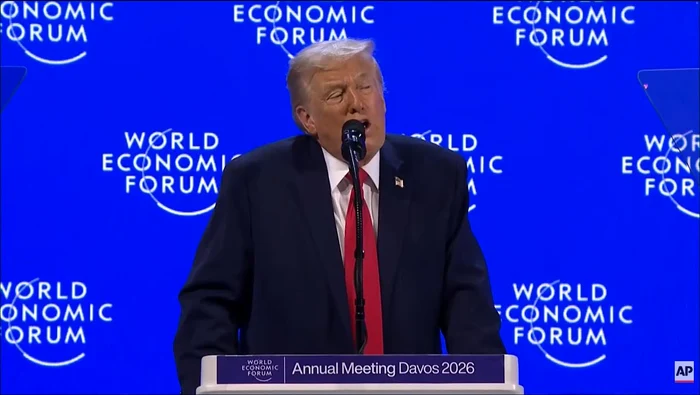
Donald Trump during his speech in Davos. PHOTO: Video capture
Donald Trump gave his speech in Davos on Wednesday, January 21, in a tense atmosphere. After his statements regarding Greenland, Trump was attacked by the president of France, Emmanuel Macron, but also by other European leaders, but he did not remain indebted.
From the start, Donald Trump specified that he was also facing some “enemies”, without naming them, after which he referred to the economic performance of the USA and wanted to emphasize the failures of Europe.
Greenland, in the center of the discourse
“I like Europe, I want it to develop, but it's not going in the right direction,” the White House leader said. “We want to have strong allies, not weak ones”he added, after criticizing the energy policy of European states. Donald Trump did not miss the opportunity to point out that Europe has extremely expensive energy, which makes it uncompetitive.
He was equally critical of Denmark and its European allies on the Greenland issue and recalled that the Danes were defeated by Nazi Germany in only 6 hours. Denmark, Trump stressed, is now just as vulnerable to China and Russia, he added, and pointed out that Europeans would be speaking German and Japanese if the US had not intervened in World War II.
Most importantly by far, he said he wanted the United States to buy Greenland, but that he would not use force. “All we ask is to get Greenland, including possession, so we can defend it“, said Donald Trump.
10 terrible years globally
Political scientist Flavius Caba deciphers, in an analysis for “Adevărul”, Trump's message, and also explains how it should be perceived in Bucharest.
“I think it is the first time that the Davos Forum is organized in this way, regarding the tension between the allies. What is specific about this Davos forum is that it presents, that it even announces a period of competition for the next 10 years. That is, through the messages sent and the speeches given by Donald Trump, but also by other leaders, I predict this period of competition between the great powers, including between the US and the EU. And the message of this forum was that we are in in a period of transition from a certain order based on some rules, from the international order established after the Second World War, towards a new direction”says Caba.
He talks about three big directions and elaborates. “During this period there will be three major directions. From the start it must be said that it will be a period of geo-economic transformations. Point two, I would refer to the alliances, including the transatlantic one. They are undergoing reformation. Point three, the resilience – both of some states, of some alliances and of other formats, will be subject to testing. That is, there will be a certain pressure for each entity to see how much it can withstand and in which direction it will go. The great powers, in this period, they can afford to go it alone. Because, or because, depending on how you look at it, they have a large economic market that allows them to play differently, and they have a strong military capability that allows them to make their point. Also, as a third element, the great powers can dictate certain terms in negotiations.” Caba adds.
An increasingly polarized world
Polarization will be the watchword, both at the level of alliances and domestically, in most states. On the other hand, the regional powers will have a different status compared to the great powers, obviously not as privileged.
“The other, medium-level countries, in particular we are talking about medium, regional powers, there will be a different dynamic here. Namely, some will comply, others will adapt, others will avoid entering this cleavage, and others will probably submit. This is how the next period of uncertainty until a new resettlement is predicted. Also in this context, and from the perspective of the United States, in addition to the previous speech of other great powers, I mean Russia and China, the United States, through the voice of the administration of at the White House, of course, he reiterated that the world will no longer be unipolar, but will be multipolar. Even though multilateralism was discussed or is being discussed in Europe, which is totally different from multipolarity, it will be noticed that multipolarity is in decline, and the international order is fragmented. In this period, we could also witness a greater polarization and fragmentation of society. Namely, the discourse of gender the street versus the elites. And here I mean a global analysis by region, without necessarily mentioning a specific state”, cthe expert considered.
Less focus on climate change
And also from Donald Trump's speech, a new direction emerges. Climate change will no longer receive the same attention. In fact, including the European Union, which promoted the Green Deal, is now backing down, even if it does not share Trump's position.
“These economic divides are emerging. There will probably be further discussion at Davos and this technological risk that we will face in the coming period. It has not been sufficiently assessed so far, so we do not know exactly how it will impact society on different dimensions, both the military and economic dimensions, but also their society. Climate change will no longer be at the forefront of the discussion, and this is the general framework in which President Trump's speech appeared”Caba also shows.
In his opinion, Donald Trump, even if he will not take Greenland by force, will seek other means to get it. It is not very clear how the Europeans will be able to resist him, especially since they were surprised by Trump's return to the White House. His speech shows that Donald Trump will not give up the island that has become a bone of contention with the Europeans.
“President Trump has, in my opinion, very well grounded his project and his intentions. He knows what he wants to achieve. Regarding the issue of Greenland, he does the cost-benefit analysis in a transactional way. In contrast, European leaders probably did not take him into account very much over time. Their approach to Trump started from the premise that he has no knowledge of foreign policy, he is transactional, he is very changeable and they did not take him very seriously in the calculation, especially after the first term, considering that he will not be elected president again. Only his return changed the paradigm again“, emphasizes Caba.
Basically, says the analyst, Donald Trump has only reiterated the program, the new US security strategy. And in his speech he followed exactly the same lines.
What Trump is after
“What Trump did now in Davos was to reiterate the elements contained in America's security strategy. It is a personalized strategy, on the personality of President Trump, where he presents his foreign policy directions very clearly, emphasizing the need for change or changes compared to all other previous administrations of the last 30 years. With regard to Greenland, he probably raised the stakes very much to still reach a negotiation, but his idea is that at the end of the mandate to be concerned as the president who expanded the territory of the United States”is Caba's opinion.
At the same time, at Davos, Ukraine took a back seat, and Greenland was in the spotlight.
“The issue of Greenland, as we have seen, has almost completely overshadowed the issue of Ukraine. Regarding Europe, what Trump said now is not much news compared to his previously expressed positions. All of President Trump's speech shows that he has his agenda very well grounded, and that he really wants to implement it.”
In such a situation, the Europeans will most likely have to negotiate with Donald Trump. But that doesn't mean surrendering to him.
What would the Europeans and Romania have to do?
“Leaders in Europe should probably come up with counter-negotiations, that is, negotiations with counter-proposals. It would be desirable for them to have very proactive diplomacy, but also in this way, so as not to anger Trump. Because Trump is unlikely to give up on this idea regarding Greenland. From this perspective, however, he is unlikely to pursue the breakup of the NATO alliance. He still sees it as an opportunity for economic development. However, he is unlikely to we are currently witnessing such an initiative on the part of the United States to break up transatlantic relations“, says the expert.
Romania, although it was not mentioned by Donald Trump, will not be bypassed by problems. Dependent on the United States for security, Romania has few options. Flavius Caba believes that Bucharest will have to continue its partnership with the USA, in order to successfully cross the turbulence of the coming years, without disconnecting from the European Union.
“As far as Romania is concerned, an attitude is needed. In this context, I don't think a total position of neutrality is indicated. Our partnership with the United States must continue, solutions must be found. Our security interest, the current context, all of these positions of ours lead us to continue working on this partnership with the US.” points out Flavius Caba.