In China, the idea is taking shape that ending the war in Ukraine would be in Beijing's interest


In intellectual and political circles in China, a question that until recently seemed taboo is increasingly being asked: is Russia a reliable and, above all, useful long-term ally? According to British historian Peter Frankopan, professor of world history at Oxford University, the responses emerging in Beijing are increasingly nuanced – with some of China's most influential thinkers concluding that ending the war in Ukraine would serve China's interests.
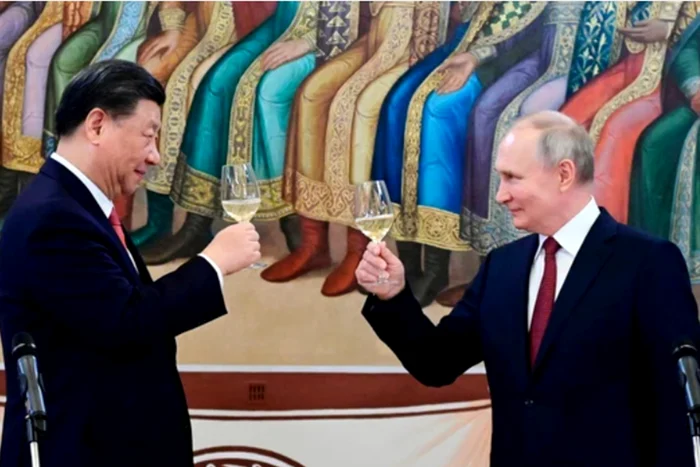
Xi Jinping could distance himself from Putin/PHOTO:AFP
In an article published in The Sunday Times, Frankopan quotes Professor Jia Qingguo, former dean of Peking University's School of International Studies and one of the leading voices in strategic thinking close to the Chinese leadership. He would have admitted that the isolation of Russia after 2022 brought China certain economic advantages, but also considerable political and diplomatic costs.
An increasingly uncomfortable partnership
In an interview given before a US operation in Venezuela, Jia Qingguo warned that Moscow's growing dependence on Beijing is seriously affecting China's relations with Europe, not only now, but also in the long term. Against this background, says Frankopan, the idea that the war in Ukraine should end has begun to gain ground in recent months in Beijing.
The reason is not necessarily a moral one, but a strategic one. The alliance with Russia, officially presented as a partnership based on common interests, is becoming increasingly unbalanced and difficult to manage in practice. The methods used by Moscow – ignoring the UN Charter, resorting to force as the primary tool of foreign policy and using the nuclear threat as a means of diplomatic pressure – directly contradict the image that China is trying to build: that of a stabilizing power, acting through rules, institutions and long-term balance.
For Chinese strategists, the problem is not only about the deterioration of Beijing's reputation in the eyes of Europeans or Americans. The real risk is being tied to a partner whose political reflexes run counter to China's fundamental instincts: order, predictability and control.
China is looking for alternatives
Frankopan also draws attention to a recent, seemingly minor but relevant signal. On Friday, China and Canada signed an agreement to reduce tariffs on Chinese electric vehicles and Canadian agricultural products. Although modest in scope, the agreement suggests that Beijing continues to see value in relationships with developed economies that operate on the basis of clear legal and institutional frameworks.
It is, at the same time, proof that for China there are alternatives to dependence on a sanctioned and deeply militarized Russia. The contrast is obvious: one partner relies on force, destruction and intimidation; the other provides markets, rules, and stability through negotiation.
Questions about “partnership without limits”
In his article, Frankopan also recalls a sensitive episode: Russia would have known in advance about the imminence of an American operation in Venezuela, but, according to sources in China, it would not have shared this assessment with Beijing. The episode reignited questions about what the “comprehensive partnership” and “boundless” proclaimed by the two states really means.
Earlier, Ukrainian President Volodymyr Zelensky said that China's position on the Russian-Ukrainian war is dictated by its own geopolitical interests, particularly its rivalry with the United States. In his opinion, Beijing is not interested in either a clear defeat of Russia or a major weakening of it.
However, the debate now taking shape in China shows that, beyond official statements, the war in Ukraine is increasingly being perceived as a strategic burden – one that complicates Beijing's global ambitions more than it serves them.